

Learn how to set up an affiliate program step by step, including commissions, software, tracking, signup, recruitment, payments, and optimization.
Affiliate marketing can be a powerful way to generate sales, leads, and new customers by working with people and businesses that promote your products or services.
Instead of paying for every visitor upfront, an affiliate program allows you to reward partners when their promotional efforts generate a qualifying result.
But starting an affiliate program involves more than creating an affiliate link.
You need to decide how affiliates will be paid, define who you want to work with, choose the right software, set up tracking, create a signup process, recruit partners, manage conversions, process commissions, and measure the results.
If you’re wondering how to set up an affiliate program, this guide walks through the process step by step.
By the end, you’ll have a practical framework for creating and launching an affiliate program for your business.
What Is an Affiliate Program?
An affiliate program is a partnership arrangement where businesses reward affiliates for generating specific results.
Depending on the business model, affiliates may earn commissions for:
- Product sales
- Leads
- New customers
- App installations
- Subscriptions
- Free-trial registrations
- Bookings
- Other predefined actions
A basic affiliate program works like this:
Business → Affiliate → Visitor → Conversion → Commission
For example, imagine you sell an online software subscription.
You give an affiliate a unique tracking link.
The affiliate promotes your software through a blog, YouTube channel, newsletter, social media account, or another marketing channel.
A visitor clicks the affiliate’s link and signs up.
Your tracking system identifies the affiliate responsible for the conversion, and your commission rules determine how much the affiliate earns.
The affiliate then receives the appropriate commission according to your program’s terms.
How to Set Up an Affiliate Program
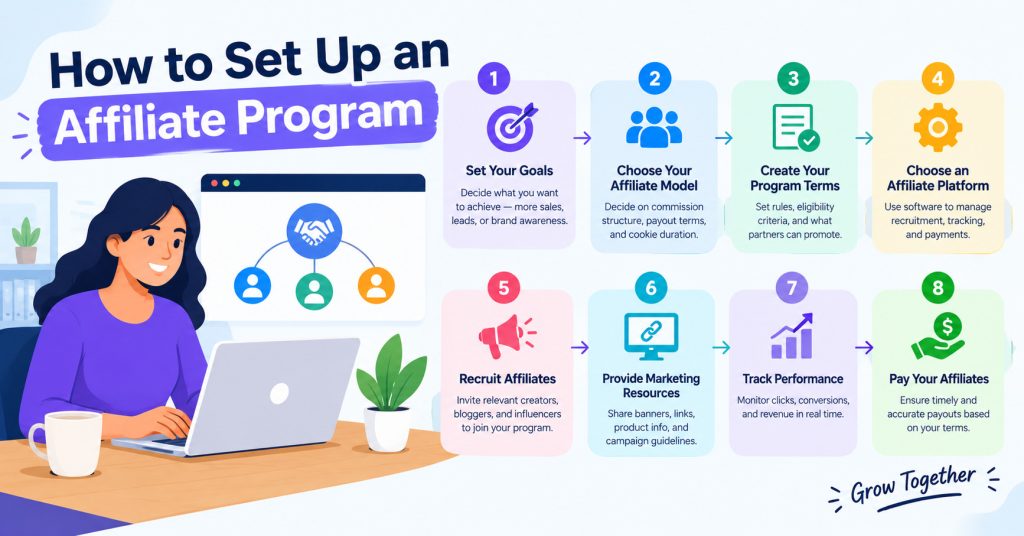
Setting up an affiliate program can be broken into several stages:
- Decide whether affiliates make sense for your business
- Choose your commission structure
- Define your ideal affiliates
- Choose affiliate program software
- Create affiliate tracking
- Create your affiliate signup process
- Prepare promotional assets
- Recruit affiliates
- Approve affiliates
- Track conversions
- Pay affiliates
- Analyze performance
- Optimize the program
Let’s look at each step.
1. Decide Whether Affiliates Make Sense for Your Business
Before you create an affiliate program, determine whether the model makes sense for your product, margins, customers, and sales process.
Affiliate marketing works particularly well when affiliates can clearly communicate the value of a product or service to an audience that trusts them.
Potentially suitable businesses include:
- Ecommerce stores
- SaaS companies
- Online courses
- Membership businesses
- Subscription services
- Financial and business services
- Travel businesses
- Digital products
- Marketplaces
- Professional services
However, the existence of an affiliate program doesn’t automatically mean affiliates will promote your business.
You need an offer that gives partners a reason to invest their time and audience attention.
Ask these questions before launching
Is the product easy to explain?
Affiliates need to understand what they’re promoting.
Does the product have enough margin to support commissions?
Your commission needs to work financially for the business.
Can affiliates reach your target customers?
A large audience isn’t necessarily useful if it isn’t relevant to your product.
Can you track conversions accurately?
If you cannot reliably determine which affiliate generated a conversion, managing the program becomes difficult.
Can you support affiliates?
Affiliates may need promotional materials, answers to questions, product information, and timely communication.
If the answers are generally positive, an affiliate program may be worth testing.
2. Choose Your Commission Structure
One of the most important decisions during affiliate program setup is determining how affiliates will be compensated.
Your commission structure should be attractive enough to encourage promotion while remaining sustainable for your business.
Common commission models include:
Percentage commission
The affiliate receives a percentage of the sale.
For example:
$100 sale × 20% commission = $20 affiliate commission
This model is common for ecommerce and digital products.
Fixed commission
The affiliate receives a predetermined amount for each qualifying conversion.
For example:
$100 per new customer
This can be useful when customer values are relatively consistent.
Recurring commission
The affiliate receives commissions from recurring subscription payments.
For example:
20% of qualifying subscription revenue
This can be attractive for SaaS and subscription businesses, although you need to define exactly how long recurring commissions continue.
Lead-based commission
The affiliate earns a fixed amount when a qualified lead is generated.
For example:
$10 per qualified lead
This model can work for businesses where a lead is more valuable than an immediate purchase.
Tiered commissions
You can create different commission levels based on affiliate performance.
For example:
| Monthly sales | Commission |
|---|---|
| 1–10 sales | 15% |
| 11–25 sales | 20% |
| 26+ sales | 25% |
The exact structure should depend on your margins, customer value, refund rates, and business model.
Define the rules clearly
Before recruiting affiliates, document:
- Commission rate
- Qualifying conversions
- Cookie or attribution period
- Refund policy
- Payment schedule
- Minimum payout threshold
- Eligible products
- Promotional restrictions
- Coupon rules
- Prohibited traffic sources
- Paid advertising rules
- Brand bidding rules
- Self-referral rules
Clear rules can prevent misunderstandings later.
3. Define Your Ideal Affiliates
The next step is deciding who you want to recruit.
You don’t necessarily need thousands of affiliates.
A smaller group of relevant partners can be more useful than a large group of affiliates who have little connection to your target customers.
Your ideal affiliates might include:
- Bloggers
- YouTubers
- Content creators
- Influencers
- Newsletter publishers
- Industry experts
- Review websites
- Comparison websites
- Community owners
- Existing customers
- Consultants
- Agencies
- Complementary businesses
Consider audience fit
The most important question isn’t:
How many followers does this person have?
Instead, ask:
Does this person’s audience have a reason to buy our product?
For example, a software company selling accounting tools may get more value from a small audience of business owners than a huge general-interest audience.
Create an affiliate profile
Write down your ideal affiliate characteristics.
For example:
Ideal affiliate:
- Creates content about ecommerce
- Has an audience of online store owners
- Publishes tutorials and product reviews
- Has an established website or YouTube channel
- Understands the product
- Uses ethical promotional methods
This gives you a clearer target when you begin recruitment.
4. Choose Affiliate Program Software
Once you’ve decided how your program should work, you’ll need a way to manage it.
This is where affiliate program software comes in.
At minimum, your software should help you:
- Create affiliate tracking links
- Record clicks
- Track conversions
- Attribute conversions
- Calculate commissions
- Manage affiliates
- Provide reporting
- Handle or prepare payouts
As the program grows, you may also need:
- Affiliate registration
- Affiliate invitations
- Affiliate communication
- Commission tiers
- Coupon tracking
- Affiliate managers
- Payment integrations
- APIs
- Automation
- Fraud controls
- Custom affiliate portals
One example is Trackdesk, which combines affiliate tracking with affiliate-program management.
Trackdesk’s current setup documentation describes a workflow that includes configuring conversion types and tiers, setting terms and conditions, customizing the affiliate portal, creating an offer and tracking, and then inviting affiliates.
Its affiliate-management tools also support affiliate invitations, registration forms, affiliate approval, messaging, affiliate managers, and other partner-management functions.
For example, businesses can invite affiliates using a link, add them manually, import affiliates, or find potential partners through the platform’s marketplace.
What should you compare?
When choosing software, compare:
| Feature | Why it matters |
|---|---|
| Affiliate tracking | Records clicks and conversions |
| Attribution | Determines which affiliate gets credit |
| Commission management | Calculates affiliate earnings |
| Registration | Gives partners a way to join |
| Affiliate management | Organizes partner accounts |
| Reporting | Measures program performance |
| Integrations | Connects the program with your existing tools |
| Payments | Helps process affiliate earnings |
| Automation | Reduces manual administration |
| API | Supports custom integrations |
| Communication | Helps you work with affiliates |
| Scalability | Supports program growth |
Don’t choose software based only on the number of features.
Choose something that matches the complexity of your program.
Want to explore an affiliate platform that combines tracking and management? Check out Trackdesk’s affiliate features and compare its capabilities with the requirements of your program.
5. Create Your Affiliate Tracking
Tracking is the technical foundation of your affiliate program.
Once an affiliate joins, they need a way to promote your business using a unique tracking link or another tracking method.
A simplified process looks like this:
Affiliate → Tracking link → Visitor click → Tracking data → Conversion → Attribution → Commission
When someone clicks an affiliate link, the tracking system records information that can later be used to connect a conversion with the affiliate.
Depending on your setup, tracking can involve:
- Cookies
- Click IDs
- Tracking parameters
- Conversion scripts
- Server-to-server postbacks
- APIs
- Coupon codes
- Webhooks
Test your tracking before launch
This step is extremely important.
Before inviting affiliates, perform a complete test:
- Generate an affiliate link.
- Click the link.
- Visit your website.
- Complete a test conversion.
- Check whether the click was recorded.
- Check whether the conversion was recorded.
- Verify the affiliate attribution.
- Check the commission calculation.
- Confirm the conversion appears in reporting.
Don’t assume tracking works simply because the software is installed.
Test the entire customer journey.
For more information, see our guide to affiliate tracking software.
6. Create Your Affiliate Signup Process
Your affiliate program needs a way for potential partners to join.
You can create a dedicated page explaining:
- What your product does
- Who your program is for
- Commission rates
- Payment terms
- Program rules
- Promotional guidelines
- How tracking works
- How affiliates can apply
- How to contact your team
Your signup form can collect information such as:
- Name
- Website
- Social media profiles
- Promotional channels
- Audience information
- Traffic sources
- Business information
- Payment details where appropriate
Automatic vs manual approval
You can choose whether affiliates are approved automatically or reviewed manually.
Automatic approval makes it easier to get partners into the program quickly.
Manual approval gives you greater control over who participates.
For a new program, manual review can be useful if you want to make sure affiliates understand your rules and use appropriate promotional methods.
Trackdesk, for example, supports both automatic and manual approval modes. Affiliates can remain in a pending state while an application is reviewed before access is granted.
Trackdesk also supports customizable affiliate registration forms, including custom questions and configurable fields.
7. Create Promotional Assets
Affiliates need something to promote.
Don’t assume every affiliate will create all of their promotional material from scratch.
Provide useful resources such as:
- Product images
- Banners
- Logos
- Product screenshots
- Videos
- Email templates
- Social media copy
- Product descriptions
- Comparison charts
- Tutorials
- Case studies
- Discount codes
- Landing pages
The more useful your resources are, the easier it can be for an affiliate to start promoting.
Create an affiliate resource library
Consider creating a simple resource section containing:
Brand assets
Logos, colors, images, and brand guidelines.
Product information
Features, benefits, use cases, pricing, and FAQs.
Promotional content
Email templates, social posts, videos, banners, and suggested messaging.
Affiliate guidelines
Rules about advertising, trademarks, coupons, paid traffic, and prohibited promotional methods.
Trackdesk also provides functionality for sharing creatives with affiliates. Its current documentation supports materials such as image banners, HTML, text links, videos, and ZIP files through an offer’s creative area.
8. Recruit Affiliates
Now you need to answer one of the most important questions:
How do you recruit affiliates?
There are several approaches.
Recruit existing customers
Your existing customers may already understand your product and could become effective advocates.
You can invite suitable customers to your affiliate program through:
- Customer dashboards
- Newsletters
- Product announcements
- Direct outreach
Contact content creators
Search for creators who already discuss topics related to your product.
For example, if you sell SEO software, look for:
- SEO bloggers
- YouTube SEO educators
- Marketing newsletters
- Digital marketing websites
- Business creators
Use your website
Add an “Affiliate Program” link to your:
- Footer
- Resources page
- Partner page
- Navigation
- Customer dashboard
This gives potential partners a way to discover your program.
Direct outreach
Identify relevant potential affiliates and contact them personally.
Avoid sending generic messages to thousands of people.
A better outreach message explains:
- Why you’re contacting them
- Why the product is relevant to their audience
- What the program offers
- How they can learn more
Affiliate marketplaces and networks
Depending on your software and business model, marketplaces and affiliate networks can also help you discover partners.
Trackdesk, for example, currently documents affiliate invitations through direct links, forms, imports, and its marketplace.
Check our guide here on how to recruit affiliates?
9. Approve Affiliates
Once people apply, decide whether they are suitable for your program.
Create a simple approval checklist.
Check their website or channel
Ask:
- Is the content relevant?
- Is the audience appropriate?
- Is the content legitimate?
- Does the promotional approach fit your brand?
Check their traffic sources
Find out whether they plan to use:
- Organic search
- YouTube
- Social media
- Paid advertising
- Communities
- Other channels
Review promotional methods
Make your rules clear about:
- Trademark bidding
- Brand keywords
- Spam
- Misleading claims
- Coupon abuse
- Incentivized traffic
- Fake leads
- Self-referrals
Decide on approval
If everything looks appropriate, approve the affiliate and give them access to their affiliate resources.
If not, reject or request more information.
Trackdesk allows businesses to use either automatic or manual approval, and affiliates can be kept in a pending state until reviewed.
10. Track Conversions
Once affiliates begin promoting your business, monitor the customer journey.
The basic process is:
Click → Tracking → Conversion → Attribution → Commission
Your tracking system should tell you:
- Which affiliate generated the click
- Whether the visitor converted
- Which offer generated the conversion
- How much revenue was generated
- How much commission is owed
Depending on your setup, you may also track:
- Conversion type
- Product
- Coupon
- Traffic source
- Location
- Device
- Campaign
- Customer value
Watch for tracking problems
Common problems include:
- Tracking code not installed correctly
- Incorrect conversion events
- Broken affiliate links
- Missing tracking parameters
- Cookie limitations
- Incorrect attribution settings
- Duplicate conversions
- Integration errors
This is why testing your tracking before recruiting a large number of affiliates is so important.
11. Pay Your Affiliates
Your affiliate program should have a clear payment process.
Before launch, tell affiliates:
- When payments are made
- Which payment methods are available
- Minimum payout amount
- Whether there is a holding period
- How refunds affect commissions
- What information affiliates need to provide
For example:
Monthly payments + $50 minimum balance + approved conversions only
The exact rules depend on your business.
Keep payment records
You should be able to determine:
- Affiliate earnings
- Approved commissions
- Pending commissions
- Paid commissions
- Refunds or reversals
- Settlement history
Trackdesk’s current affiliate-management documentation includes billing and payment workflows, including payment methods, settlement management, CSV exports, Stripe Connect, Tipalti, PayPal, and API-based billing functionality.
The specific payment methods available can depend on the platform and plan, so verify the current options before choosing your software.
12. Analyze Affiliate Program Performance
Launching an affiliate program isn’t the end of the process.
Once you have data, analyze what’s working.
Useful metrics can include:
Affiliate recruitment
- Number of applications
- Approval rate
- Number of active affiliates
- Affiliate activation rate
Traffic
- Clicks
- Visitors
- Traffic sources
- Landing-page activity
Conversions
- Conversion rate
- Number of conversions
- Revenue
- Average order value
Commissions
- Total commissions
- Average commission
- Commission as a percentage of revenue
- Pending commissions
- Paid commissions
Affiliate performance
- Top affiliates
- Revenue per affiliate
- Conversions per affiliate
- Active vs inactive affiliates
Program economics
Ultimately, you want to understand whether the program is producing sustainable business results.
For example:
Affiliate revenue − affiliate commissions − program costs = contribution toward profitability
The exact calculation will depend on your margins and other costs.
13. Optimize Your Affiliate Program
Once your program is generating data, start improving it.
Don’t try to optimize everything at once.
Focus on the biggest opportunities.
Improve recruitment
If you’re receiving too few applications, consider:
- Improving your affiliate landing page
- Increasing outreach
- Improving your commission offer
- Creating better promotional resources
- Contacting more relevant creators
Improve activation
If many affiliates join but never promote, examine the onboarding process.
Ask:
- Did they receive their tracking link?
- Do they understand the product?
- Did they receive promotional assets?
- Do they know how commissions work?
- Do they know where to get help?
Improve conversion rates
If affiliates generate many clicks but few conversions, investigate:
- Landing pages
- Pricing
- Product-market fit
- Affiliate audience quality
- Tracking
- Promotional messaging
Support high-performing affiliates
If certain partners consistently generate results, consider providing:
- Higher commission tiers
- Exclusive promotions
- Custom landing pages
- Early product access
- Better promotional assets
- Direct communication with an affiliate manager
Remove low-quality activity
Not every affiliate will be a good long-term partner.
Monitor for:
- Fraudulent activity
- Misleading promotions
- Brand violations
- Poor-quality traffic
- Duplicate accounts
- Self-referrals
- Unauthorized paid advertising
Optimization is an ongoing process.
Affiliate Program Setup Checklist
Before launching your program, use this checklist.
Business strategy
- Confirm affiliate marketing fits your business
- Define your target customers
- Define your ideal affiliates
- Determine your commission budget
Commission structure
- Choose commission type
- Set commission rates
- Define qualifying conversions
- Define refund and reversal rules
- Set payment schedule
- Set minimum payout threshold
Software
- Choose affiliate program software
- Configure your program
- Set up offers
- Configure commission tiers
- Connect required integrations
Tracking
- Create affiliate tracking
- Install required tracking
- Configure conversion events
- Configure attribution
- Test affiliate links
- Test conversions
Affiliate experience
- Create signup page
- Create registration form
- Write program terms
- Create onboarding instructions
- Prepare promotional assets
- Add affiliate contact information
Recruitment
- Create an affiliate recruitment list
- Contact potential affiliates
- Announce your program
- Add an affiliate-program link to your website
- Consider affiliate marketplaces
Operations
- Define affiliate approval process
- Define payment process
- Set up reporting
- Assign affiliate managers if needed
- Establish support procedures
Optimization
- Monitor affiliate performance
- Monitor conversions
- Review commissions
- Identify top affiliates
- Review inactive affiliates
- Test new commission structures
- Improve affiliate resources
How Long Does It Take to Set Up an Affiliate Program?
The time required depends on the complexity of your business and the software you choose.
A simple program may be configured relatively quickly if you already have:
- A functioning website
- A clear commission structure
- A defined product
- Payment infrastructure
- Affiliate software
- Conversion tracking
A more complex program may take longer because of:
- Multiple products
- Different commission rates
- Recurring commissions
- Multiple conversion types
- Complex integrations
- Custom tracking
- Large affiliate teams
- Multiple payment systems
Don’t rush the tracking and payment stages simply to launch faster.
A program that launches quickly but records conversions incorrectly can create more problems later.
Common Mistakes When Starting an Affiliate Program
Mistake 1: Choosing a commission rate without checking margins
A commission that looks attractive to affiliates may not be sustainable for the business.
Calculate the economics first.
Mistake 2: Launching without testing tracking
Always perform test clicks and conversions before inviting partners.
Mistake 3: Making the affiliate application too complicated
Ask for the information you actually need.
Too many unnecessary questions can discourage potential affiliates.
Mistake 4: Recruiting everyone
More affiliates isn’t automatically better.
Focus on relevant partners who can reach your target customers.
Mistake 5: Giving affiliates no promotional resources
Affiliates need product information and materials to promote effectively.
Mistake 6: Ignoring affiliate communication
Partners are more likely to stay engaged when they can get answers and updates.
Mistake 7: Focusing only on clicks
Clicks are useful, but conversions and revenue ultimately tell you more about program performance.
Mistake 8: Never optimizing the program
Your first commission structure and onboarding process don’t have to remain unchanged forever.
Use your data to improve them.
Frequently Asked Questions
How do I set up an affiliate program?
To set up an affiliate program, determine whether affiliate marketing fits your business, choose a commission structure, define your ideal affiliates, select affiliate program software, configure tracking, create an affiliate signup process, prepare promotional assets, recruit and approve affiliates, track conversions, pay commissions, and analyze performance.
How much does it cost to start an affiliate program?
The cost depends on your affiliate software, payment processing, commissions, integrations, and other program expenses. Some affiliate platforms offer free trials or entry-level plans, while more advanced programs may require a larger software budget.
What is the best commission rate for affiliates?
There isn’t one commission rate that works for every business. Your rate should consider product margins, customer value, refund rates, recurring revenue, and what is reasonable for your industry and affiliate audience.
What is affiliate program software?
Affiliate program software is technology that helps businesses operate affiliate programs. Depending on the platform, it can include affiliate recruitment, registration, tracking, conversion attribution, commission management, reporting, communication, and payments.
How do I recruit affiliates?
You can recruit affiliates through existing customers, content creators, bloggers, YouTubers, industry experts, newsletters, direct outreach, your website, affiliate marketplaces, and affiliate networks.
Should I automatically approve affiliates?
Automatic approval makes it easier for people to join quickly, while manual approval gives you more control over who participates. Your choice should depend on your program’s risk, promotional rules, and the type of affiliates you want.
How do I track affiliate sales?
Affiliate sales can be tracked using unique affiliate links and tracking mechanisms such as cookies, click IDs, conversion events, server-to-server postbacks, APIs, or coupon codes. The tracking system then attributes qualifying conversions to the appropriate affiliate.
How do affiliate programs pay affiliates?
Affiliate programs can use payment methods such as PayPal, bank transfers, payment platforms, or other supported payout services. The available methods depend on the software and payment infrastructure you use.
Do I need affiliate software to start an affiliate program?
You can technically manage a very small affiliate program manually, but dedicated affiliate program software becomes increasingly useful as the number of affiliates, conversions, commission calculations, and payments grows.
Can Trackdesk help set up an affiliate program?
Trackdesk provides tools for setting up and managing affiliate programs, including conversion types, commission tiers, offers, tracking, affiliate invitations, registration, communication, and partner management. Its current quick-setup documentation walks users through configuring the program, creating an offer and tracking, and inviting affiliates.
Final Thoughts
Learning how to set up an affiliate program is really about building a system that works for both your business and your affiliates.
The process starts with the economics.
You need a product worth promoting, a sustainable commission structure, and a clear idea of the partners you want to work with.
Then you need the infrastructure:
Software → Tracking → Signup → Promotional assets → Recruitment → Approval → Conversions → Payments → Reporting
Once the program is running, the work doesn’t stop.
Use your data to identify your best affiliates, improve onboarding, strengthen your promotional resources, refine commissions, and remove problems that affect tracking or affiliate quality.
If you want to start an affiliate program without building the tracking and management infrastructure from scratch, an affiliate platform such as Trackdesk can provide many of the components needed to operate the program, including affiliate invitations, registration, tracking, communication, management, reporting, and payment-related workflows.
The important thing is to choose your software based on your actual requirements and test the complete affiliate journey before you begin recruiting partners at scale.