
Affiliate tracking vs affiliate management explained. Learn the differences, features, examples, and why growing affiliate programs need both.
Affiliate marketing involves two related but different activities: tracking what affiliates generate and managing the affiliates who promote your business.
These activities are sometimes treated as if they mean the same thing, but they solve different problems.
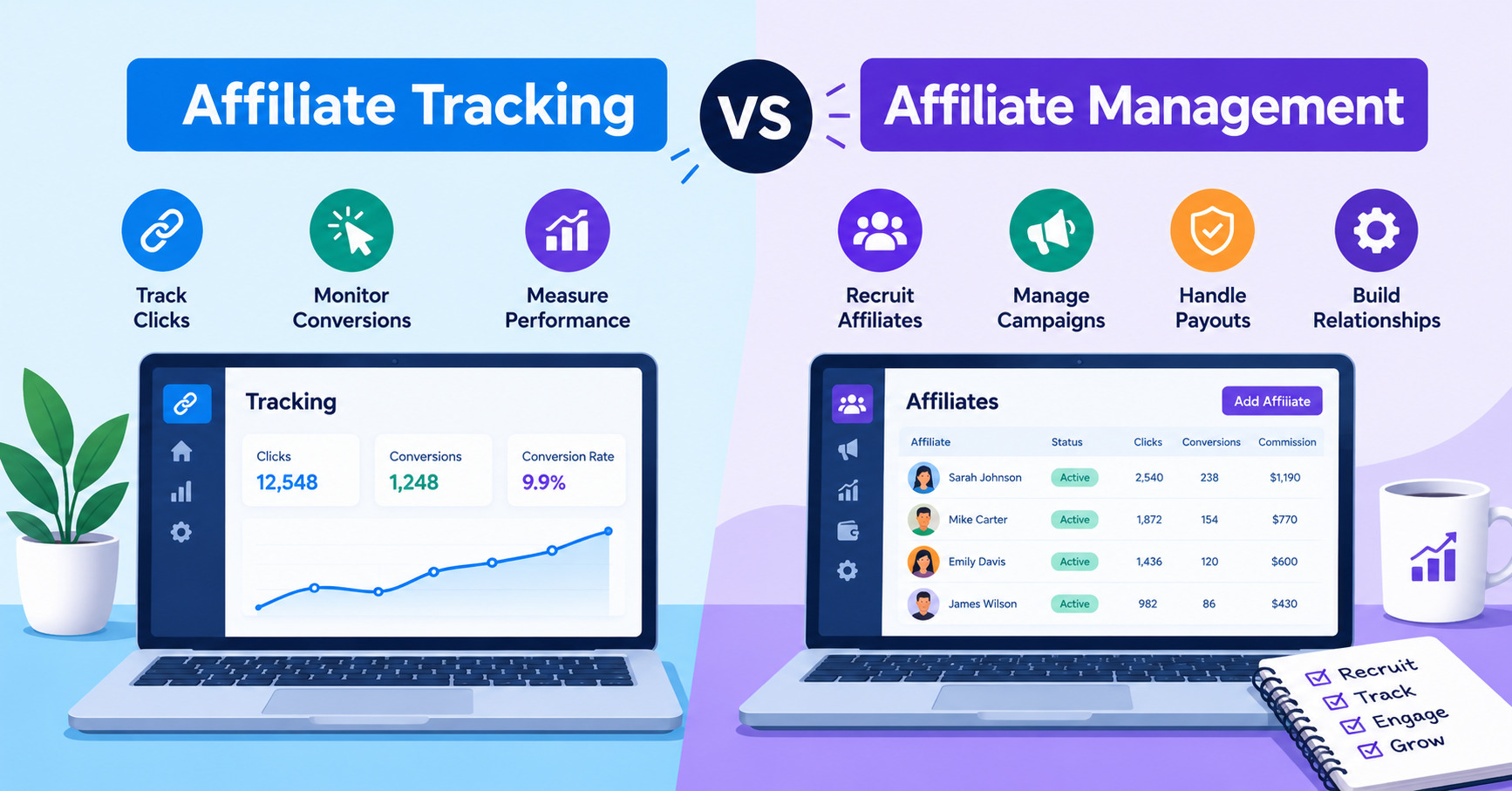
Affiliate tracking focuses on recording clicks, conversions, attribution, revenue, and other performance data.
Affiliate management focuses on the people and operations behind the program, including affiliate recruitment, onboarding, communication, commissions, payments, and partner relationships.
Understanding the difference between affiliate tracking vs affiliate management can help you choose the right software for your affiliate program.
In this guide, we’ll explain how both work, where they overlap, the features to look for, and where a platform such as Trackdesk fits into the picture.
What Is Affiliate Tracking?
Affiliate tracking is the process of recording and connecting activity generated by affiliates to the conversions they produce.
When an affiliate promotes a product or service, the business needs a way to determine whether a visitor came through that affiliate and whether that visitor eventually completed a desired action.
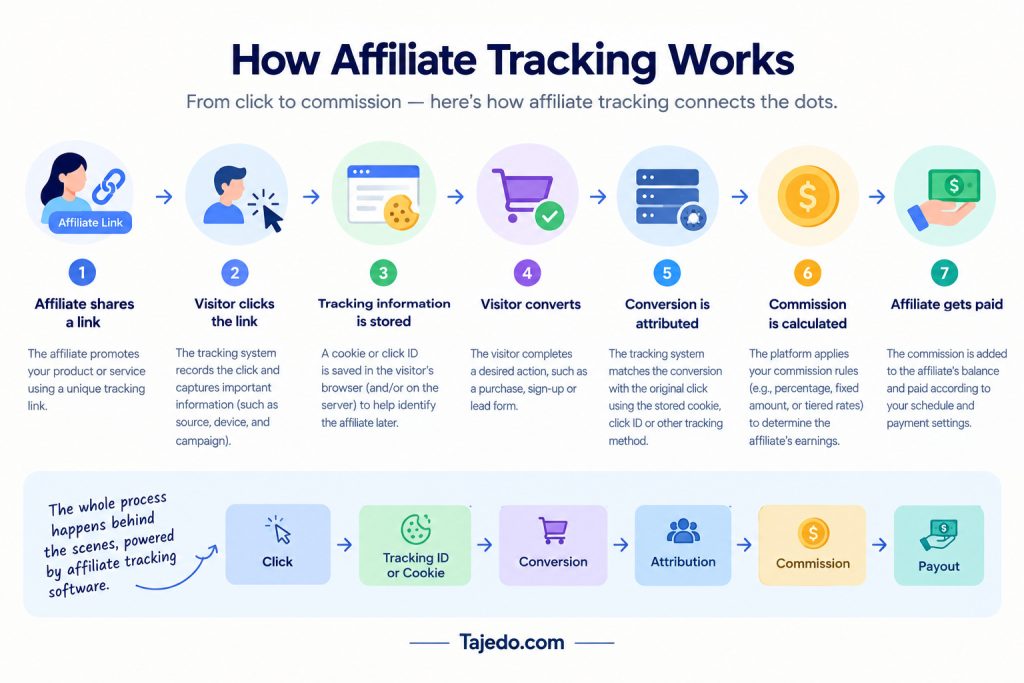
A simplified affiliate tracking process looks like this:
Affiliate link → Click → Tracking information → Conversion → Attribution → Commission
For example, imagine an affiliate promotes an online software product.
The affiliate receives a unique tracking link such as:
example.com/?affiliate=123
A visitor clicks the link.
The tracking system records information about the click and associates it with the affiliate. Depending on the implementation, this may involve cookies, click IDs, tracking parameters, server-to-server tracking, or other mechanisms.
If the visitor later purchases the product, the tracking system attempts to connect that conversion to the original affiliate activity.
The business can then calculate the appropriate commission.
What does affiliate tracking record?
Depending on the platform and implementation, affiliate tracking can record:
- Affiliate clicks
- Tracking links
- Click IDs
- Cookies
- Conversion events
- Sales
- Leads
- Revenue
- Commission amounts
- Attribution information
- Traffic sources
- Coupons
- Sub-IDs or custom parameters
The purpose is to answer a fundamental question:
Which affiliate should receive credit for this conversion?
For a deeper explanation, see our guide to how affiliate tracking works.
What Is Affiliate Management?
Affiliate management is the broader process of operating and growing an affiliate program.
Instead of focusing only on clicks and conversions, affiliate management deals with the people, relationships, processes, and administration involved in running the program.
An affiliate manager may be responsible for:
- Recruiting affiliates
- Reviewing affiliate applications
- Approving new affiliates
- Onboarding partners
- Assigning affiliates to offers
- Communicating with affiliates
- Providing promotional materials
- Managing commission structures
- Monitoring affiliate performance
- Handling affiliate questions
- Managing payments
- Creating reports
- Preventing fraud
- Developing relationships with high-performing partners
In other words:
Affiliate tracking tells you what happened.
Affiliate management helps you manage the people and processes around what happened.
Example of affiliate management
Imagine a company has 200 affiliates.
The company needs to know more than how many clicks and conversions those affiliates generated.
It may also need to know:
- Which affiliates are active?
- Which applications are waiting for approval?
- Which affiliates need help?
- Which affiliates should receive higher commission rates?
- Which affiliates belong to a particular manager?
- Which affiliates haven’t generated a conversion recently?
- Which partners should receive a new promotional campaign?
- Which affiliates have been paid?
- Which affiliates are generating suspicious traffic?
These are affiliate management questions rather than purely tracking questions.
Affiliate Tracking vs Affiliate Management: The Key Differences
The easiest way to understand the distinction is to compare their primary purposes.
| Affiliate tracking | Affiliate management |
|---|---|
| Tracks clicks | Manages affiliate relationships |
| Records conversions | Recruits affiliates |
| Attributes conversions | Approves affiliates |
| Tracks revenue | Onboards affiliates |
| Records affiliate activity | Communicates with affiliates |
| Uses tracking links and IDs | Manages affiliate accounts |
| Calculates attribution | Manages commission structures |
| Provides performance data | Handles payments and settlements |
| Helps identify conversion sources | Helps grow and organize the program |
| Focuses on data and attribution | Focuses on people, processes, and operations |
The two functions are different, but they work closely together.
For example:
Tracking: Affiliate A generated 25 sales.
Management: Affiliate A is one of your highest-performing partners, so your affiliate manager contacts them about a new campaign and reviews their commission tier.
The tracking data provides the information needed to make the management decision.
Affiliate Tracking and Affiliate Management Often Work Together
Although the distinction is useful, businesses don’t necessarily need two completely separate systems.
Many modern affiliate tracking platforms combine tracking and management features.
This can create a workflow such as:
Recruit affiliate → Approve affiliate → Create tracking link → Generate traffic → Track clicks → Record conversions → Calculate commissions → Report performance → Pay affiliate
The tracking component handles the measurement.
The management component handles the relationship and operational side.
This is particularly useful as an affiliate program grows.
A business managing five affiliates may be able to handle many tasks manually.
A business managing hundreds or thousands of affiliates may need dedicated software to organize the entire program.
Why Businesses Eventually Need Both
Not every affiliate program needs sophisticated management software from day one.
However, tracking and management requirements tend to become more complex as a program grows.
1. More affiliates mean more administration
With a small number of partners, an affiliate manager might know every affiliate personally.
As the number grows, it becomes harder to keep track of:
- Applications
- Affiliate information
- Performance
- Communication
- Commission rates
- Payment status
- Affiliate activity
Management software can centralize this information.
2. More traffic requires better tracking
As affiliate traffic increases, accurate tracking becomes increasingly important.
A business needs to know whether conversions are being attributed correctly and whether clicks, conversions, revenue, and commissions are being recorded properly.
This is where a dedicated tracking system becomes valuable.
3. Commission structures become more complicated
A small affiliate program might pay every affiliate the same percentage.
A larger program might use:
- Different commission rates
- Product-specific commissions
- Affiliate tiers
- Recurring commissions
- Performance bonuses
- Different offers
- Different conversion types
The tracking system needs to identify the conversion, while the management system needs to apply the appropriate business rules.
4. Affiliate communication becomes more important
Larger programs often require regular communication with partners.
For example:
- New product announcements
- Promotional campaigns
- Commission changes
- Program updates
- New marketing materials
- Affiliate support
A centralized management system can make these communications easier to organize.
5. Payments become more complex
More affiliates also means more payouts.
The business needs to determine:
Who earned what?
Which conversions are approved?
How much does each affiliate receive?
Which affiliates have been paid?
Tracking provides the underlying conversion data, while management and billing tools help turn that data into settlements and payments.
Examples of Affiliate Tracking vs Affiliate Management
A few examples make the difference clearer.
Example 1: Tracking an affiliate sale
An affiliate sends a visitor through a unique affiliate link.
The visitor clicks, browses the website, and eventually purchases a product.
The tracking system records:
- Affiliate
- Click
- Conversion
- Revenue
- Attribution
- Commission
This is affiliate tracking.
Example 2: Recruiting the affiliate
The business discovers that the affiliate could be a valuable partner and invites them to join its affiliate program.
The affiliate completes a registration form.
The business reviews the application and approves the account.
This is affiliate management.
Example 3: Improving the affiliate relationship
The affiliate consistently generates sales.
The business decides to increase their commission rate and provide exclusive promotional materials.
This is affiliate management, although the decision may be based on affiliate tracking data.
Example 4: Investigating a conversion
A conversion appears in the system.
The business checks the click ID, attribution information, traffic source, and conversion data to determine how the sale was recorded.
This is primarily affiliate tracking and attribution.
Affiliate Tracking vs Affiliate Management Software
The distinction also applies to software.
Affiliate tracking software
An affiliate tracking platform primarily helps businesses measure affiliate activity.
Typical features include:
- Tracking links
- Click tracking
- Conversion tracking
- Cookies
- Click IDs
- Attribution
- Coupon tracking
- Server-to-server tracking
- Conversion reporting
- Revenue tracking
The core question is:
Where did this conversion come from?
Affiliate management software
Affiliate management software provides a wider set of tools for operating the affiliate program.
Typical features include:
- Affiliate recruitment
- Registration
- Affiliate approval
- Onboarding
- Affiliate profiles
- Affiliate communication
- Affiliate managers
- Commission management
- Reporting
- Payment management
- Tracking
- Integrations
- Automation
The core question is:
How do we operate and grow this affiliate program?
The distinction isn’t always absolute because many platforms provide both.
Features to Look for in an Affiliate Tracking Platform
If your primary need is tracking, pay particular attention to the following features.
Tracking links
The platform should be able to generate unique links that identify individual affiliates and offers.
Conversion tracking
The software should be able to record the conversions that matter to your business, such as purchases, leads, subscriptions, or other actions.
Attribution
Look at how the platform determines which affiliate receives credit for a conversion.
Depending on the platform, attribution may involve first-touch or last-touch rules, cookies, click IDs, coupons, or other mechanisms.
Server-to-server tracking
S2S tracking can provide another way to send conversion information between systems without relying entirely on browser-based tracking.
Reporting
You should be able to analyze clicks, conversions, revenue, commissions, and affiliate performance.
Integrations
Check whether the platform works with your ecommerce platform, payment processor, CRM, website, or other technology.
Features to Look for in Affiliate Management Software
If you need to manage a growing affiliate program, look beyond tracking.
Important features can include:
Affiliate recruitment
Look for registration forms, invitations, affiliate discovery, or marketplace functionality where relevant.
Affiliate onboarding
The platform should make it easy to approve affiliates, provide links, explain program rules, and get new partners started.
Affiliate communication
Email, dashboard messages, announcements, ticketing, or other communication features can reduce the need to manage every interaction separately.
Affiliate managers
If several people manage the program, look for team roles and the ability to assign affiliates to specific managers.
Commission management
The platform should support the commission structures your business actually uses.
Payments
Check which payout methods are available and how settlements are handled.
Reporting
Management reports should make it possible to understand individual affiliate performance as well as overall program performance.
Automation
Automation can reduce repetitive administrative tasks as the program grows.
Where Does Trackdesk Fit?
Trackdesk is a useful example because it combines affiliate tracking and affiliate management in the same platform.
Trackdesk describes itself as an affiliate tracking platform that helps businesses launch, manage, and scale affiliate, referral, and partnership programs. Its current documentation describes the platform as combining tracking, partner management, and payout preparation.
That means it isn’t limited to recording affiliate clicks and conversions.
Trackdesk for affiliate tracking
On the tracking side, Trackdesk supports features including:
- Direct tracking
- Redirect tracking
- Affiliate tracking links
- Conversion attribution
- Cookies
- Coupon attribution
- Server-to-server tracking
- Postbacks
- Webhooks
- Conversion reporting
- Fraud-prevention features
Its current tracking documentation lists 35 tracking-related articles covering areas such as attribution, cookies, coupons, postbacks, APIs, webhooks, smart links, traffic control, and conversion deduplication.
This makes the platform useful for the measurement side of an affiliate program.
Trackdesk for affiliate management
On the management side, Trackdesk provides tools for:
- Inviting affiliates
- Affiliate registration
- Manual or automatic affiliate approval
- Affiliate status management
- Affiliate communication
- Affiliate managers
- CSV affiliate imports
- Affiliate ticketing
- Affiliate alerts
- Affiliate billing
- Affiliate payments
Trackdesk’s affiliate management documentation specifically covers recruiting and inviting affiliates, registration, messaging, affiliate managers, CSV imports, billing, payments, and other management tasks.
For larger teams, Trackdesk also provides affiliate manager roles that allow specific affiliates to be assigned to individual managers with scoped access to their data and communication tools.
So the distinction looks like this:
Trackdesk tracking:
Clicks → conversions → attribution → revenue → commissions
Trackdesk management:
Recruit → register → approve → communicate → manage → report → pay
The two sides work together rather than operating as completely separate systems.
When Should You Focus on Tracking vs Management?
The answer depends on what you’re trying to accomplish.
If you’re mainly trying to determine which campaigns, affiliates, links, and traffic sources are producing conversions, your priority should be tracking and attribution.
If you’re trying to build and operate an affiliate program, you’ll need management functionality as well.
For example:
| Your situation | What matters most |
|---|---|
| Testing a few affiliate links | Tracking |
| Measuring affiliate conversions | Tracking |
| Understanding attribution | Tracking |
| Running a small affiliate program | Tracking + basic management |
| Recruiting multiple affiliates | Management + tracking |
| Managing hundreds of affiliates | Management + tracking |
| Multiple affiliate managers | Management + tracking |
| Complex commission structures | Management + tracking |
| Automated affiliate payouts | Management + tracking |
| Scaling an affiliate program | Both |
The important thing is not to think of affiliate tracking and affiliate management as competing concepts.
They are two parts of the same affiliate-program workflow.
Frequently Asked Questions
Is affiliate tracking the same as affiliate management?
No. Affiliate tracking focuses on measuring affiliate activity and attributing conversions. Affiliate management covers the broader process of recruiting, onboarding, communicating with, paying, and managing affiliates.
What is the difference between affiliate tracking and affiliate management?
The simplest distinction is that affiliate tracking measures performance, while affiliate management operates the affiliate program.
Tracking answers questions such as “Which affiliate generated this sale?”
Management answers questions such as “How do we recruit, support, communicate with, and pay this affiliate?”
Do I need both affiliate tracking and affiliate management?
If you’re running a growing affiliate program, having both capabilities can be useful. Tracking provides the performance and attribution data, while management tools help you operate the partner relationships and administrative processes around that data.
Can one platform handle affiliate tracking and management?
Yes. Some affiliate platforms combine tracking and management functionality. This can reduce the need to connect several separate systems and give businesses a centralized view of their affiliate program.
Is affiliate management more important than affiliate tracking?
They serve different purposes, so it isn’t simply a matter of one being more important. Accurate tracking is necessary to correctly measure and attribute affiliate activity, while management tools help businesses operate and grow the program.
What is an affiliate tracking platform?
An affiliate tracking platform is software that records affiliate traffic and conversions and helps attribute those conversions to the appropriate affiliate. Many platforms also provide reporting, commission, and broader program-management features.
Can affiliate tracking software manage affiliates?
Some tracking platforms also include affiliate management features, but the capabilities vary. If you need recruitment, onboarding, communication, affiliate managers, payments, and other program-management functions, check that the platform explicitly supports those features.
Does Trackdesk provide both affiliate tracking and management?
Yes. Trackdesk currently provides both tracking and affiliate-management functionality. Its documentation covers tracking features such as conversion attribution, cookies, coupons, postbacks, and webhooks, alongside management features such as affiliate recruitment, registration, communication, affiliate managers, billing, and payments.
Final Thoughts
The difference between affiliate tracking vs affiliate management comes down to scope.
Affiliate tracking is about measuring what happens:
Click → Conversion → Attribution → Revenue → Commission
Affiliate management is about managing the people and processes behind the program:
Recruit → Onboard → Communicate → Manage → Report → Pay
As an affiliate program grows, businesses often need both.
Tracking helps ensure that affiliate activity is measured and attributed correctly. Management tools help turn that data into an organized program where affiliates can be recruited, supported, rewarded, and paid.
When comparing an affiliate tracking platform, therefore, don’t look only at whether it can record clicks and conversions. Consider whether you also need affiliate recruitment, onboarding, communication, commission management, reporting, payments, integrations, and automation.
Trackdesk is one example of a platform that brings both sides together, combining affiliate tracking with tools for managing affiliates and partner programs.
Want to see how Trackdesk combines affiliate tracking and management? Explore its features to see which tracking and program-management tools fit your affiliate workflow.