
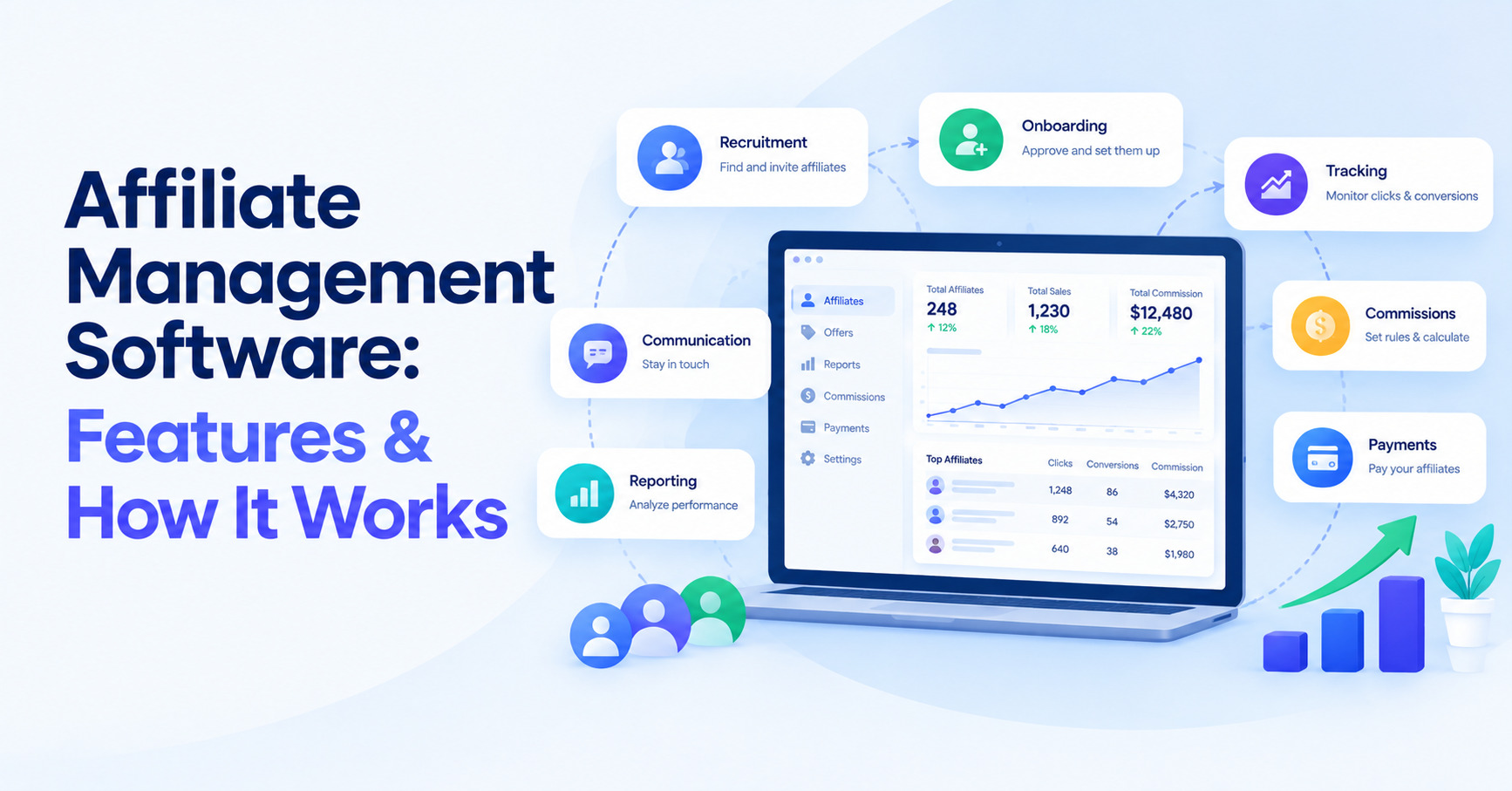
Learn how affiliate management software works, including recruitment, onboarding, tracking, commissions, reporting, communication, payments, integrations, and automation.
Running an affiliate program can start simply: recruit a few partners, give them affiliate links, track sales, and pay commissions.
But as the program grows, managing affiliates manually becomes much more difficult.
You may need to approve new partners, organize affiliate information, communicate with different affiliates, monitor performance, calculate commissions, manage payments, and connect your affiliate program with your existing business tools.
This is where affiliate management software comes in.
Affiliate management software gives businesses a centralized system for recruiting, onboarding, tracking, communicating with, and paying affiliates. Instead of managing different parts of an affiliate program through spreadsheets, email, payment platforms, and separate tracking tools, businesses can bring many of these activities together in one platform.
In this guide, we’ll explain what affiliate management software is, why businesses use it, the features to compare, and how platforms such as Trackdesk approach affiliate program management.
Looking for the tracking side of affiliate software? See our guide to affiliate tracking software to learn how clicks, conversions, cookies, attribution, and affiliate links work.
What Is Affiliate Management Software?
Affiliate management software is software designed to help businesses operate and manage affiliate programs.
An affiliate program connects a business with affiliates or partners who promote its products or services. Affiliates typically receive a commission when their referred traffic generates a qualifying action, such as a purchase, lead, or subscription.
Affiliate management software helps organize the operational side of that relationship.
Depending on the platform, it can provide tools for:
- Affiliate recruitment
- Affiliate registration
- Affiliate onboarding
- Affiliate tracking
- Commission management
- Performance reporting
- Affiliate communication
- Affiliate payments
- Affiliate segmentation
- Affiliate manager access
- Integrations
- Automation
- Affiliate program administration
In other words, an affiliate management platform is designed to help businesses manage the entire partner relationship rather than simply record affiliate clicks.
Trackdesk, for example, describes its platform as helping businesses launch, manage, and scale affiliate, referral, and partnership programs. Its functionality combines tracking, partner management, and payout preparation.
Affiliate management software vs affiliate tracking software
The two terms are related, but they aren’t necessarily identical.
Affiliate tracking software primarily focuses on recording clicks, conversions, attribution, and other performance data.
Affiliate management software usually covers a broader range of activities, including tracking plus affiliate recruitment, onboarding, communication, commission administration, reporting, and payments.
A simple way to think about the difference is:
| Affiliate tracking | Affiliate management |
|---|---|
| Records clicks | Manages affiliate accounts |
| Tracks conversions | Handles affiliate registration |
| Attributes conversions | Supports recruitment |
| Uses tracking links | Supports onboarding |
| Records performance | Manages commissions |
| Provides tracking reports | Supports communication |
| Helps determine attribution | Helps organize payments |
Many modern platforms combine both.
That combination is often described as affiliate tracking and management.
Why Do Businesses Use Affiliate Management Software?
The main reason businesses use affiliate management software is to make an affiliate program easier to operate as it grows.
A small program with five affiliates might be manageable through spreadsheets and email.
A program with 100, 500, or thousands of affiliates creates a very different workload.
You need to know:
- Who has joined the program?
- Which affiliates have been approved?
- Which affiliates are generating sales?
- How much commission does each affiliate have?
- Which affiliates need support?
- Which affiliates are assigned to which manager?
- Which payments are pending?
- Which integrations are working?
- Which offers are performing?
- Which affiliates should receive different commission structures?
An affiliate management platform puts this information into a more centralized workflow.
1. Centralized affiliate information
Instead of keeping affiliate information across multiple spreadsheets and email threads, businesses can maintain affiliate records in one system.
Depending on the platform, an affiliate profile may include information such as:
- Name
- Email address
- Affiliate ID
- Account status
- Tracking information
- Commission information
- Payment details
- Assigned manager
- Performance data
This becomes increasingly important as the number of affiliates grows.
2. More organized affiliate onboarding
Affiliate onboarding is more than simply giving someone a tracking link.
A business may need to:
- Receive an application.
- Review the affiliate.
- Approve or reject the application.
- Collect required information.
- Provide program instructions.
- Give the affiliate access to offers.
- Provide tracking links or coupons.
- Explain commission rules.
- Give the affiliate a way to contact the business.
Affiliate program management software can bring several of these steps into one workflow.
3. Easier performance monitoring
Affiliate managers need to understand which partners are generating results.
An affiliate management system can provide information about metrics such as:
- Clicks
- Conversions
- Revenue
- Commissions
- Conversion rates
- Affiliate performance
- Offer performance
This can make it easier to identify which areas of the program require attention.
4. Reduced manual administration
Without dedicated software, affiliate management can involve repetitive tasks.
For example, an affiliate manager might manually:
- Update affiliate spreadsheets
- Send approval emails
- Calculate commissions
- Export payment information
- Check tracking data
- Respond to affiliate questions
- Update affiliate records
Automation can reduce some of this administrative work.
Affiliate Recruitment
Recruitment is one of the first areas where affiliate management software can become useful.
A business needs a way to attract potential affiliates and bring them into its program.
Recruitment can happen through:
- An affiliate registration page
- Direct invitations
- Email outreach
- Existing customers
- Content creators
- Influencers
- Industry communities
- Affiliate networks or marketplaces
- Existing business relationships
Some affiliate management platforms provide tools for directly inviting affiliates.
For example, Trackdesk currently supports several methods for adding affiliates, including invitations through links, manual entry, forms, imports, and its marketplace.
A recruitment workflow might look like this:
Recruit prospect → Registration → Review → Approval → Onboarding → Affiliate link → Promotion → Conversion
The advantage of managing these steps within one platform is that affiliate information can remain connected throughout the relationship.
Affiliate Onboarding
Recruiting an affiliate is only the beginning.
Once someone joins, they need to understand how the program works.
A good onboarding process should make it clear:
- What products they can promote
- How commissions work
- What promotional methods are allowed
- How tracking works
- Where to find affiliate links
- How to access promotional materials
- When commissions are paid
- How to contact the program manager
Some affiliate management platforms allow businesses to customize registration forms and affiliate-facing messages.
Trackdesk, for example, provides customizable affiliate registration functionality and allows businesses to display messages on affiliate registration pages and dashboards.
The objective is to reduce friction between registration and the affiliate’s first successful promotion.
Affiliate Tracking
Tracking is a core component of affiliate management.
After an affiliate joins a program, the business needs to know which visitors and conversions are associated with that affiliate.
A typical tracking process looks like:
Affiliate → Tracking link → Visitor click → Website → Conversion → Attribution → Commission
Tracking may involve:
- Affiliate IDs
- Tracking links
- Cookies
- Click IDs
- Conversion events
- Coupon codes
- Server-to-server tracking
- Attribution rules
This is why affiliate management software and affiliate tracking software are often closely connected.
The management side tells you who your affiliates are and how to manage them.
The tracking side tells you what their traffic and conversions are doing.
For more detail, see our article on how affiliate tracking works.
Commission Management
Commission management is another important part of affiliate program software.
Businesses may use different commission structures depending on their products and business models.
For example:
- Percentage of sale
- Fixed amount per sale
- Fixed amount per lead
- Recurring commission
- Tiered commissions
- Product-specific commissions
- Affiliate-specific commissions
- Performance bonuses
The software needs to connect the conversion with the correct affiliate and commission structure.
This is especially important when a business has multiple offers or different commission rules.
A centralized system can make it easier to determine:
Affiliate + Offer + Conversion + Commission rule = Affiliate earnings
The exact capabilities vary between platforms, so commission rules should be one of the first areas you compare when evaluating affiliate manager software.
Reporting and Analytics
Affiliate reporting helps businesses understand what is happening inside their program.
A useful affiliate management platform may provide reports covering:
- Affiliate performance
- Clicks
- Conversions
- Revenue
- Commissions
- Offers
- Traffic
- Payouts
- Geographic data
- Conversion trends
Reporting can help answer practical questions such as:
Which affiliates are generating conversions?
Which offers are producing the most revenue?
How much commission has been generated?
Which partners need additional support?
Where are tracking or conversion problems occurring?
Trackdesk currently promotes real-time reporting and analytics, including customizable reports and access to error logs.
The important point is that reporting should help you understand the program, not simply provide a large collection of numbers.
Affiliate Communication
Affiliate relationships require communication.
Affiliates may have questions about:
- Commission rates
- Tracking
- Payments
- Offers
- Promotional materials
- Program rules
- New products
- Performance
- Account access
Managing these conversations entirely through a personal email can become difficult as the program grows.
Some affiliate program management software includes communication tools directly inside the platform.
Trackdesk’s affiliate management functionality includes email messaging, dashboard messages, registration-page messages, contact information, and affiliate ticketing features.
This can help create a more structured communication process.
For example, a business could use its affiliate dashboard to announce:
New promotional materials are now available.
Or:
A new product has been added to the affiliate program.
Or:
Please update your payment information before the next settlement.
Communication tools can therefore become part of the affiliate management workflow rather than something handled separately.
Affiliate Payments
Getting affiliates paid accurately and on time is an important part of program management.
The payment process generally involves:
- Tracking conversions.
- Calculating commissions.
- Confirming eligible earnings.
- Creating a payable balance.
- Collecting required payment information.
- Processing the payment.
- Recording the settlement.
The exact payment methods vary between affiliate management platforms.
Depending on the software, businesses may be able to work with payment services such as PayPal, Stripe, Tipalti, Wise, bank transfers, or other payment systems.
Trackdesk’s current affiliate-management documentation includes payment methods, billing details, settlement management, CSV-based payment workflows, Stripe Connect, Tipalti, PayPal, and API-based billing functionality.
When comparing affiliate management software, don’t look only at whether a platform says it supports payments.
Check:
- Which payment methods are supported?
- Are payments automated?
- Are there minimum payout thresholds?
- How are refunds handled?
- Can payments be exported?
- Are payment records available?
- Can the platform integrate with your existing payment system?
Integrations
Affiliate programs rarely operate independently from the rest of a business.
You may already use:
- Shopify
- WooCommerce
- Stripe
- PayPal
- CRM software
- Email marketing platforms
- Zapier
- Analytics tools
- Payment platforms
- Customer databases
An affiliate management platform should therefore fit into your existing technology stack.
Integrations can help connect affiliate activity with other business systems.
For example:
Store → Affiliate platform → Conversion → Commission → Reporting → Payment
Trackdesk currently highlights integrations with services including Stripe, Shopify, WooCommerce, PayPal, HubSpot, Zapier, and other tools.
Before choosing software, create a list of the systems your business already uses.
Then check whether the affiliate platform supports those systems directly or through APIs and automation tools.
Automation
Automation is one of the biggest reasons businesses move from spreadsheets to dedicated affiliate software.
Affiliate program management involves many repetitive activities.
Automation can potentially help with:
- Affiliate invitations
- Affiliate approvals
- Welcome messages
- Tracking
- Conversion recording
- Commission calculations
- Affiliate notifications
- Reporting
- Payment preparation
- Data synchronization
For example, instead of manually adding every new affiliate, a registration system can collect their information and place them into an approval workflow.
Similarly, instead of manually calculating every commission, the software can calculate earnings based on the configured commission rules and recorded conversions.
The more affiliates a business manages, the more valuable these workflows can become.
What Features Should You Compare?
Not every affiliate management platform provides the same features.
Before subscribing to affiliate program software, compare the capabilities that matter to your business.
Here’s a practical checklist.
| Feature | What to look for |
|---|---|
| Affiliate recruitment | Invitations, registration forms, marketplace or discovery tools |
| Affiliate onboarding | Registration workflows, approval controls, onboarding messages |
| Affiliate tracking | Links, cookies, click IDs, conversion tracking and attribution |
| Commission management | Flexible commission rules and accurate calculations |
| Reporting | Affiliate, conversion, revenue and commission reports |
| Communication | Email, dashboard messages and support tools |
| Affiliate managers | Team roles, permissions and affiliate assignment |
| Payments | Supported payout methods and settlement workflows |
| Integrations | Ecommerce, payment, CRM and automation integrations |
| API | Ability to connect custom systems |
| Automation | Automated approvals, notifications, tracking and other workflows |
| Customization | Registration forms, dashboards, branding and affiliate experience |
| Data export | CSV or other ways to access program data |
| Scalability | Ability to handle growth in affiliates and conversions |
You should also consider usability.
A platform may have dozens of features, but if your team struggles to understand the interface, some of that functionality may never be used.
Affiliate Management Software vs Spreadsheets
Spreadsheets can be useful when an affiliate program is very small.
For example, a business with a handful of affiliates might track:
- Affiliate name
- Sales
- Commission
- Payment status
in a spreadsheet.
The problem is that spreadsheets don’t inherently provide affiliate tracking, registration workflows, attribution, affiliate dashboards, or automated payment processes.
As the program becomes more complex, businesses may end up maintaining several spreadsheets alongside email, analytics, ecommerce software, and payment tools.
Dedicated affiliate management software brings more of these functions into one environment.
| Spreadsheet | Affiliate management software |
|---|---|
| Manual affiliate records | Centralized affiliate profiles |
| Manual updates | Automated data flows |
| Limited tracking | Dedicated affiliate tracking |
| Manual commission calculations | Configurable commission management |
| Email-based communication | Built-in communication tools |
| Manual reporting | Automated reporting |
| Manual payment preparation | Settlement and payout workflows |
| Limited permissions | User roles and access controls |
| Difficult to scale | Designed for larger programs |
This doesn’t mean every business needs dedicated software immediately.
The right choice depends on the size and complexity of the affiliate program.
Trackdesk as an Affiliate Management Software Example
Trackdesk is one example of a platform that combines affiliate tracking with broader affiliate management functionality.
Its affiliate management tools cover areas such as recruiting affiliates, registration, communication, affiliate managers, affiliate data, and importing affiliates.
For example, businesses can invite affiliates using an invitation link, add affiliates manually, use registration forms, import affiliates, or use the Trackdesk marketplace.
Affiliate recruitment and registration
Trackdesk provides multiple ways to bring affiliates into a program.
Businesses can create affiliate registration workflows and control whether new affiliates are automatically approved or manually reviewed.
The platform supports automatic and manual approval modes, while affiliate statuses can be changed as the program develops.
That can be useful for businesses that want to review applications before giving partners access to their program.
Affiliate management
Once affiliates are inside the platform, businesses can manage their accounts, performance, communication, and related information.
Trackdesk also supports importing multiple affiliates through CSV, which can be useful when migrating an existing affiliate program from another system or spreadsheet.
Affiliate managers
For organizations with multiple people managing affiliates, Trackdesk provides dedicated affiliate manager functionality.
Managers can be assigned specific affiliates and receive access to information and communication tools related to those affiliates. Trackdesk currently documents affiliate manager and super affiliate manager roles, with the feature available on Enterprise and Network plans.
This can create a structure such as:
Affiliate Program → Affiliate Managers → Assigned Affiliates
rather than having one administrator handle every affiliate directly.
Communication
Trackdesk also includes affiliate communication functionality.
Businesses can provide contact information, send messages, and display custom messages on affiliate dashboards and registration pages.
Tracking and performance
Management is only useful if the business can also measure affiliate activity.
Trackdesk combines affiliate management with tracking functionality for clicks, conversions, attribution, coupons, landing pages, and other tracking mechanisms.
This creates a broader workflow:
Recruit → Register → Approve → Onboard → Track → Manage → Report → Pay
That combination is the main reason to look at affiliate management software as more than just an affiliate tracking tool.
Want to Explore Trackdesk’s Affiliate Management Features?
If you’re comparing affiliate management software for your business, Trackdesk is one platform worth examining alongside other options.
Its current feature set includes affiliate recruitment and registration, affiliate management, communication, affiliate managers, tracking, reporting, integrations, and payout-related tools.
You can explore the platform’s affiliate management features and see how its tools fit your requirements:
Explore Trackdesk’s affiliate management features
Before signing up, compare the platform against your specific requirements, including the number of affiliates you expect to manage, tracking requirements, commission structures, integrations, team permissions, communication needs, and payout workflows.
Frequently Asked Questions
What is affiliate management software?
Affiliate management software is a platform that helps businesses recruit, onboard, track, communicate with, manage, and pay affiliates. It can combine affiliate tracking with broader program-management functions.
What is an affiliate management platform?
An affiliate management platform is software that provides a centralized system for operating an affiliate program. Depending on the platform, it can include affiliate registration, tracking, commissions, reporting, communication, integrations, and payments.
What is affiliate program management software?
Affiliate program management software helps businesses organize and operate affiliate programs. It can manage affiliate accounts, applications, tracking, commissions, communication, reporting, and payouts.
What is affiliate manager software?
Affiliate manager software provides tools for people responsible for managing affiliate relationships. Common functionality includes affiliate profiles, performance reports, communication, commission information, and partner management.
Is affiliate tracking the same as affiliate management?
No. Affiliate tracking focuses primarily on recording clicks, conversions, attribution, and performance. Affiliate management covers a broader set of activities, including recruitment, onboarding, communication, commissions, payments, and relationship management.
When should a business use affiliate management software?
A business may consider dedicated software when its affiliate program becomes difficult to manage manually. Growth in affiliate numbers, conversions, commission calculations, reporting requirements, or payment administration can all create a need for more structured tools.
Can affiliate management software automate payments?
Some platforms provide payment and settlement functionality or integrate with payment providers. The exact payment methods and automation capabilities vary by platform, so businesses should verify the supported payment workflows before subscribing.
What should I look for in affiliate program software?
Important areas to compare include affiliate recruitment, onboarding, tracking, attribution, commission management, reporting, communication, payment processing, integrations, automation, API access, user permissions, and scalability.
Final Thoughts
Affiliate programs involve much more than tracking affiliate links.
As a program grows, businesses need systems for recruiting partners, approving applications, onboarding affiliates, monitoring performance, calculating commissions, communicating with partners, and managing payments.
That’s the role of affiliate management software.
The right platform can bring these activities into a more organized workflow while reducing the amount of manual administration involved in running an affiliate program.
When comparing an affiliate management platform, focus on the features that match your business rather than simply choosing the platform with the longest feature list.
Look at tracking, commission management, reporting, communication, payments, integrations, automation, user permissions, and scalability.
Trackdesk is one example of a platform combining affiliate tracking with affiliate management features, including affiliate recruitment, registration, communication, affiliate managers, reporting, integrations, and payout-related functionality.
For businesses evaluating affiliate program software, those are the areas worth examining before making a decision.