
Comparing the best funnel tracking software — Hyros, ClickMagick, Voluum, RedTrack, FunnelFlux, ClickFunnels & Amplitude — for accurate attribution, funnel mapping, and ad ROI.
If you’re running paid ads, you already know the frustrating part isn’t the traffic — it’s figuring out what happens to it after the click.
A prospect sees your ad, clicks through, maybe opts in, watches a webinar, or abandons the cart on step three of checkout. Then a sale shows up in your dashboard, and you’re left wondering which part of that journey actually worked — and which part quietly leaked money.
That’s the problem funnel tracking software solves.
Instead of relying only on ad-platform reporting or basic web analytics, a dedicated funnel tracker connects the visitor’s journey from ad click to landing page, offer, checkout, and conversion. You can see where people convert, where they drop off, and which traffic sources are driving results.
We compared seven popular tools — Hyros, ClickMagick, RedTrack, Voluum, FunnelFlux, ClickFunnels, and Amplitude — based on funnel mapping, attribution, integrations, ease of setup, and pricing.
One important note: ClickFunnels and Amplitude aren’t traditional ad-attribution trackers. They solve different parts of the funnel problem, so we’ve included them with clear “best for” use cases rather than pretending they’re identical tools.
Quick Comparison: Best Funnel Tracking Software
| Tool | Best For | Starting Price | Funnel Mapping | Attribution Model | Free Trial |
|---|---|---|---|---|---|
| Hyros | High-ticket ads, coaches, courses & call-based funnels | $69/mo for up to $5k tracked monthly revenue | Funnel-specific tracking for sales calls, webinars & e-commerce | Multi-touch, AI-assisted attribution | No free trial |
| ClickMagick | Beginners, affiliates & simple funnel tracking | $79/mo | Funnel Steps Report and visitor-path tracking | Multi-touch attribution, including advanced models on higher plans | 14 days |
| RedTrack | Affiliate & performance marketers | $69/mo | Multi-step funnels, landers, offers & campaign flows | Multi-touch attribution, CAPI/S2S tracking | 14 days |
| Voluum | Advanced media buying & traffic distribution | $119/mo | Campaign flows, landing pages, offers & rule-based paths | Multi-touch, conversion & traffic-source attribution | Check current offer |
| FunnelFlux | Complex, visual & non-linear funnels | $99/mo | Visual funnel builder with nodes, paths & branching | Rule-based / explicit attribution | 14 days |
| ClickFunnels | Building sales funnels with built-in tracking | $97/mo | Built-in funnel steps, pages & conversion tracking | Primarily native/last-click-style reporting | 14 days |
| Amplitude | SaaS, product-led growth & in-app funnels | Free | Funnel exploration, behavioral paths & retention | Behavioral/product analytics | Free plan |
1. Hyros — Best for Ad Attribution & High-Ticket Funnels
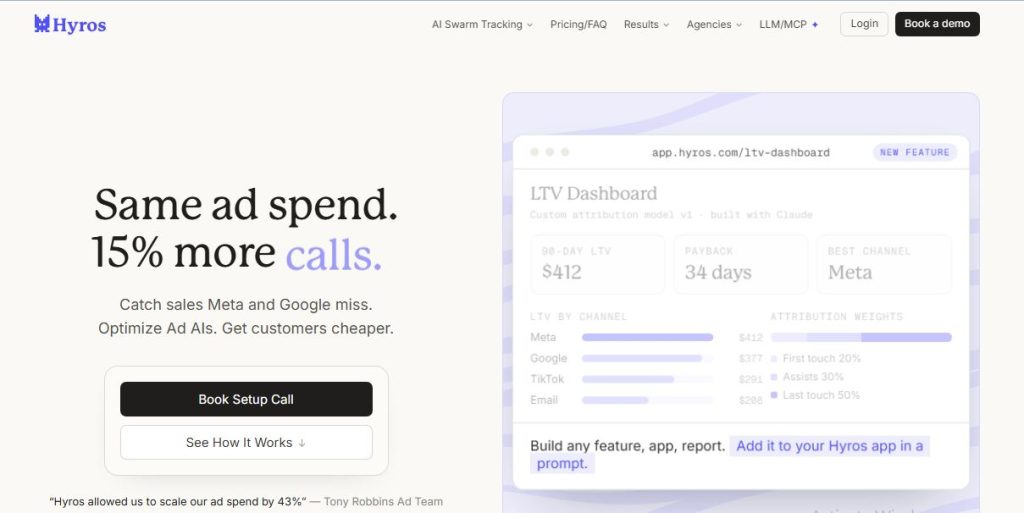
Hyros is built for advertisers running paid traffic into high-ticket offers — think course creators, coaches, and agencies where a single sale might involve a webinar, a sales call, or a multi-week email sequence before it closes.
Rather than treating every funnel the same, Hyros gives you dedicated setup flows depending on the funnel type you’re running. Standard e-commerce, webinar, and sales-call funnels each get their own tracking configuration.
Standout features:
- Funnel-type-specific tracking — Separate setups for e-commerce, webinar, and sales-call funnels, so the tracking approach matches how the funnel actually converts.
- Phone/call attribution — Connects phone and offline conversions back to the original ad, which is especially useful for high-ticket businesses where sales calls close the deal.
- AI/behavior-based attribution — Helps identify which touchpoints across a longer, multi-step customer journey contributed to the sale, with a long attribution window.
- Ad platform integrations — Connects with Facebook, Google, and other major ad networks so conversion data can feed back into campaign optimization.
- Long customer-journey tracking — Built around businesses where the path from first click to sale can involve multiple ads, pages, emails, webinars, and calls.
Pricing: Starts at $69/mo for up to $5k tracked monthly revenue. Price goes up to $1499/mo for up to $750k tracked monthly revenue. The price depends on how much monthly revenue you track through the platform.
Pros
- Strong fit for multi-touch attribution across complex, high-ticket customer journeys
- Native call tracking is uncommon among funnel trackers
- Particularly useful for webinar, coaching, and course funnels
- Built for longer buying cycles rather than simple one-click conversions
Cons
- Setup is more involved than simpler trackers and may require onboarding help
- Pricing isn’t transparent upfront
- Can be more than you need for a basic landing-page-to-checkout funnel
- Higher cost can make it harder to justify for smaller campaigns
Best if: you’re spending serious ad budget on high-ticket offers with phone, webinar, or other long customer-journey touchpoints and need deeper attribution across the entire path.
Read Hyros Review | Visit website
2. ClickMagick — Best for Beginners & Simple Funnel Steps
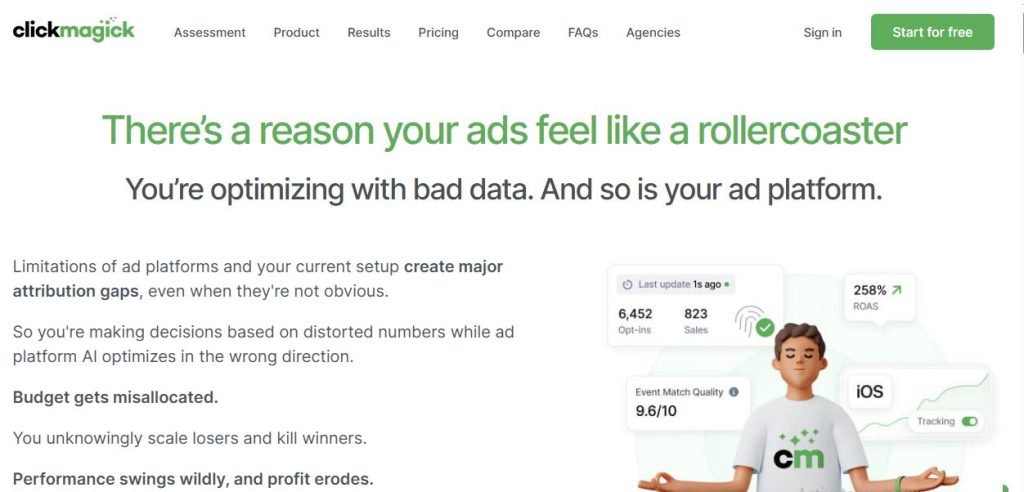
ClickMagick is one of the more accessible options on this list — a web-based tracker built around link tracking, real-time stats, and a visual breakdown of how traffic moves through your funnel.
It’s particularly useful for affiliates and solo marketers who want clear funnel visibility without the complexity of an enterprise-level tracking platform.
Standout features:
- Funnel Steps Report — A visual report showing the paths visitors take through your funnel, making it easier to see exactly where people drop off.
- TrueTracking® — Designed to provide a central view of clicks, conversions, and customer journeys, with cross-device tracking and bot filtering.
- Multi-touch attribution models — Includes models such as linear, position-based, and time-decay attribution, helping you look beyond last-click reporting.
- Conversion Velocity & Lifetime Value Reports — Shows how quickly visitors convert and helps you understand their value beyond the initial conversion.
- Real-time link and campaign tracking — Gives you a live view of traffic and conversion activity across your tracked campaigns.
Pricing: Starts at $79/month — The Starter plan includes up to 10,000 clicks per month and one funnel project. Higher plans increase click and funnel capacity.
Pros
- Relatively easy setup compared with more advanced trackers
- Funnel Steps Report gives useful visual drop-off data
- Lower entry price than some enterprise-focused tracking platforms
- 24/7 support and a large library of tutorials
- Good fit for affiliates and solo advertisers
Cons
- Certain traffic sources aren’t permitted, so check the current terms before signing up
- Less suited to very complex, multi-path funnels than RedTrack or FunnelFlux
- More advanced campaigns may require higher-tier features
- Support and documentation may be more limited outside English
Best if: you’re an affiliate marketer, solo advertiser, or beginner who wants straightforward funnel-step visibility and attribution without a complicated setup process.
Read ClickMagick Review | Visit website
3. RedTrack — Best for Affiliate-Specific Funnel Structures
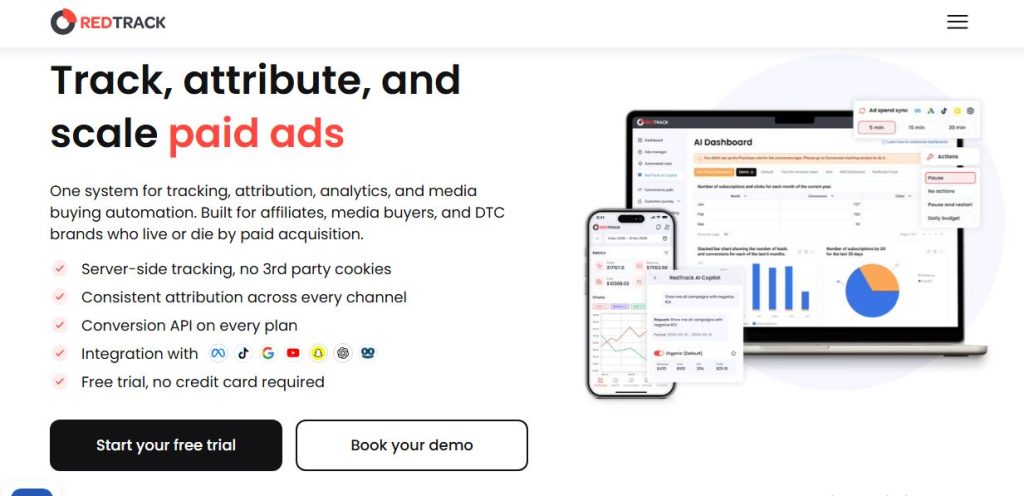
RedTrack is built with affiliate funnel structures in mind. It supports a wide range of funnel types, including standard funnels, listicles, pre-landers, and multi-step funnels with your own offers.
That makes it a strong fit if your campaigns vary a lot in shape from one offer or traffic source to the next.
Standout features:
- Dedicated funnel tracking for affiliates — Build and track simple or complex funnels with landers, pre-landers, and listicles while controlling how clicks flow through weights, filters, and caps.
- Granular funnel-type support — Supports standard funnels, listicle funnels, and multi-funnels, with or without tracking links and with or without your own offers.
- Server-side and Parallel Tracking — Combines server-side tracking with on-page tracking, while Parallel Tracking allows a fully custom server-side setup with RedTrack acting as the attribution and reporting layer.
- Publisher, affiliate, and coupon tracking — Track individual publishers, influencers, referral partners, and promo-code-based referrals.
- CAPI and ad-platform integrations — Supports conversion data sharing with platforms such as Meta, Google, and TikTok for campaign optimization.
RedTrack Pricing: Starts around $69/month — Pricing varies by plan, traffic volume, and available features. Higher tiers provide more capacity and advanced functionality.
Pros
- Detailed support for varied affiliate funnel structures
- Strong CAPI and server-side tracking options
- Useful controls for multiple traffic sources and offers
- Good middle ground between simple link tracking and advanced media-buying platforms
- Well suited to listicles, pre-landers, and multi-step campaigns
Cons
- More technical setup than ClickMagick
- Server-side and Parallel Tracking can add a learning curve
- Some features require more configuration to get the full benefit
- Its feature set overlaps with Voluum, which can make the two harder to distinguish
Best if: you’re an established affiliate running listicles, pre-landers, multi-step funnels, or multiple offers and want tracking built around those structures.
4. Voluum — Best for AI-Powered Traffic Distribution
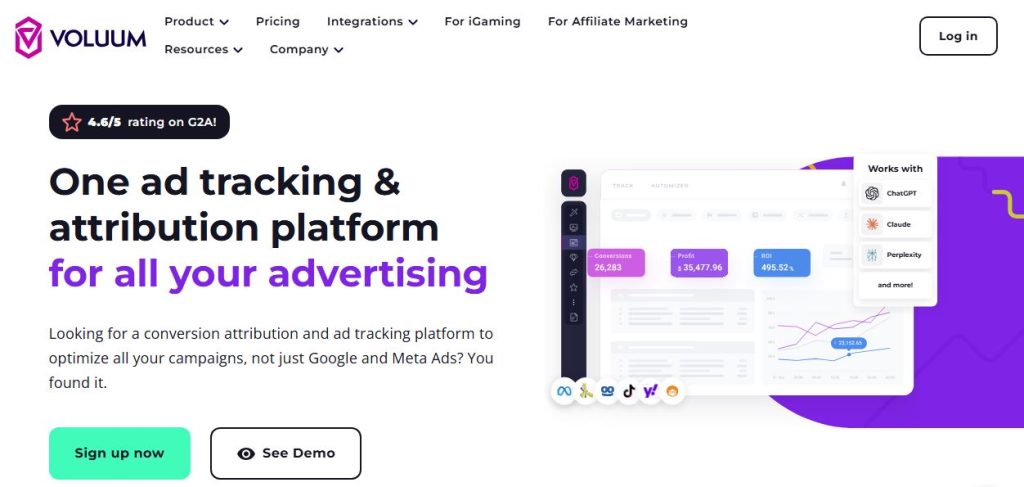
Voluum is a cloud-based tracking platform built for performance marketers who need to manage paid traffic at scale.
Alongside standard click and conversion tracking, it offers AI-powered traffic distribution that can automatically route visitors toward better-performing landing pages and offers.
It’s also one of the more established names in affiliate and performance tracking, with a large range of integrations and detailed campaign reporting.
Standout features:
- Traffic Distribution AI — Automatically routes traffic toward better-performing landing pages and offers based on performance data.
- Rule-based traffic distribution — Lets you create conditional routing based on factors such as country, device, operating system, and campaign performance.
- Extensive reporting — Provides 30+ data points across impressions, visits, clicks, and conversions for detailed campaign analysis.
- Automizer and Auto-Rules — Helps automate actions such as bid changes, campaign pausing, and blacklist or whitelist management.
- Wide range of integrations — Connects with ad platforms, affiliate networks, traffic sources, and other marketing tools.
Pricing: Starts around $119/month and scales based on traffic volume and plan. Voluum’s pricing structure can be more complex than simpler trackers, so confirm current limits and tiers before subscribing.
Pros
- AI-powered routing goes beyond passive tracking
- Detailed reporting with 30+ data points
- Strong automation options for larger campaigns
- Useful when managing multiple campaigns, offers, and traffic sources
- Large integration range and established user base
Cons
- Steeper learning curve than ClickMagick or RedTrack
- Per-step funnel drop-off isn’t its main strength
- Pricing can become more expensive as traffic grows
- Advanced automation may be unnecessary for smaller campaigns
Best if: you’re a media buyer or performance marketer scaling paid traffic across multiple offers and want automation to help decide where visitors should be routed.
5. FunnelFlux — Best for Visual, Non-Linear Funnel Building
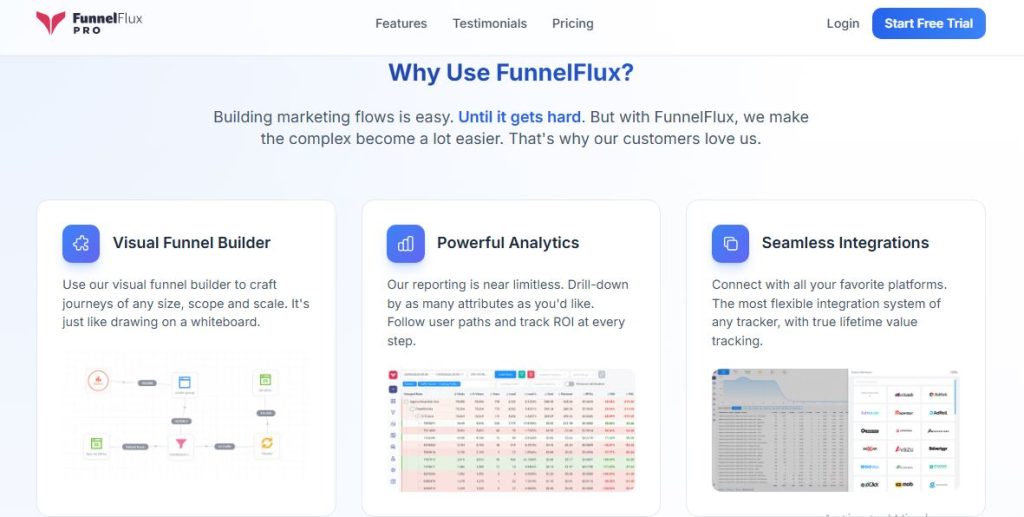
FunnelFlux takes a different approach from most funnel trackers: it organizes your tracking around the funnel itself, not just individual campaigns.
You build the customer journey as a visual flowchart, connect different steps with conditions and actions, and send traffic from multiple sources through the same funnel.
That makes it particularly useful when your funnel includes upsells, multiple landers, offer rotations, or other paths that don’t fit neatly into a simple lander-to-offer setup.
Standout features:
- Visual Funnel Builder — Build multi-path funnels using a drag-and-drop canvas, making complex visitor journeys easier to map and manage.
- Flexible funnel architecture — Create conditional paths based on factors such as country, device, percentages, and other rules.
- Unlimited funnel nodes — Build large funnel structures without the same type of node restrictions found in simpler visual tools.
- Lifetime Value tracking — Track customer value beyond a single conversion, which is useful for subscriptions and repeat purchases.
- Self-hosted or managed hosting — Choose between running FunnelFlux yourself or using managed hosting, depending on how much control you want over the tracking environment.
Pricing: Starts around $99/month for the cloud-hosted Pro version. A self-hosted licensing option is also available.
Pros
- Flexible architecture for complex and non-linear funnels
- Visual builder makes complicated paths easier to understand
- Self-hosted option gives you more control over your tracking setup
- Handles upsells, multiple landers, offer rotations, and conditional paths
- Lifetime value tracking is useful for repeat-purchase businesses
Cons
- Steeper learning curve than ClickMagick
- The visual builder takes time to master
- More focused on controlling and tracking defined funnels than broad, disconnected-channel attribution
- Less mainstream brand recognition than platforms such as Voluum or ClickFunnels
Best if: you run complex, multi-path funnels with upsells, multiple landers, conditional routing, or offer rotations and want visual control over the entire customer journey.
6. ClickFunnels — Best All-in-One Funnel Builder (Not a Dedicated Tracker)
ClickFunnels is worth including here with one important caveat: it’s primarily a funnel-building platform, not a dedicated ad-attribution or click-tracking tool like Hyros, ClickMagick, Voluum or RedTrack.
It handles landing pages, checkout flows, upsells, and other funnel pieces while providing basic performance stats inside the platform.
That makes it useful for people who aren’t just asking, “Where did this visitor come from?” but also, “How do I build and manage the funnel in the first place?”
Standout features:
- Built-in funnel templates — Launch webinar, sales, lead-generation, and product funnels without building every page from scratch.
- Native funnel analytics — See page-level conversion rates and funnel performance inside the platform.
- All-in-one funnel stack — Handle landing pages, checkout, email follow-ups, order bumps, and upsells in one place.
- A/B testing and funnel optimization — Test different funnel pages and variations to find areas that can improve conversion rates.
- Third-party integrations — Connect your funnel with payment systems, email tools, ad platforms, and dedicated tracking software.
Pricing: Starts at $97/month for the base plan, with higher plans offering additional features and capacity.
Pros
- Fast way to build a complete sales funnel
- Reduces the number of separate tools needed for pages and checkout
- Includes basic funnel analytics
- Can be paired with dedicated trackers such as ClickMagick or RedTrack
- Useful if you don’t already have a separate funnel builder
Cons
- Native tracking is basic compared with dedicated attribution platforms
- Higher starting price than several dedicated trackers
- May include functionality you don’t need if you already have a page builder
- A dedicated tracker is still useful when you need deeper traffic attribution
Best if: you need to build the funnel itself — including pages, checkout, upsells, and basic reporting — and you’re open to pairing ClickFunnels with a dedicated tracker for deeper attribution.
7. Amplitude — Best for Product-Led Growth & In-App Funnels
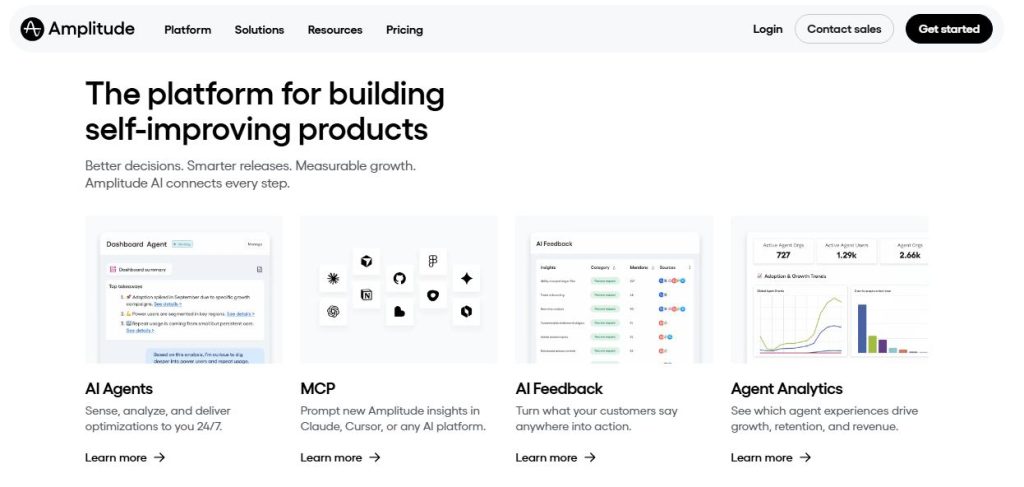
Amplitude is the odd one out on this list, so it’s worth being clear about what it does.
It’s a product analytics platform, not an ad-attribution or affiliate funnel tracker. It’s built for SaaS and product-led growth teams that need to understand how users move through an app or product — from signup and onboarding to feature adoption and paid upgrades.
If your funnel starts with an ad click and ends at checkout, the first six tools are a better fit.
But if your funnel starts with a signup and ends with a paid in-app conversion, Amplitude is built for that job.
Standout features:
- Funnel Exploration — Build custom funnels from the events you track and see where users drop off between steps.
- Path Analysis — Shows the routes users actually take before and after key events, helping you spot unexpected friction or drop-off points.
- Retention & Cohort Analysis — Compare how different user groups behave, convert, and stick around over time.
- Cross-Device, Event-Based Tracking — Tracks user actions across devices using an event-based model, making it a better fit for apps and digital products than link-based tracking.
- Behavioral Segmentation — Group users based on actions, traits, or product behavior to see which segments convert and retain better.
Pricing: Free tier available — Amplitude offers a free plan for teams getting started, while paid plans scale based on usage and tracked users. Enterprise pricing is custom.
Pros
- Powerful funnel and path analysis for understanding in-app behavior
- Free tier lets you test the platform before paying
- Strong fit for SaaS, subscriptions, and product-led businesses
- Retention and cohort reports go beyond one-time conversion tracking
- Useful for finding friction inside onboarding and product experiences
Cons
- Not designed for ad-platform attribution or affiliate tracking
- No native focus on ad clicks, publishers, or campaign-level traffic tracking like the other tools here
- Overkill if you only need to track a landing-page-to-checkout funnel
- Requires proper event tracking inside your app or product, which makes setup more technical than a link tracker
Best if: you’re running a SaaS or product-led business and need to understand in-app conversion, user behavior, and retention. It’s not the right fit if your main goal is tracking paid traffic from an ad click through a marketing funnel to a sale.
How to Choose the Right Funnel Tracking Software
With seven very different tools on this list, there’s no single fit for everyone. The right choice comes down to the funnel you’re running, how complex it is, and how much control you need over your tracking.
By Use Case
Affiliate marketer or beginner → ClickMagick
If you want clear funnel-step data without a steep setup process, ClickMagick is a practical starting point. Its Funnel Steps Report makes it easy to spot where visitors drop off.
Established affiliate with varied funnel structures → RedTrack
Running listicles, pre-landers, multi-step funnels, and multiple offers? RedTrack is designed around these kinds of affiliate campaign structures.
Scaling media buyer → Voluum
If you’re managing paid traffic across several offers and campaigns, Voluum adds automated traffic distribution and detailed reporting that becomes more useful as your traffic volume grows.
Complex, non-linear funnels → FunnelFlux
Upsells, multiple landers, conditional paths, and offer rotations can get messy fast. FunnelFlux’s visual builder gives you a way to map and control those paths from one place.
High-ticket offers with webinars or sales calls → Hyros
For longer buying journeys where a prospect might see several ads, attend a webinar, receive emails, and eventually book a sales call, Hyros focuses heavily on multi-touch attribution and phone-based conversions.
You haven’t built your funnel yet → ClickFunnels
If the immediate problem is building the pages, checkout, upsells, and other funnel pieces, ClickFunnels handles that side first. You can then add a dedicated tracker such as ClickMagick or RedTrack when you start driving paid traffic.
SaaS or product team → Amplitude
If your funnel lives inside an app or software product, Amplitude belongs in a different category. It focuses on user behavior, product funnels, retention, and in-app conversions rather than ad-click attribution.
By Budget
Your starting budget can narrow the list quickly:
- Entry-level: ClickMagick, RedTrack, and FunnelFlux start in the lower price range, depending on the current plan and usage limits.
- Higher-volume tracking: Voluum starts higher and scales with traffic and plan limits.
- Tracked Revenue: Hyros uses pricing based on monthly tracked revenue.
- Funnel builder: ClickFunnels combines funnel creation with basic tracking rather than acting as a dedicated tracker.
- Free to start: Amplitude has a free tier for product analytics.
By Technical Comfort
Want something you can set up yourself: ClickMagick is the simpler starting point.
Comfortable with more configuration: RedTrack and Voluum give you more control over campaign tracking, routing, and optimization.
Want self-hosted control: FunnelFlux offers a self-hosted option for marketers who want more control over their tracking setup.
Prefer guided onboarding: Hyros is better suited to businesses willing to work through a more involved setup and onboarding process.
The Honest Takeaway
For many serious advertisers, the question isn’t “Which one tool should I use?” It’s “Which tools should work together?”
A common setup is a funnel builder such as ClickFunnels handling the pages and checkout, with a dedicated tracker like ClickMagick, RedTrack, Voluum, FunnelFlux, or Hyros handling deeper traffic and attribution data.
That distinction matters. A funnel builder can tell you whether your pages are converting. A dedicated tracker can help answer the harder question:
Which traffic source, campaign, and visitor path actually produced those conversions?
Frequently Asked Questions About Funnel Tracking Software
What’s the difference between funnel tracking and web analytics?
Web analytics tools, such as standard Google Analytics setups, mainly report on sessions, pageviews, and individual events. They can show what happened on your site without always giving you a clear view of one visitor’s full journey.
Dedicated funnel tracking software connects that journey. You can follow the path from ad click → landing page → offer → checkout → conversion and see where visitors drop off along the way.
This makes it easier to connect a sale back to the traffic and funnel path that produced it.
Do I need a separate funnel tracker if I already use ClickFunnels?
If you need deeper attribution, yes. ClickFunnels is primarily built for creating and managing funnels, with built-in performance reporting for your pages and funnel steps.
A dedicated tracker such as ClickMagick or RedTrack adds deeper traffic-source and conversion tracking.
The two can work together: ClickFunnels builds the funnel, while the dedicated tracker handles more detailed attribution.
Which funnel tracker is best for affiliate marketers?
ClickMagick and RedTrack are both strong fits for affiliate marketers because they focus heavily on link tracking, funnel steps, traffic sources, and campaign attribution.
ClickMagick is geared toward simpler funnel tracking and ease of use. RedTrack gives affiliates more control when campaigns involve pre-landers, listicles, multiple offers, and more complex funnel structures.
Is Hyros or ClickMagick better for beginners?
ClickMagick is generally the easier place to start. Its setup is more straightforward and its pricing is more accessible than Hyros’ custom-priced platform.
Hyros is aimed more at businesses running complex, high-ticket campaigns where webinars, sales calls, and longer customer journeys make deeper attribution useful.
Can I use more than one tracking tool at once?
Yes. Different tools can serve different jobs.
For example, you could use RedTrack or Voluum for paid-traffic attribution while using Amplitude to understand what users do after they sign up for a SaaS product.
The important part is avoiding duplicate tracking that can distort your numbers. Decide which platform is your main source for ROI reporting, then make sure the other tools have clearly defined jobs.
Ready to Get Real Visibility Into Your Funnel?
Choosing funnel tracking software starts with your actual funnel, not the longest feature list.
If you’re just starting out, ClickMagick gives you straightforward funnel-step tracking without a complicated setup. If you’re scaling paid traffic into more complex or high-ticket offers, tools like Hyros or RedTrack give you more advanced attribution options.
And if you haven’t built your funnel yet, ClickFunnels can handle the pages, checkout, and funnel structure before you layer dedicated tracking on top.
Want to take a closer look? Check out our full breakdowns:
- [Hyros Review: Is It Worth the Price?]
- [ClickMagick Review: Full Features & Pricing Breakdown]
- [RedTrack vs Voluum: Which Should You Choose?]
Still unsure which setup makes sense for your funnel? Drop a comment below and tell us what you’re running. We’ll help you narrow down the options.