
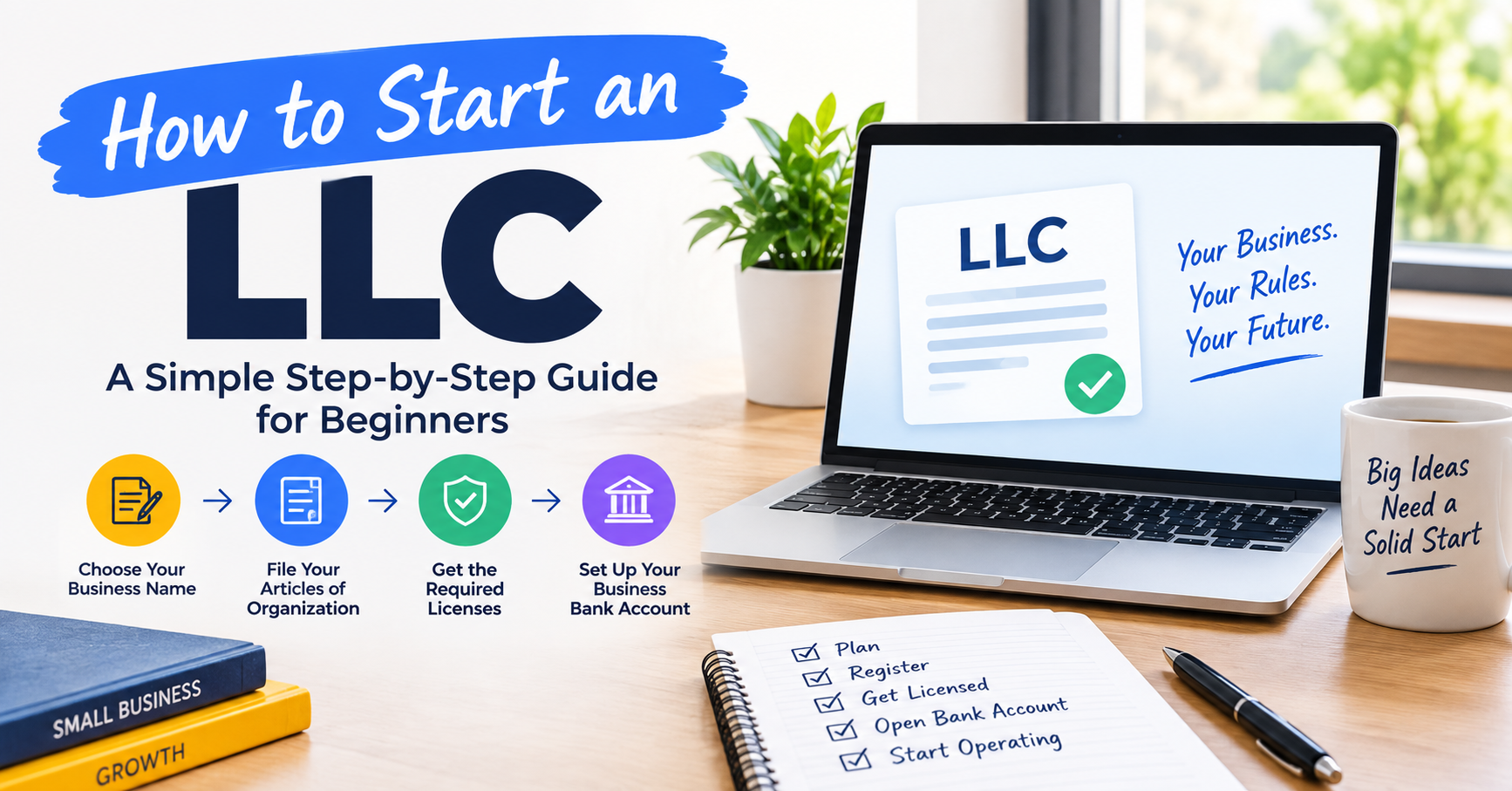
Most people fail to start an LLC because they do not know which forms matter. A quick Google search returns a dozen checklists. Half of them contradict each other. Suddenly a task that should take an afternoon becomes weeks of confusion.
Here’s the reality: forming an LLC is mostly a paperwork process. Once you know which documents you need, in what order, and why each matters, you have a straightforward checklist. It is not a legal minefield. This guide shows the forms you need to start an LLC. They come in the correct order, making legal setup straightforward and free of guesswork.
What Is an LLC, and Why Form One?
A Limited Liability Company (LLC) is a business structure that legally separates your personal assets from your business’s liabilities. In plain terms: if your business gets sued or racks up debt it can’t pay, your personal savings, home, and car are generally protected. Something that isn’t true if you’re operating as a sole proprietor.
Beyond liability protection, LLCs offer a few other advantages that make them the default choice for most small business owners:
- Pass-through taxation. Profits and losses pass through to your personal tax return, avoiding the “double taxation” that corporations can face.
- Flexible management. LLCs don’t require a board of directors or formal corporate structure — you can run it as a single owner or split management among multiple members however you choose.
- Credibility. Operating as “Your Business, LLC” rather than under your own name signals legitimacy to clients, vendors, and potential partners.
LLCs are a common fit for freelancers going full-time, small business owners, side-hustlers turning a hobby into income, real estate investors holding rental property, and e-commerce sellers scaling past a casual side gig. If any of that sounds like you, the forms below are exactly what you’ll need to get set up properly.
The Core Forms You Need to Start an LLC
Here’s every document involved in forming an LLC, and what each one actually does:
Articles of Organization. This is the actual formation document filed with your state’s Secretary of State (or equivalent agency). It legally creates your LLC. It typically includes your business name, address, registered agent information, and management structure. Until you file and obtain approval, your LLC doesn’t legally exist.
Operating Agreement. An internal agreement governs how your LLC operates. The agreement specifies ownership percentages, how profits and losses are allocated, and member duties. Also, it sets voting rights and what happens when a member leaves or the firm dissolves. Most states don’t legally require one, but skipping it is one of the most common — and costly — mistakes LLC owners make.
EIN (Employer Identification Number) application. This is a free form filed with the IRS that gives your LLC a federal tax ID, similar to a Social Security number for your business. You’ll need it to open a business bank account, file taxes, and hire employees, even if you’re a single-member LLC with no employees.
Registered Agent designation. Every LLC needs a registered agent — a person or service designated to receive legal documents and official state correspondence on behalf of the business. This can be you, another member, or a professional registered agent service, and it’s typically named directly in the Articles of Organization.
Initial Report / Statement of Information. Some states require a follow-up filing shortly after formation (separate from the Articles of Organization) that confirms or updates basic business details — this varies significantly by state, so it’s worth checking your state’s specific requirement.
Business licenses and permits. Depending on your industry and location, you may need additional licenses beyond the LLC formation itself — a general business license, a professional license, a seller’s permit, or industry-specific permits. This isn’t one-size-fits-all, so it’s worth a quick check with your city/county alongside your state filing.
Banking resolution / EIN confirmation letter. Once you have your EIN and Articles of Organization, most banks will ask for both (sometimes alongside an internal banking resolution) before letting you open a business bank account — a critical step for keeping personal and business finances separate.
State-by-State Differences (What to Watch For)
LLC formation isn’t identical from state to state — a few key differences are worth knowing before you file:
- Filing fees vary widely. Depending on the state, filing your Articles of Organization can cost anywhere from around $50 to $500 or more. States like Kentucky and Arkansas sit at the low end, while states like Massachusetts and Tennessee run considerably higher.
- Some states require publication of formation. A handful of states require newly formed LLCs to publish a formation notice in local newspapers. This applies in states like New York and Arizona. It is an extra step (and cost) many business owners aren’t expecting.
- Annual report and franchise tax requirements differ. Many states require an annual or biennial report to keep your LLC in good standing. Sometimes this is paired with a franchise tax or a flat annual fee. California, for example, requires an $800 minimum annual franchise tax regardless of income, while other states have no annual fee at all.
- Registered agent rules vary slightly. Most states allow you to act as your own registered agent if you have a physical address in the state, but some have specific requirements around availability during business hours.
This state-by-state variation is exactly why a generic, one-size-fits-all template can cause problems — a document written for Delaware’s requirements may not hold up the same way in Texas or Florida. It’s worth confirming your specific state’s requirements before filing, or using a template service that lets you select your state directly.
Order of Operations (What to File First)
Therefore, filing the right forms in the right sequence saves you from delays, rejected bank applications, or redoing paperwork. Here’s the order that works:
1. Choose a business name. Pick a name that complies with your state’s LLC naming rules (usually requiring “LLC” in the name, and avoiding restricted words like “Bank” or “Insurance” without special approval).
2. Check name availability. Search your state’s business name database to confirm your chosen name isn’t already taken — most Secretary of State websites offer a free search tool .
3. File the Articles of Organization. Submit this to your state’s filing office along with the required fee. This is the step that legally creates your LLC.
4. Get your EIN. Once your LLC is approved, apply for your EIN through the IRS (this is free and can typically be done online in minutes). You’ll need your approved Articles of Organization on hand.
5. Draft your Operating Agreement. With your LLC officially formed and your EIN in hand, put your Operating Agreement in place — even for a single-member LLC. This protects your liability status and clarifies how the business runs.
6. Open a business bank account. Bring your EIN confirmation and Articles of Organization to the bank — most institutions require both before opening an account, and some also ask to see your Operating Agreement.
7. Obtain any required licenses or permits. Depending on your industry and location, apply for the specific licenses or permits your business needs to operate legally.
The order matters because each step often depends on the one before it — banks won’t open an account without an EIN, and you can’t get an EIN without an approved LLC. Trying to skip ahead usually just means backtracking later.

Common Mistakes People Make When Forming an LLC
Even straightforward LLC formations go sideways when these get overlooked:
- Skipping the Operating Agreement because it’s “not required.” Most states don’t legally mandate one, which leads many single-member LLC owners to skip it entirely. But without it, you have no formal documentation separating you from the business. A gap that can weaken your liability protection if it’s ever challenged in court, and one that turns into a serious problem fast if you ever bring on a second member without clear terms in place.
- Using a personal address instead of a proper registered agent. Listing your home address as the registered agent means legal notices and state correspondence get sent there. This includes, in the event of a lawsuit, a process server showing up at your house. It also makes your home address part of the public record.
- Forgetting state-specific annual filings. Missing an annual report or franchise tax payment doesn’t just mean a late fee — many states will administratively dissolve an LLC that falls out of compliance, meaning you lose your liability protection without even realizing it happened.
- Mixing personal and business finances before the LLC is properly separated. Using a personal bank account for business transactions (or vice versa) undermines the entire point of forming an LLC. Courts can “pierce the corporate veil” and hold you personally liable if your finances aren’t kept clearly separate from day one.
DIY vs. Template vs. Lawyer/Formation Service: What’s the Right Choice?
When it comes to actually putting your LLC documents together, there are three real paths:
Filing everything yourself from scratch. The cheapest option — you’re only paying the state filing fee — but it’s time-consuming and easy to miss a document. Drafting your own Operating Agreement without a template, for example, often means leaving out clauses that matter (like what happens if a member wants to leave).
Hiring a business attorney. The most thorough option, and worth considering for complex multi-member LLCs with significant assets or unusual ownership arrangements. But for a simple single-member or small partner LLC, paying attorney rates to draft standard formation documents is often overkill.
Using a legal template or formation service. This is where most small business owners land — attorney-drafted, state-specific templates for the documents that matter (Operating Agreements, banking resolutions, registered agent forms) without paying for custom legal work on routine paperwork.
It’s worth noting: your Articles of Organization still get filed directly with your state’s Secretary of State — no service files that particular form on your behalf as a substitute for the state process. Where a service like US Legal Forms adds real value is everywhere else — a customizable, state-specific Operating Agreement, registered agent designation forms, and banking resolutions, all in one place, so you’re not drafting them from a blank page or leaving gaps that come back to bite you later.
Step-by-Step: Getting Your LLC Documents with US Legal Forms

Here’s how the process works:
1. Select your state and LLC document package. Choose your state so the templates you get — Operating Agreement, registered agent designation, banking resolution — match your state’s specific requirements.
2. Customize with your business name, member details, and ownership splits. Fill in your LLC’s name, member names and ownership percentages, management structure (member-managed vs. manager-managed), and any specific provisions relevant to your business.
3. Download and file the Articles of Organization with your state. Use the completed Articles template to file directly with your state’s Secretary of State, and keep your Operating Agreement, registered agent form, and other documents on record — these aren’t filed with the state, but you’ll need them for banking, contracts, and any future disputes.
4. Use the completed documents to open your business bank account and apply for licenses. Bring your EIN confirmation, filed Articles of Organization, and Operating Agreement to the bank, and reference your business details when applying for any required local licenses or permits.
→ [Get your LLC formation documents through US Legal Forms here]
Conclusion
Starting an LLC isn’t the legal minefield it can feel like from the outside — it’s a documentation process. Once you know which forms you actually need, in what order, and why each one matters, the whole thing comes down to a checklist you can work through in an afternoon.
Get your Articles of Organization filed, your EIN in hand, and your Operating Agreement in place, and you’ve covered the core of what protects your business — and you — going forward.
If you’re ready to put your LLC documents together today, US Legal Forms gives you state-specific, attorney-drafted Operating Agreements and formation documents you can customize in minutes — no blank page, no missed clauses.
Bookmark this before you start your filing, and share it with anyone you know who’s been putting off forming their LLC.
FAQ
Do I legally need an Operating Agreement?
Most states don’t require one by law, but it’s strongly recommended regardless — even for single-member LLCs. It reinforces your liability protection and clarifies how the business is run if questions ever come up.
How much does it cost to form an LLC?
State filing fees range from around $50 to $500+, depending on the state, plus any ongoing annual report or franchise tax fees specific to where you’re forming.
Can I be my own registered agent?
Yes, in most states, as long as you have a physical address in that state and are available during standard business hours to receive legal documents.
How long does it take to form an LLC?
It varies by state — some approve Articles of Organization within a few business days, while others can take several weeks, especially with standard (non-expedited) processing.
Do I need a lawyer to start an LLC?
Not for most standard formations. A lawyer becomes more valuable for complex multi-member LLCs, unusual ownership structures, or significant assets — for a typical small business, well-drafted templates cover the standard requirements.