
The best content optimization tools for SEO, compared on SERP analysis, content briefs, topic coverage, scoring, AI content and AI search visibility.
Affiliate disclosure: This page contains affiliate links. If you sign up through them, we may earn a commission at no extra cost to you. It does not change how we describe any tool.
Content optimization tools help you write pages that cover a topic the way Google and AI engines expect. They study the pages already ranking for your keyword, show you what those pages include, and score your draft against that picture. The best ones now go further, helping with briefs, AI drafts and tracking whether AI tools cite your brand.
There are a lot of options, and they are not interchangeable. Some are scoring tools, some are writing platforms, and some are built for agencies or enterprise teams. This guide compares eleven of them on the things that matter most:
- SERP analysis: how well the tool studies what ranks
- Content briefs: whether it turns research into a plan for writers
- Topic coverage: how it shows what your draft is missing
- Optimization scores: how it grades your draft
- AI content: whether it can write or rewrite for you
- AI search visibility: whether it tracks citations in tools like ChatGPT
Best Content Optimization Tools Compared
| Tool | Best for | Starting price | Key strength |
|---|---|---|---|
| Frase | An all-in-one SEO and GEO content workflow | $39 per month (yearly), $49 monthly | Research-to-monitoring loop with AI visibility tracking |
| Jasper | Marketing teams producing on-brand content | $59 per seat per month (yearly), $69 monthly | Brand voice and multi-channel content |
| Clearscope | Editorial and enterprise teams | $129 per month | A trusted content grade and unlimited users |
| Scalenut | Guided first drafts | Roughly $39 to $59 per month | Cruise Mode drafting workflow |
| Page Optimizer Pro | Technical on-page SEO | $40 per month | Test-backed on-page recommendations |
| Surfer SEO | Scoring inside Google Docs and WordPress | $49 per month (yearly), $59 monthly | Content Score and SERP Analyzer |
| MarketMuse | Large sites and topical authority | Limited free plan; paid plans sales-led | Site-wide topic modeling |
| GrowthBar | Budget-conscious bloggers | $36 per month ($20.30 yearly) | Low-cost AI drafts with SEO outlines |
| Rankability | Agencies tracking AI search | $99 per month | Content optimizer plus AI search tracking |
| NeuronWriter | Low-cost semantic SEO | $23 per month ($19/mo when billed yearly) | NLP optimization at a low price |
| Dashword | Fast briefs and scoring | $99 per month | Brief builder plus content monitoring |
1. Frase
Frase is an AI content platform that takes you from keyword to published, monitored page without leaving one workspace. It researches the search results, builds your brief, drafts in your brand voice and scores the result for both Google and AI search. Then it keeps watching the page after it goes live.
Core advantage: Most tools stop at the draft. Frase keeps going, which matters because rankings slip and AI citations shift after you publish. With AI visibility tracking on every plan and Content Guard drafting fixes for pages that slide, you spend less time stitching tools together and more time publishing content that holds its ground.
Key features:
- SERP research that ends in a brief: Frase studies the pages ranking for your keyword and turns their topics, questions and headings into a brief, with topic clusters for planning.
- AI agent with brand voice: It drafts in your brand voice and can write natively in more than 70 languages.
- Live SEO and GEO score: The editor scores your draft for Google and for AI search as you write.
- AI Visibility tracking: It monitors where AI engines cite your brand, with more engines on higher plans.
- Site audits: It scores each page for SEO, GEO and AI readiness, ranked by impact.
- Content Guard: It watches published pages for ranking decay, drafts a fix, and waits for your approval.
- Publishing: It publishes to WordPress, Webflow, Sanity and Wix, or hosts content on FraseCMS.
Pricing: Starter is $39 per month on yearly billing ($49 monthly) for 10 articles. Professional is $103 ($129) for 40 articles, and Scale is $239 ($299) for 100. There is a 7-day free trial with no credit card.
Ideal for: Bloggers, affiliate marketers and small teams that want research, writing, scoring and monitoring in one place.
Bottom line: Frase is the broadest tool on this list. It costs more than a basic scorer, but it replaces several steps. See our Frase review for the full breakdown.
2. Jasper
Jasper is an AI platform built for marketing teams that need a lot of content to sound like one brand. It handles blog posts, ads, email and social copy in a single workspace, guided by your saved brand voice, audiences and product knowledge.
Core advantage: Search traffic rarely arrives on its own. Blog posts, landing pages, emails and ads all shape how people find and trust you, and Jasper keeps every one of them on message. If your content has to work across channels, not just rank, that consistency saves editing time and keeps your brand recognizable wherever readers meet it.
Key features:
- Canvas workspace: A collaborative space for drafting and editing on-brand content.
- Marketing agents: Jasper advertises 100 or more purpose-built agents, with advanced agents on Business.
- Brand Voices: You define tone and vocabulary, and Jasper applies it. Pro includes 2.
- Knowledge assets and Audiences: Upload brand documents and save audience personas, with limits by plan.
- Multi-format content: Blogs, ads, email and social copy in one place.
- SEO mode: Reviewers report that deeper keyword scoring relies on a Surfer SEO integration.
- Business-plan tools: Studio for custom agents, Grid for content at scale, and an API.
Pricing: Pro is $59 per seat per month on yearly billing, or $69 monthly. Business is a custom quote. Jasper offers a 7-day Pro trial, and reviewers report a card is required.
Ideal for: Marketing teams and agencies that need on-brand content beyond SEO articles.
Bottom line: Jasper is strongest as a marketing workflow tool, not a SERP-first optimizer. See our Frase vs Jasper comparison.
Try Jasper’s 7-day free trial →
3. Clearscope
Clearscope is a content optimization platform trusted by many editorial and enterprise teams. It studies the pages ranking for your keyword, then grades your draft against the terms and topics those pages cover. Newer additions include AI drafts and prompt tracking for AI visibility.
Core advantage: A score is only useful if your team trusts it. Clearscope’s grade is clear and easy to act on, so writers know what is missing and editors know when a draft is ready. With unlimited users on every plan, you can bring the whole team into one workflow without paying per seat.
Key features:
- Content grade editor: A live grade shows how well your draft covers the terms found in top-ranking pages.
- Topic Explorations: Research reports on the terms, questions and competitor content to cover, which work like briefs.
- Report-grounded AI drafts: Both published plans include 20 a month.
- AI visibility tracking: Prompt tracking, with 50 prompts on Essentials and 300 on Business. Most reviews list ChatGPT and Gemini.
- Query fan-out awareness: Shows the related searches AI platforms run.
- Content inventory: Tracks your existing pages to support refresh decisions.
- Integrations: Google Docs, WordPress and Google Search Console.
Pricing: Essentials is $129 per month and Business is $399, with Enterprise custom. Reviews report a 14-day trial.
Ideal for: Teams with strong writers, many users and an established publishing process.
Bottom line: A polished grader with a steep jump between plans. See our Frase vs Clearscope comparison.
4. Scalenut
Scalenut is an AI SEO platform that combines keyword research, outlines, drafting and optimization in one place. Its Cruise Mode walks you from a keyword to a structured long-form draft in a few guided steps.
Core advantage: If you are new to SEO, the hard part is knowing what to do next. Cruise Mode removes that guesswork by turning research into an outline and an outline into a draft, step by step, so you can publish faster without building your own process first.
Key features:
- Cruise Mode: Guided keyword-to-draft workflow.
- Keyword planner and clustering: Finds keywords and groups them into topics.
- SERP and competitor analysis: Shows what top-ranking pages cover.
- Automatic outlines and briefs: Built into the drafting flow.
- SEO editor with NLP scoring: Scores your draft and suggests terms to add.
- AI writing: Drafts full articles and sections.
- GEO tracking: Some reviewers report it is included on all plans, so confirm on Scalenut’s site.
Pricing: Entry plans are at $59 per month, with a 7-day trial that reportedly needs a card.
Ideal for: People newer to SEO who like step-by-step guidance.
Bottom line: A friendly all-in-one for drafting, though reviewers say some useful features sit on higher plans.
5. Page Optimizer Pro
Page Optimizer Pro focuses on the on-page details that can help a page climb the results. It gives page-specific recommendations for each keyword, adds entity analysis based on Google’s language model, and offers schema suggestions and page monitoring.
Core advantage: Plenty of tools give generic advice. POP’s recommendations are backed by ranking tests run by its founder, Kyle Roof, which gives technical SEOs a reason to trust what they are being asked to change. If you want precise, page-level guidance rather than a broad score, that detail is the draw.
Key features:
- Content editor: Specific on-page recommendations for each page and keyword.
- Test-backed recommendations: Based on ranking experiments.
- Google NLP entity analysis: Shows which entities top-ranking pages contain.
- Schema recommendations: Suggests structured data to add.
- POP Watchdog: Monitors pages for ranking movement, with limits by plan.
- AI Writer: Drafts content from POP’s recommendations.
Pricing: Basic at $40 per month, Unlimited at $72 and Teams at $143, with credits that vary by plan. There is no free trial, but POP offers a 7-day refund window.
Ideal for: Technical SEOs who want detailed on-page data.
Bottom line: Strong on detail, less of an end-to-end workflow, and its interface is dated.
6. Surfer SEO
Surfer SEO is a content optimization platform that has been around since 2017. Its Content Editor grades your draft against top-ranking pages as you type, while a SERP Analyzer, keyword research and an AI Tracker round out the toolkit.
Core advantage: Writers get feedback where they already work. Surfer’s live Content Score and its Google Docs and WordPress integrations let you optimize as you write instead of in a separate pass, which makes consistent on-page optimization much easier to build into your routine.
Key features:
- Content Editor and Content Score: Grades your draft against top-ranking pages and lists terms to add.
- SERP Analyzer: Detailed data on the pages that rank.
- Keyword research and Topical Map: Helps plan what to write and how to cluster it.
- Surfer AI: AI drafting from a keyword.
- Content Audit: Compares existing pages with what currently ranks.
- AI Tracker: Monitors mentions across ChatGPT, Perplexity, Google AI Mode, AI Overviews and Gemini, with coverage varying by plan.
- Google Docs extension and WordPress plugin: Optimize inside your existing editor.
Pricing: Reported plans run from Discovery at $49 per month on yearly billing ($59 monthly) to Standard at $99 ($119) and Pro at $182 ($219). Surfer renamed its plans in 2026, so confirm on its site.
Ideal for: Writers who want a mature score inside Google Docs or WordPress.
Bottom line: A specialist in on-page work that has been widening its reach. See our Frase vs Surfer SEO comparison.
7. MarketMuse
MarketMuse is a content intelligence platform built for planning at scale. It models the topics across your whole site, scores your coverage against competitors, and flags the gaps worth filling next.
Core advantage: Ranking for one keyword is a page problem. Building authority on a subject is a site problem, and MarketMuse is designed for the second. By showing where your topical coverage is thin across a large content library, it helps you decide what to write, update or consolidate before you spend on content that will not move the needle.
Key features:
- Site-wide topic modeling: Maps the topics your site covers.
- Topical authority scoring: Compares your coverage with competitors.
- Personalized difficulty: Estimates how hard a topic is for your site, according to reviews.
- Content inventory: Audits existing pages and flags what to update.
- Content briefs: Lists the topics and questions a page should cover.
- Content scoring and AI drafts: Grades drafts and helps start articles.
Pricing: There is a free plan with limited queries. For a Paid plan you’ll need to book a demo.
Ideal for: Large sites and content teams planning strategy around topical authority.
Bottom line: Powerful for planning, heavier and pricier than most tools here.
8. GrowthBar
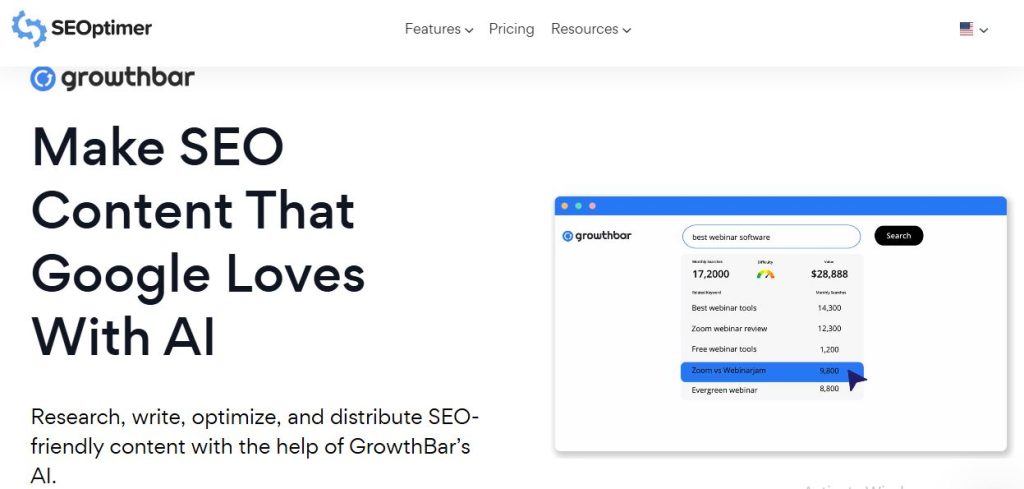
GrowthBar is an AI writing and SEO tool, now owned by SEOptimer, that builds outlines from the search results and turns them into blog drafts. It adds a 0 to 100 optimization meter, keyword research and basic rank tracking.
Core advantage: Not every blogger can justify an enterprise-level subscription. GrowthBar’s low entry price gives solo creators and small businesses a way to get SERP-based outlines and AI drafts without a big monthly commitment, which can make a regular publishing schedule far more realistic.
Key features:
- SERP-based AI outlines: Suggests headings, keywords and word counts from top Google results.
- AI blog writer: Includes a drag-and-drop blog builder that produces a draft in minutes.
- Content Optimization Meter: A 0 to 100 score for how well your post is optimized.
- Keyword research and competitor data: Included on all plans.
- Rank tracking: Tracks 25 keywords on Standard.
- Chrome extension and WordPress drafting: Work from inside your editor.
Pricing: Standard is $36 per month ($20.30 on yearly billing) for 25 AI articles. Pro is $74.25 ($55.30) and Agency is $149.25 ($90.30). There is a 7-day trial and no free plan.
Ideal for: Solo bloggers and small businesses on a budget.
Bottom line: An affordable way to get drafts, with less scoring depth than dedicated optimizers.
9. Rankability
Rankability is an AI SEO platform built with agencies in mind. Its Content Optimizer scores drafts using NLP and entity suggestions, and its AI search tracking shows whether platforms like ChatGPT mention your brand.
Core advantage: Clients now ask about AI citations as well as Google rankings. Rankability puts content optimization and AI search tracking in the same platform, with the client workspaces and branded reporting agencies need, so you can show both kinds of progress without piecing together separate tools.
Key features:
- Content Optimizer: NLP-based scoring with entity suggestions.
- Content briefs: AI-generated briefs from SERP research.
- AI writer and rewrites: Drafting tied to the optimizer.
- Keyword research and content monitoring: Finds topics and watches published pages.
- AI search tracking: Tracks citations across AI platforms such as ChatGPT, Claude and Gemini.
- Agency features: Unlimited client workspaces, branded reports, and API access are reported on paid plans.
Pricing: Starter at $99 per month up to several hundred dollars on higher, credit-based plans.
Ideal for: Agencies that report on both Google rankings and AI citations.
Bottom line: A good fit for agencies, though pricing is less clear than most.
10. NeuronWriter
NeuronWriter is a semantic SEO optimizer that uses NLP to show which terms and entities your content should cover. It pairs SERP research with a live content score and an AI writer, at a price few competitors match.
Core advantage: Good optimization should not require a big budget. NeuronWriter gives you the core of what pricier tools offer, including semantic analysis, competitor research and scoring, which makes it a practical choice for bloggers and small teams who want solid on-page optimization on a tight budget.
Key features:
- NLP semantic analysis: Surfaces the terms and entities your content should cover.
- SERP research: Competitor analysis for each keyword.
- Content score: A live score with term recommendations.
- AI writer: Drafting powered by monthly credits.
- Content Designer: One-click articles on higher plans.
- Plagiarism checker and integrations: WordPress and Search Console on higher plans.
Pricing: Plans run from Bronze at $23 per month ($19 yearly) through Silver ($45), Gold ($69) and Platinum ($93) to Diamond ($117). A 7-day trial is reported, and lifetime deals have been offered at times.
Ideal for: Budget-conscious SEOs and bloggers.
Bottom line: Strong value, though reviewers find the interface less polished and it has no rank tracking.
11. Dashword
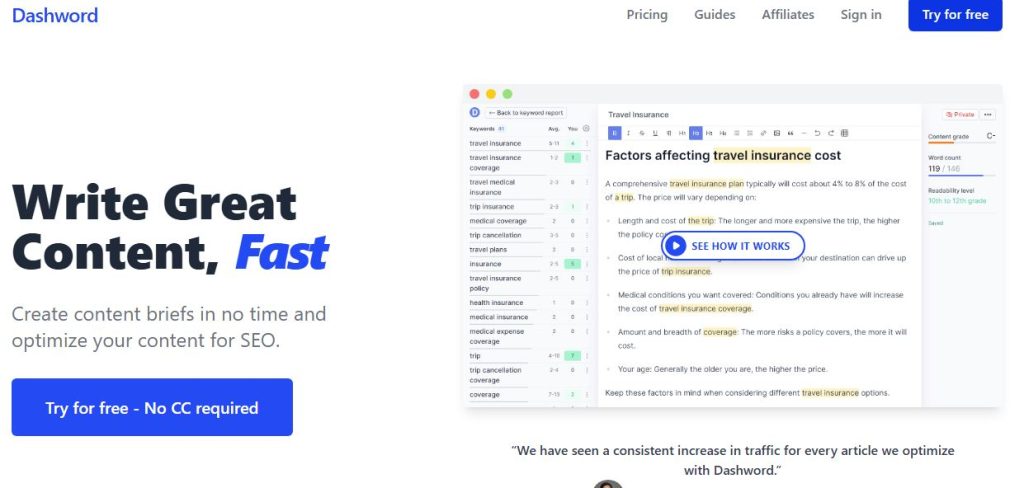
Dashword is built around content briefs and scoring. It compiles what the top-ranking pages cover into a brief your writers can follow, then scores their drafts in real time.
Core advantage: Briefs are where good content gets made or lost. Dashword turns competitor outlines, questions and planned links into a single handoff, so writers start with a clear plan, which can mean fewer revision rounds. Content monitoring then helps you spot published pages that begin to underperform.
Key features:
- Content brief builder: Compiles competitor outlines, questions and planned links into one brief.
- Live content score: Updates as you write, showing coverage gaps.
- Content monitoring: Flags underperforming published pages.
- Keyword research: Includes monthly search volume.
- AI Writer: 100,000 words on Startup.
- Google Docs integration: Write inside a familiar editor.
Pricing: Startup is $99 per month for 30 content reports and 5 seats, with the first report free. Business starts at $349 for 100 reports, 10 seats, bulk reports, API access and SSO. Annual billing saves about 20%. Some older listings show lower entry prices, so confirm on Dashword’s site.
Ideal for: Content teams and agencies whose writers draft by hand and want briefs and scoring.
Bottom line: Focused and easy to use, but pricier at entry than several rivals.
What Are Content Optimization Tools?
Content optimization tools are software platforms that show you how to make a page more complete, relevant and competitive for a search query. They analyze the pages already ranking for your keyword, identify the topics, terms, questions and structure those pages share, and compare your draft against that picture.
Most then give you an optimization score and a list of gaps to fix. Newer tools add briefs for writers, AI drafting, and tracking of whether AI engines like ChatGPT cite your brand. They do not replace editorial judgment or guarantee rankings, but they take the guesswork out of deciding what a page should cover.
How to Choose the Best SEO Content Optimization Tools
Start with the job you need done, then check price and team size.
- SERP analysis: Surfer SEO, Clearscope, Page Optimizer Pro and NeuronWriter go deepest on what ranks.
- Content briefs: Frase, Dashword, MarketMuse and Clearscope turn research into a plan for writers.
- Topic coverage: MarketMuse and Clearscope are strongest at showing gaps across a topic or a whole site.
- Optimization scores: Surfer, Clearscope, NeuronWriter and GrowthBar all grade drafts, with different levels of polish.
- AI content: Frase, Jasper, Scalenut and GrowthBar write full drafts. Jasper is best for marketing copy.
- AI search visibility: Frase, Clearscope, Surfer and Rankability track AI citations to varying degrees.
Then weigh these questions:
- Do you want a scorer or a workflow? Scorers are cheaper. Workflow tools save more steps.
- How many people will use it? Per-seat pricing adds up for teams, while Clearscope offers unlimited users.
- How much do you publish? Plans meter different things, including articles, words, reports and credits.
- Do you report on AI citations? If so, check engine coverage and prompt limits.
- What is your budget? Entry prices range from about $20 to $129 per month across this list.
If you want research, writing, scoring and monitoring in one place, Frase is worth testing. If you only need a lean scorer, one of the cheaper options may fit better. For more options, see our guides to Frase alternatives and the best AI SEO tools.
Conclusion
There is no single best content optimization tool, because the right one depends on how you work. Surfer and Clearscope are strong graders. NeuronWriter and GrowthBar keep costs down. MarketMuse suits large-site strategy. Jasper suits marketing teams. Rankability and Dashword serve agencies and brief-driven teams.
Frase stands out for covering the whole loop, from research and drafting to publishing and AI visibility tracking, and it offers a free trial so you can test it on a real article.
FAQs About SEO Content Optimization Tools
What is an SEO content optimization tool?
It is software that studies the pages ranking for a keyword and shows you what topics, terms and structure your own page should include. Most add a score that grades your draft against those pages.
Do content optimization scores guarantee higher rankings?
No. A score shows how well your content covers a topic compared with ranking pages. It is a useful guide, but rankings also depend on links, site authority, search intent and many other factors.
Which content optimization tool is best for beginners or small budgets?
NeuronWriter, GrowthBar and Scalenut are common starting points because of their lower prices and guided workflows. Frase offers a 7-day free trial with no credit card if you want to try a fuller workflow first.
Do these tools help with AI search visibility?
Some do. Frase, Clearscope, Surfer SEO and Rankability include AI visibility or citation tracking, with differences in which AI engines they cover and how many prompts you can track.
Can I publish AI-written drafts as they are?
It is safer not to. AI drafts are a starting point, and they still need editing, fact-checking and your own examples before publishing.
Do I need more than one content optimization tool?
Usually not. Most of these tools overlap on research and scoring, so most people choose one that matches their workflow. Agencies sometimes pair a scorer with a separate writing or marketing tool.
Related reading: Frase review | Frase vs Surfer SEO | Frase vs Clearscope | Frase vs Jasper | Frase alternatives | Best AI SEO tools