
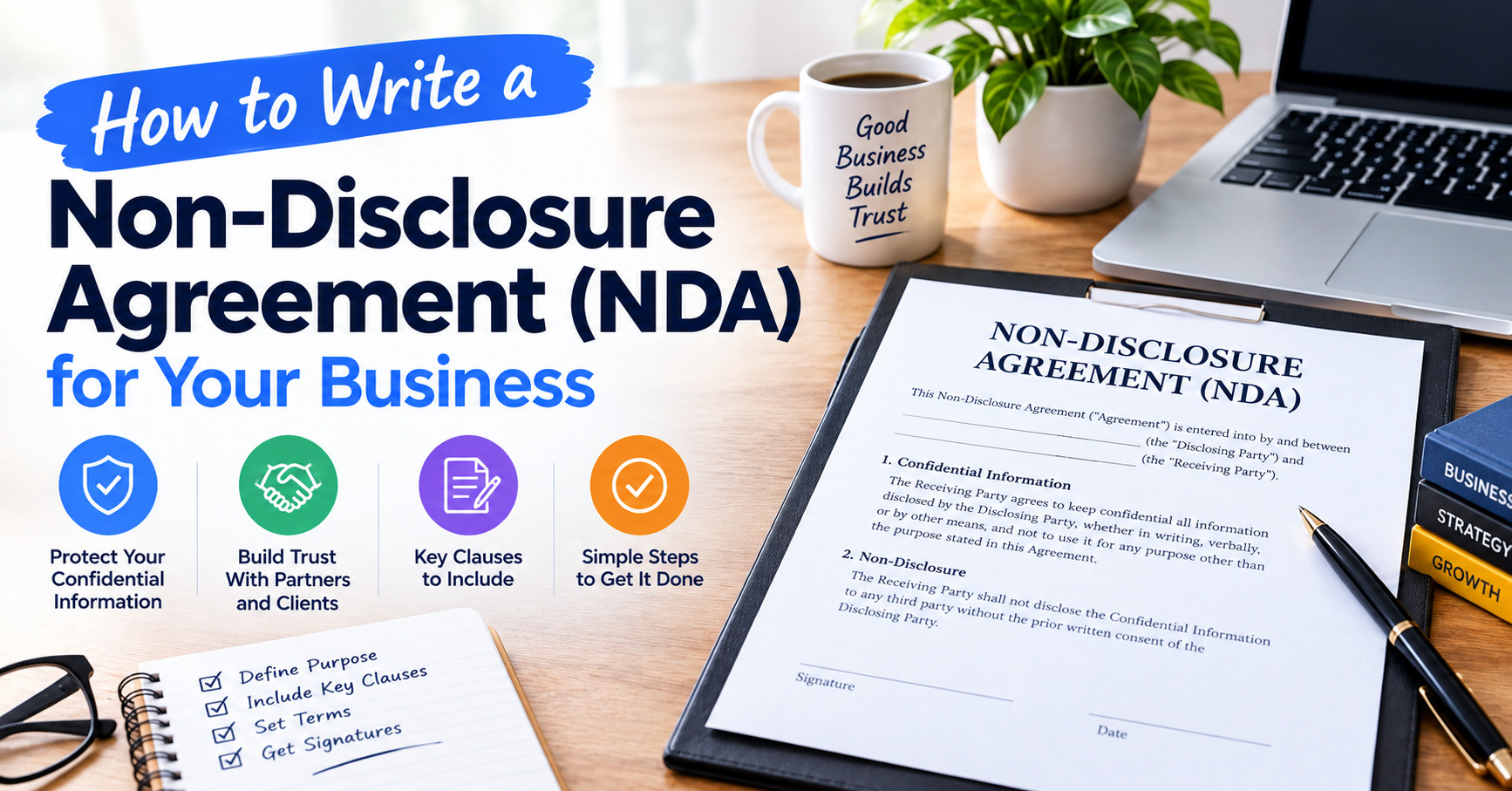
Imagine you’re about to bring on a freelance developer to build your app, or you’re meeting with a potential investor to pitch your business idea. Before you share your roadmap, client list, or the mechanics behind your product, you need to know how to write a Non-Disclosure Agreement (NDA) for your business that protects the information you’re about to share.
The good news? An NDA doesn’t have to be complicated or expensive. In this guide, you’ll learn exactly what an NDA is, when you need one, which clauses to include, and how to create an agreement that clearly protects your confidential information.
What Is an NDA, Exactly?
A Non-Disclosure Agreement (NDA) is a legal contract that restricts one or more parties from sharing confidential information with anyone outside the agreement. It creates a legally binding obligation to keep specific information private — whether that’s a business plan, source code, client data, or financial details.
There are two main types:
- Unilateral NDA — only one party is sharing confidential information (e.g., you’re briefing a contractor on your product).
- Mutual NDA — both parties are exchanging confidential information (e.g., two companies discussing a potential merger or partnership).
Knowing which type you need is the first step to drafting the right agreement.
When You Actually Need One
Not every conversation requires an NDA, but here are the situations where one is smart:
- Hiring freelancers or contractors who’ll have access to your systems, code, or strategy
- Pitching investors or partners on a business idea before it’s public
- Sharing product roadmaps, source code, or prototypes with outside collaborators
- Onboarding new employees who’ll handle trade secrets or client data
- Negotiating a potential acquisition or partnership
On the flip side, don’t overuse NDAs. Slapping one on every casual conversation can come across as distrustful and slow down deals that don’t actually involve sensitive information. Use them when there’s something real to protect.
Related Posts:
The Core Components of an Enforceable NDA
A vague or poorly worded NDA can be difficult to enforce if things go wrong. Here’s what a solid NDA needs to include:
Parties involved. Clearly name the disclosing party (the one sharing information) and the receiving party (the one obligated to keep it confidential). For a mutual NDA, both parties fill both roles.
Definition of “confidential information.” This is the heart of the document. Be specific — list categories like financial records, customer lists, source code, business strategies, or product designs. Vague definitions (“all information shared”) are harder to enforce.
Exclusions from confidentiality. Spell out what’s not covered — information already public, information the receiving party already knew, or information independently developed without reference to the disclosed material.
Obligations of the receiving party. What exactly must they do (or not do)? Typically: not disclose the information to third parties, not use it for personal gain, and take reasonable steps to protect it.
Time period. How long does the confidentiality obligation last? Common terms range from 1–5 years, though some information (like trade secrets) may need indefinite protection.
Governing law and jurisdiction. Specify which state’s laws govern the agreement and where disputes would be resolved. This matters if parties are in different states.
Remedies for breach. What happens if someone violates the agreement? Most NDAs specify injunctive relief (a court order to stop the disclosure) alongside monetary damages.
Signatures and date. Both parties need to sign and date the agreement for it to be enforceable.
Common Mistakes People Make
Even well-intentioned business owners get NDAs wrong. Watch out for these pitfalls:
- Making the scope too broad. An NDA that tries to cover “any and all information” can be thrown out as unenforceable.
- Making it too narrow. If your definition of confidential information is too specific, you leave gaps that aren’t actually protected.
- No clear time limit. Courts are wary of indefinite restrictions unless the information genuinely warrants it (like a secret formula).
- Skipping jurisdiction details. Without a specified governing state, enforcement gets murky, especially with remote teams or out-of-state contractors.
- Using a random template from a Google search. Generic templates found online are often outdated, missing key clauses, or not compliant with your state’s laws — which brings us to the real question:
DIY vs. Template vs. Lawyer: What’s the Right Choice?
You’ve got three real options when it comes to getting an NDA in place:
Drafting one from scratch. Technically free, but risky. It’s easy to miss a clause, use unenforceable language, or leave out state-specific requirements — especially if you’re not familiar with contract law.
Hiring a lawyer. The gold standard for complex situations (large deals, high-stakes trade secrets), but a simple NDA drafted by an attorney can still run you $200–$500 or more, plus turnaround time.
Using a vetted legal template service. This is the middle ground most small business owners and freelancers land on — attorney-drafted templates that are customizable and built to comply with your state’s requirements, at a fraction of the cost and time.
This is exactly where a service like US Legal Forms comes in. It gives you access to attorney-drafted NDA templates (both unilateral and mutual) that you can customize to your specific business situation in minutes, without paying hundreds of dollars for a one-off contract.
Step-by-Step: Creating Your NDA with US Legal Forms
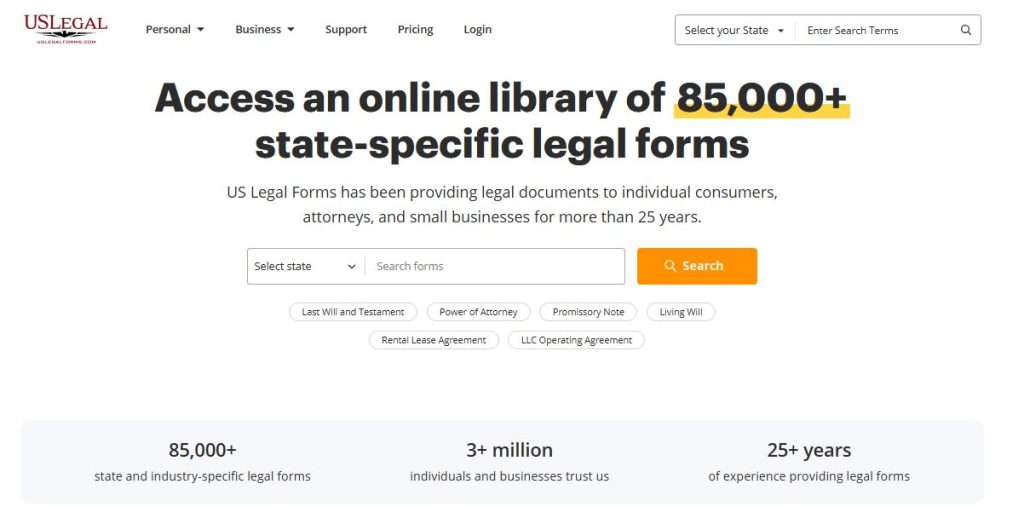
Here’s how simple the process is:
1. Search and select your template. Choose between a unilateral or mutual NDA, depending on whether one or both parties are sharing confidential information.
2. Customize the details. Fill in the party names, effective date, and your state’s jurisdiction so the agreement is compliant with local law.
3. Define your confidential information. Tailor the confidentiality clause to your specific business — your product, client data, financials, or whatever applies.
4. Download and sign. Export your finished NDA and get it signed (many workflows pair this with an e-signature tool for a fully digital process).
→ [Get your NDA template through US Legal Forms here]
Final Thoughts
An NDA is one of the cheapest forms of insurance you can put in place for your business. Whether you’re bringing on a new contractor, pitching an investor, or discussing a partnership, a few minutes spent getting the right protections in writing can save you a massive headache down the line.
If you’re ready to put one in place today, US Legal Forms gives you attorney-drafted, state-compliant templates you can customize in minutes — no lawyer’s fee required.
Found this helpful? Share it with a co-founder or contractor who needs to get their NDA sorted.
FAQ
Is a verbal NDA enforceable?
Generally, no — or at least it’s extremely hard to prove and enforce. Always get confidentiality agreements in writing.
How long should an NDA last?
It depends on the sensitivity of the information. Most business NDAs run 1–5 years; trade secrets may warrant indefinite protection.
Can I use the same NDA for every contractor?
You can use the same template, but you should customize the confidential information section for each situation to keep it enforceable.
Do NDAs hold up in court?
Yes, when they’re properly drafted with clear terms, reasonable scope, and proper signatures. Vague or overly broad NDAs are the ones that get challenged.
Is an NDA the same as a non-compete?
No. An NDA restricts sharing of confidential information. A non-compete restricts someone from working for a competitor or starting a competing business. They’re often used together but serve different purposes.