
Frase vs Dashword is a comparison worth exploring if you want to create SEO content that competes with top-ranking pages. Both tools help you research a keyword, analyze search results, build a content brief, and score your draft against competing content. On the surface, they look similar, which is why many content creators compare them.
The difference is how much of the job each one covers. Dashword is deliberately narrow. It is built around content briefs, a live content score, and monitoring for published pages, and it works inside Google Docs. Frase is broader. Its product pages describe a workflow that runs from research and writing through optimization, publishing, and monitoring, with AI visibility tracking built in.
This comparison covers research, content briefs, optimization, AI writing, AI visibility, monitoring, publishing, pricing, and workflow, so you can see which tool best matches the way you work.
Frase vs Dashword: Quick Comparison
| Frase | Dashword | |
|---|---|---|
| Core idea | One loop: research, write, optimize, publish, monitor, fix | Briefs and scoring for writers, plus page monitoring |
| Research and briefs | SERP research that ends in a brief, topic clusters | Brief builder that compiles competitor outlines, questions and keyword data |
| Optimization | Live SEO and GEO score in the editor | Live content score showing coverage gaps |
| AI writing | AI agent in your brand voice, 70+ languages | AI Writer with a word allowance, described as lighter |
| AI visibility | On every plan, engines grow by plan | None reported in a June 2026 review |
| Monitoring | Site audit plus Content Guard drafts fixes | Content monitoring tracks pages and flags drops |
| Publishing | WordPress, Webflow, Sanity, Wix, FraseCMS | Google Docs add-on, with limited publishing reported |
| Entry price (monthly billing) | $49 | $99 |
| Free option | 7-day trial, no credit card | First report free |
The short version: Dashword is a focused brief-and-score tool for writers. Frase is a workflow for teams that want research through monitoring in one place.
What Is Frase?
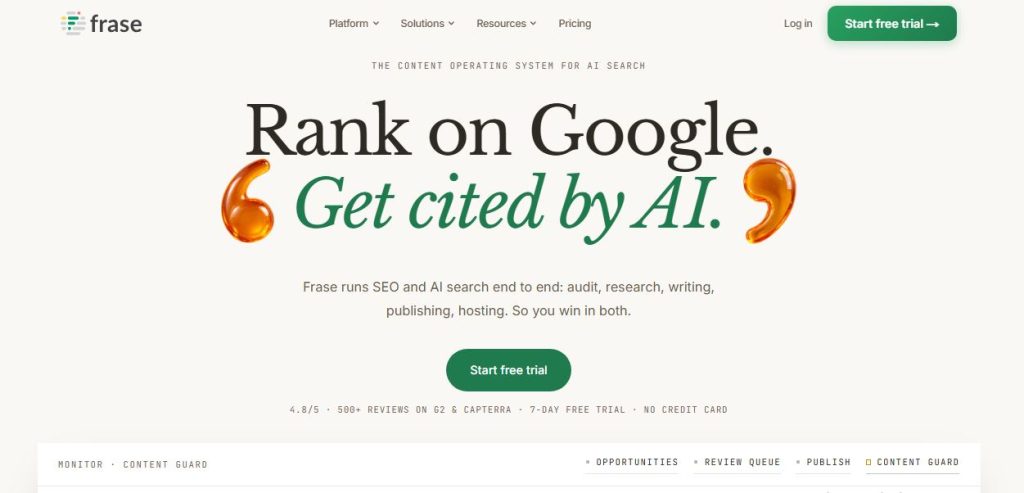
Frase is an AI content platform built around SEO and GEO, which means optimizing for Google and for the AI engines that cite sources. It treats content as a loop: capture what your audience asks, research and draft, publish, track how pages perform in Google and AI search, and fix the ones that slip.
For the full picture, read our Frase review and the Frase pricing breakdown.
Frase Key Features
These are the eight features that define Frase today:
- SEO research that ends in a brief: Frase studies the pages ranking for your keyword and turns their topics, questions and headings into a brief, with topic clusters to plan related content.
- AI agent with brand voice: It drafts in your brand voice, writes natively in more than 70 languages, and can publish on its own for the content types you choose.
- Live SEO and GEO scoring: The editor scores your draft for Google and for AI search as you write, with suggestions you choose to apply.
- AI Visibility tracking: Frase monitors where AI engines cite your brand, starting with ChatGPT and Google AI and adding Perplexity, Claude and Gemini on higher plans.
- Site audits: It crawls your site and scores each page for SEO, GEO and AI readiness, ranked by impact.
- Content Guard: It watches published pages for ranking or traffic decay, drafts a fix, and republishes only after you approve.
- Frase Answers: A free widget answers visitors from your own content and records the questions they ask, so you know what to write next.
- Publishing and integrations: Frase publishes to WordPress, Webflow, Sanity and Wix, or hosts content on FraseCMS, and offers an MCP server and CLI for use inside other AI tools.
What Is Dashword?
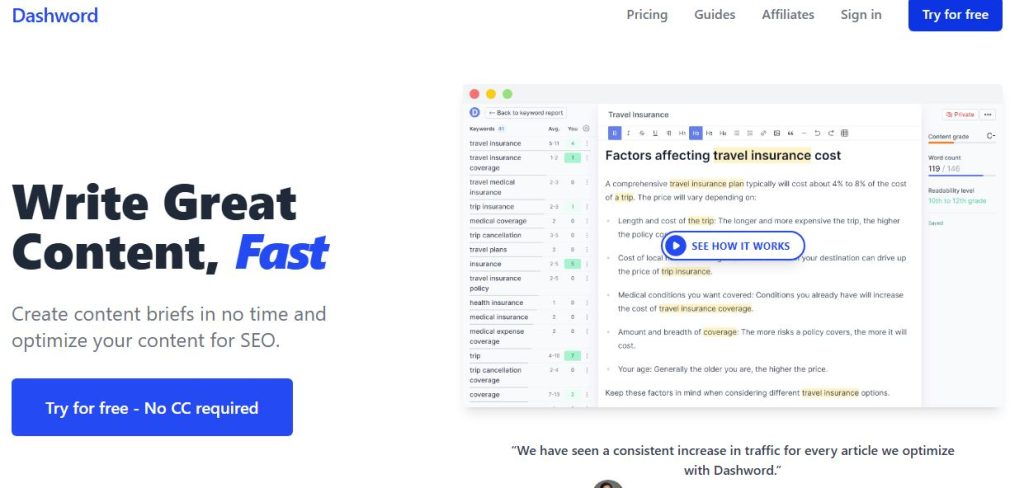
Dashword is an SEO content optimization platform for writers and content teams. It turns the patterns on page one of Google into a practical writing workflow: a brief that tells a writer what to cover, a live score that shows how well a draft covers it, and monitoring that watches the page after it is published. Reviewers often praise its clean interface and its Google Docs add-on, which lets teams keep writing in the tool they already use.
Dashword Key Features
These are the seven features that define Dashword today:
- Content brief builder: Compiles competitor outlines, questions and keyword data into one brief a team can follow.
- Live content score: Updates as you write and maps to specific keyword and topic coverage gaps.
- Content monitoring: Tracks published pages, alerts you to traffic drops and provides updated keyword reports.
- Keyword research: Includes search volume data for choosing what to cover.
- AI Writer: Startup includes an allowance of 100,000 words, though reviewers describe the AI features as lighter than a full article writer.
- Google Docs add-on: Write and score inside a familiar editor, with Word export also reported.
- Team and API features: Startup includes 5 seats. Business adds 10 seats, bulk report creation, API access and SSO.
Frase vs Dashword: Feature Comparison
This table sets the two tools side by side. Dashword details come from third-party reviews, so confirm current features on Dashword’s site.
| Feature | Frase | Dashword |
|---|---|---|
| Keyword and SERP research | Yes | Yes, through its brief builder |
| Content briefs | Detailed briefs with topic clusters | Core strength, compiled from competitor pages |
| Live optimization score | SEO and GEO score | Content score |
| Scoring for AI search | Yes | Not reported |
| AI writing | AI agent with brand voice, 70+ languages | AI Writer with 100,000 words on Startup, described as lighter |
| AI citation tracking | Every plan | Not reported |
| Site-wide audit | Yes, with cannibalization detection | Not reported |
| Page monitoring | Content Guard, with drafted fixes | Content monitoring with alerts and keyword reports |
| Visitor question capture | Frase Answers | Not listed |
| Publishing to a CMS | WordPress, Webflow, Sanity, Wix, FraseCMS | Google Docs add-on, WordPress and Zapier listed by one source |
| API access | MCP server, CLI and API | Business plan |
| Seats | 1, 3 or 5 by plan | 5 on Startup, 10 on Business |
Frase vs Dashword: Research
Frase begins from a keyword. It studies what already ranks, pulls out the topics, questions and headings competitors cover, and offers topic clusters to plan related content. Frase Answers adds questions from your own visitors.
Dashword also starts from a keyword. It researches the pages ranking for it and gathers outlines, questions and keyword data, including search volume, into a single document.
The workflow difference: Both answer what should this page cover. Frase adds a first-party source of ideas through Frase Answers. Dashword keeps research tightly focused on producing a brief.
Frase vs Dashword: Content Briefs
This is where the two are most alike, and Dashword is at its best.
Dashword’s brief builder is its core feature. It pulls competitor outlines and FAQs into one document quickly, which reviewers credit with cutting research time and giving distributed teams a single plan to follow.
Frase also turns research into a brief, with topic clusters, and can hand that brief straight to its AI agent.
The workflow difference: If your writers work from briefs and nothing else, either tool delivers. Frase’s brief can flow directly into a draft. Dashword’s brief is built to hand to a human writer.
Frase vs Dashword: Content Optimization
Dashword’s content score updates in real time and ties to specific coverage gaps, which reviewers describe as clear and easy to act on.
Frase also scores as you write, but its score covers both SEO and GEO, meaning optimization for AI search as well as Google. Suggestions are optional, and nothing changes without your approval.
The workflow difference: Both give you a live score to work toward. Frase’s score also considers AI search. Dashword’s is simpler and focused on coverage.
Frase vs Dashword: AI Writing
Frase’s agent drafts in your brand voice, can write natively in more than 70 languages, and can publish on its own for chosen content types once you trust it.
Dashword’s AI Writer is included with an allowance, but reviewers describe its AI features as covering things like meta descriptions, intros and rephrasing rather than a full article draft. Dashword’s own pitch is helping writers, not replacing them.
The workflow difference: If you want the tool to produce first drafts, Frase does more. If your writers draft by hand and want guidance, Dashword’s lighter approach is enough. With either tool, plan to edit.
Frase vs Dashword: AI Visibility
Frase includes AI Visibility on every plan. Starter tracks ChatGPT and Google AI, Professional adds Perplexity plus AI crawler monitoring, and Scale adds Claude and Gemini. It also scores content for GEO as you write.
Dashword does not appear to include AI visibility tracking or GEO features. A June 2026 review lists this as a gap as buyers shift attention to ChatGPT and Perplexity.
The workflow difference: If you report on whether AI tools cite your brand, this is the clearest gap between the two. If you only care about Google rankings, it matters less.
Frase vs Dashword: Monitoring and Content Audits
Dashword does monitor published pages. It tracks them, alerts you to traffic drops and provides updated keyword reports so you can spot pages that need work.
Frase goes a step further. Site audits score every page for SEO, GEO and AI readiness, and Content Guard watches for ranking or traffic decay, drafts a revision, and republishes only after you approve.
The workflow difference: Dashword tells you which pages need attention. Frase also drafts the fix. For a big library of aging posts, that saves time.
Frase vs Dashword: Publishing
Frase publishes to WordPress, Webflow, Sanity and Wix in a click, or hosts content on FraseCMS. It also offers an MCP server, CLI and API.
Dashword centers on its Google Docs add-on, with Word export. One source lists WordPress and Zapier integrations, while a June 2026 review describes no publishing workflow.
The workflow difference: Dashword is built for the writing stage. Frase carries content through to your CMS.
Frase vs Dashword Pricing Comparison
The two tools price differently, so compare what each plan measures as well as its price.
| Frase | Dashword | |
|---|---|---|
| Entry plan | Starter, $49 monthly ($39 yearly) | Startup, $99 monthly |
| Middle plan | Professional, $129 monthly ($103 yearly) | None |
| Higher plan | Scale, $299 monthly ($239 yearly) | Business, from $349 monthly |
| Annual billing | 20% off | About 20% off |
| Free option | 7-day trial, no credit card | First report free, no permanent free plan |
Here is what the plans measure:
| Frase Starter | Frase Professional | Frase Scale | Dashword Startup | Dashword Business | |
|---|---|---|---|---|---|
| Main unit | 10 articles | 40 articles | 100 articles | 30 content reports | 100 content reports |
| Seats | 1 | 3 | 5 | 5 | 10 |
| Monthly price | $49 | $129 | $299 | $99 | From $349 |
A few points stand out. A Dashword content report is a brief and score for one page, while a Frase article covers research, drafting and scoring, so the units are not the same. Dashword works out to roughly $3.30 per report on Startup, close to Frase Professional at about $3.23 per article, though Frase’s price also covers drafting, AI visibility and Content Guard. Both figures are our own arithmetic.
Reviewers also point out that Dashword’s jump from $99 to $349 leaves no middle tier, and that 30 reports a month can run out quickly for teams producing briefs, rewrites and refreshes. Frase’s Starter plan is cheaper to enter and has a Professional step in between. For more on Frase’s plans, see our Frase pricing guide.
Workflow: Brief-and-Score vs Full Loop
The clearest way to see the difference is to follow one article through each tool.
One article with Frase:
- Pick a keyword, or take a question captured by Frase Answers.
- Frase studies the top-ranking pages and builds a brief.
- The agent drafts in your brand voice.
- You edit with the live SEO and GEO score.
- You publish to your CMS.
- Frase tracks rankings and AI citations, and Content Guard drafts a fix if the page slips.
One article with Dashword:
- Enter a keyword and generate a content report.
- Review the brief of competitor outlines, questions and keyword data.
- A writer drafts in Google Docs, with the live content score open beside it.
- Edit until the score covers the gaps.
- Publish through your own process.
- Use monitoring to spot pages that start to lose traffic.
Notice where each workflow puts the effort. Dashword sharpens the brief and the scoring, then leaves drafting and publishing to you. Frase tries to cover the whole path. Teams with strong writers and an established publishing process often like a focused tool. Teams that want fewer tools and more done for them often prefer the full loop.
Explore Frase’s current features and free trial →
Frase Strengths
- Research, briefs, drafting, scoring, publishing and monitoring in one platform
- SEO and GEO scoring in the editor
- AI Visibility on every plan, with more engines on higher plans
- Content Guard drafts fixes for decaying pages
- Frase Answers turns visitor questions into content ideas
- Lower entry price and a middle plan
- 7-day trial with no credit card
Dashword Strengths
- A clean, quick brief builder that writers find easy to use
- A clear live content score tied to coverage gaps
- Google Docs add-on for teams that prefer to write there
- Content monitoring with alerts and keyword reports
- Five seats included on the entry plan
- First report free, so you can try it on real content
Alternatives to Frase and Dashword
If neither tool fits, two other options cover what these two do not. For a wider list, see our guide to Frase alternatives and the best AI SEO tools.
KoalaWriter: The Cheap Alternative
If price is the main obstacle, KoalaWriter is the budget route. Plans start at $25 per month for 45,000 words, against $99 for Dashword Startup and $49 for Frase Starter on monthly billing, and every new account gets 5,000 free words with no credit card. It turns a keyword into a full article using live search data, applies SEO optimization automatically, and offers a bulk mode.
The trade-offs are real. Koala is centered on producing articles, so it lacks deep scoring, and in the material we reviewed we did not find an AI citation tracker like Frase’s. It suits affiliate and niche site owners who want drafts at volume on a small budget. See our Frase vs KoalaWriter comparison.
Jasper: Best for Marketing Workflows
If your work goes beyond SEO articles, Jasper is the stronger fit. It is built for marketing teams that need on-brand content across blogs, ads, email and social, with Brand Voices, Knowledge assets, Audiences and marketing agents. Pro costs $59 per seat per month on yearly billing, or $69 monthly, and Business is custom.
The trade-off is that Jasper is not centered on SERP research or ranking. Reviewers report that its deeper SEO scoring relies on a Surfer SEO integration. It suits teams where brand consistency across channels matters more than search depth. See our Frase vs Jasper comparison.
Try Jasper’s 7-day free trial →
Which Tool Fits Different Use Cases?
- A solo blogger or affiliate marketer: Frase. The lower entry price, built-in drafting and monitoring match a one-person workflow.
- A team of writers who want briefs and a score in Google Docs: Dashword, for its focused workflow.
- An agency producing briefs for freelancers: Dashword, if 30 reports a month is enough. Otherwise compare Frase’s higher plans.
- A team that reports on AI citations: Frase, since Dashword does not appear to include AI visibility tracking.
- A blog with a large library of aging posts: Frase, for Content Guard. Dashword’s monitoring suits flagging pages by hand.
- A publisher that wants drafts and publishing included: Frase.
- A budget-conscious publisher who mainly needs drafts: KoalaWriter.
- A marketing team producing more than SEO articles: Jasper.
For head-to-head comparisons with other tools, see Frase vs Surfer SEO, Frase vs Clearscope and Frase vs Scalenut.
Conclusion
Frase and Dashword both turn search results into a plan for your content, but they stop at different points. Dashword sharpens the brief and the score, and leaves the drafting and publishing to you. Frase aims to cover the whole path, from research through monitoring, with AI visibility tracking included, at a lower entry price.
Test both on a real article. Dashword’s first report is free, and Frase offers a 7-day trial.
FAQs About Frase vs Dashword
Is Frase better than Dashword?
Neither is better for everyone. Dashword is a focused brief-and-score tool that writers find easy to use. Frase covers more of the workflow, including drafting, AI visibility, publishing and monitoring. Choose by workflow.
Which is cheaper, Frase or Dashword?
Frase is cheaper to start, at $49 monthly ($39 yearly) against $99 monthly for Dashword. The plans measure different things, so compare what you need each month.
Does Dashword have a free plan or trial?
Dashword has no permanent free plan, but the first content report is free. Some sources also mention a 7-day trial, so confirm on its site. Frase offers a 7-day trial with no credit card.
Does Dashword track AI visibility?
A June 2026 review reports no AI search visibility tracking or GEO features. Frase includes AI Visibility on every plan.
Can Dashword write full articles?
It includes an AI Writer with an allowance, but reviewers describe it as lighter, covering things like intros, meta descriptions and rephrasing. Frase’s agent drafts full articles in your brand voice.
Does Frase have content briefs like Dashword?
Yes. Frase turns its SERP research into a brief with topics, questions and headings, and can hand it to its AI agent for drafting.
Can I use Frase and Dashword together?
You can, but they overlap on briefs and scoring, so most people choose one.
What is a good Dashword alternative?
Frase is a good option if you want briefs, drafting, AI visibility and monitoring together. KoalaWriter is a cheaper option for drafts, and Jasper suits marketing workflows.
Related reading: Frase review | Frase pricing | Frase vs Surfer SEO | Frase vs Clearscope | Frase vs Scalenut | Frase vs KoalaWriter | Frase vs Jasper | Frase alternatives | Best AI SEO tools