
The ThriveCart vs Lemon Squeezy decision comes down to one trade: do you want to keep more of every sale, or have someone else handle your sales tax?
Lemon Squeezy is a merchant of record, which means it acts as the legal seller of your products and handles global sales tax and VAT for you, in exchange for 5% + 50¢ per sale. ThriveCart is a checkout and revenue platform where you stay the seller, pay 0% in platform transaction fees, and get a full funnel toolkit with order bumps, upsells, courses, and affiliates. Neither is better for everyone, so the right choice depends on your sales volume, your products, and how much of the tax side you want to own.
This guide compares both platforms on fees, tax compliance, checkout, subscriptions, and affiliate management, with real fee math so you can see where each one costs less.
ThriveCart vs Lemon Squeezy Feature Comparison
| Feature Category | ThriveCart | Lemon Squeezy |
|---|---|---|
| Primary Focus | Checkout, Funnel & Revenue Platform | Merchant of Record for Digital Products & SaaS |
| Seller of Record | You | Lemon Squeezy |
| Platform Fee | 0% (plus your gateway’s fee) | 5% + 50¢ per transaction |
| Monthly Fee | $47/mo ($37/mo annual) or $495 lifetime | $0 |
| Sales Tax Filing and Remittance | Optional integrated remittance tools; you remain seller of record | Lemon Squeezy handles it |
| Order Bumps & One-Click Upsells | Yes | Yes |
| Course & Community Hosting | Yes (ThriveCart Academy) | No, file delivery or external LMS integration |
| Affiliate Management | Affiliate Center (Pro+ plan, $87/mo) | Built-in Affiliate Platform |
| Subscriptions | Yes, with retention tools | Yes (+0.5% fee), with built-in recovery and dunning |
| Free Trial | 30 days | No monthly fee to trial |
What Is ThriveCart? (Checkout Platform Overview)
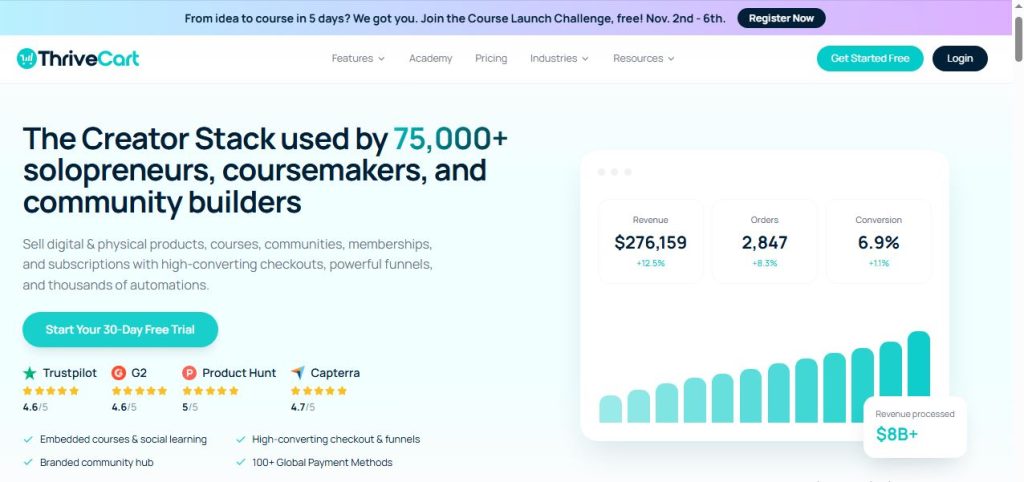
ThriveCart is a fully hosted checkout platform built to help online entrepreneurs sell courses, coaching, SaaS, and digital products through high-converting checkout pages, order bumps, and upsell funnels, without needing separate hosting or plugins.
Money from your sales flows directly into your own connected payment gateway, such as Stripe or PayPal. ThriveCart never touches or holds your revenue, which is why it can charge 0% in platform transaction fees at every plan tier. That also makes you the legal seller of record, with the tax responsibilities that come with it, covered in the tax section below.
Beyond checkout, ThriveCart has grown into a broader revenue platform with subscription management, affiliate tools, revenue reporting, and course and community hosting through ThriveCart Academy.
Key Features of ThriveCart
- Checkout engine: Embedded or hosted checkout in modal, single-page, or multi-step layouts.
- Order bumps and one-click upsells and downsells: Increase average order value directly in the cart flow.
- Payment plans and subscriptions: Installment billing, recurring payments, and subscription retention tools.
- ThriveCart Academy: Course and community hosting bundled into every plan.
- Built-in affiliate center: Recruit and manage affiliates and joint venture partners from the Pro+ plan.
- Tax calculation, collection, and remittance tools: Automatic sales tax, VAT, and GST at checkout, tax reports and invoices, and optional integrated remittance features launched in fall 2026.
- Multi-currency checkout: Sell in local currencies with market-specific pricing.
- 0% platform transaction fees: No added fee from ThriveCart on top of your payment gateway, at every plan tier.
Get started with ThriveCart’s 30-day free trial →
What Is Lemon Squeezy? (Merchant of Record Platform Overview)

Lemon Squeezy is a payment and checkout platform for digital products, software, and subscriptions that acts as your merchant of record. Instead of you selling directly to customers, Lemon Squeezy becomes the legal seller of each transaction, which is how it can calculate, collect, and file sales tax and VAT on your behalf.
There’s no monthly fee and no setup cost. You pay 5% + 50¢ on every successful transaction, with small stackable surcharges for international cards, PayPal, and subscription payments. Stripe acquired Lemon Squeezy in 2024, and it remains popular with indie software sellers, SaaS founders, and creators who sell to a global audience and don’t want to register for tax in multiple countries.
Key Features of Lemon Squeezy
- Merchant of record: Lemon Squeezy is the legal seller and handles global sales tax and VAT.
- Hosted checkout: Built-in checkout for digital products, software, and subscriptions.
- Order bumps and one-click upsells: Raise average order value with no extra add-on fees.
- Subscriptions and license keys: Sell recurring plans and software licenses.
- Subscription recovery and dunning: Built-in automated billing recovery to protect against involuntary churn.
- Built-in Affiliate Platform: Recruit partners with flexible commission controls.
- Zero monthly fee: No platform subscription, you only pay per transaction.
- Store approval process: Stores are reviewed and approved before they go live.
ThriveCart vs Lemon Squeezy: Core Difference (Seller of Record vs. Merchant of Record)
Here’s the difference in plain language. With ThriveCart, you are the seller. Customers pay you through your own Stripe or PayPal account, you keep the revenue, and you carry the responsibility for your own sales tax compliance. With Lemon Squeezy, Lemon Squeezy is the seller. It collects the money, handles the tax, and pays you what’s left after its fee.
That single difference explains almost everything else about the two platforms: why Lemon Squeezy charges more per sale, why ThriveCart can charge nothing per sale, and why they appeal to different sellers. If you want to keep more of each sale and run funnels, ThriveCart is the more direct fit. If you want tax compliance handled for you as you sell globally, Lemon Squeezy is built for that.
Fees and Real Cost Compared
ThriveCart’s platform fee is 0%. You pay a flat license price, $47/month ($37/month billed annually), or a one-time $495 lifetime license on the Standard plan, plus your payment gateway’s standard rate. With Stripe, that’s 2.9% + 30¢ per domestic card transaction.
Lemon Squeezy’s platform fee is 5% + 50¢ per transaction, with no monthly fee. It also applies stackable surcharges:
- International cards: +1.5% for customers outside the US
- PayPal payments: +1.5%
- Subscription payments: +0.5%
- Payout fees: US bank payouts are free through Stripe or $0.50 flat through PayPal. International bank payouts cost 1% per payout through Stripe, or 3% (capped at $30) through PayPal.
What does a $100 sale cost?
On a $100 domestic card sale:
- Lemon Squeezy: 5% + 50¢ = $5.50, before any surcharges
- ThriveCart with Stripe: 2.9% + 30¢ = $3.20 in processing fees, plus your ThriveCart license cost
Add an international customer to the Lemon Squeezy sale and the fee rises to $7.00.
Where does ThriveCart become cheaper?
Using ThriveCart Standard on annual billing ($444/year) and Stripe’s standard rate, with $100 sales:
- At about 190 sales per year, the two cost about the same. That’s roughly 16 sales per month, or about $19,000 in annual revenue.
- At 100 sales a year ($10,000): Lemon Squeezy costs about $550, while ThriveCart plus Stripe costs about $764.
- At 1,000 sales a year ($100,000): Lemon Squeezy costs about $5,500, while ThriveCart plus Stripe costs about $3,644, a gap of roughly $1,856 a year.
This is an illustration, not a quote. It leaves out Lemon Squeezy’s surcharges, which would widen the gap for international and PayPal buyers, and it leaves out what you’d spend on tax filing and remittance with ThriveCart, which narrows it. For sellers with low volume, Lemon Squeezy’s pay-as-you-go model can be cheaper. As volume grows, ThriveCart’s flat pricing pulls ahead.
See current ThriveCart plans and start your free trial →
ThriveCart vs Lemon Squeezy: Tax Compliance and Global Selling Compared
This is the strongest argument for Lemon Squeezy, and it’s worth understanding clearly before you choose.
Lemon Squeezy: tax handled for you
As the merchant of record, Lemon Squeezy calculates, collects, files, and carries the liability for global sales tax and VAT. You don’t register for tax IDs in other countries or file returns in each region. That’s a major time and compliance saver if you sell internationally.
ThriveCart: calculated, collected, and now with remittance tools
Because ThriveCart is a software layer, not a merchant of record, you are the legal seller. Here’s what that means in practice:
- Your money stays with you. Revenue goes straight into your own payment gateway. ThriveCart never holds it.
- The legal liability is yours. You’re responsible for registering for tax IDs, filing returns, and paying collected taxes to the right governments, such as US states or EU VAT authorities.
- ThriveCart does the checkout work. On both Standard and Pro+, it automatically calculates the correct sales tax, VAT, or GST by buyer location, adds it to the invoice, and collects it. It also provides tax reports and formatted invoices, including UBL XML files for EU e-invoicing, to hand to your accountant or tax software.
- Remittance tools have launched. In fall 2026, ThriveCart launched integrated tax remittance features, available as an optional integration. ThriveCart is still not a merchant of record, though, so you remain the legal seller of record. If you manage taxes yourself through ThriveCart, you are ultimately responsible for meeting your filing requirements.
The bottom line: ThriveCart now covers calculating and collecting taxes, with optional remittance tools, but you remain the seller of record. Lemon Squeezy takes on the legal seller role and the filing liability entirely. If you’d rather not deal with tax registration at all, that’s what the extra fee on Lemon Squeezy buys.
ThriveCart vs Lemon Squeezy: Checkout, Order Bumps, and Upsells Compared
Both platforms include the conversion tools that raise average order value.
ThriveCart is cart-first. Its checkout is a dedicated, conversion-focused engine with order bumps, one-click upsells and downsells, A/B testing, and payment plans, and it can run as a hosted page, an embed, or a modal.
Lemon Squeezy builds these features into its checkout too:
- Order bumps: Add an optional add-on, such as a workbook, priority support, or a mini-course, that customers add with a single checkbox before paying.
- One-click upsells: Present a targeted offer right after a successful purchase, and the buyer accepts with one click without re-entering card details.
- No extra fees: There are no separate monthly costs for bumps or upsells, and those transactions are processed at your standard rate, plus any surcharges.
On features alone, the two are close. ThriveCart goes further with multiple order bumps on Pro+, A/B testing, cart abandonment recovery, and a wider funnel toolkit.
Subscriptions and Recurring Revenue Compared
ThriveCart offers subscription management with retention tools, including retention offers that present a downgrade, pause, or discount before a cancellation, anchored billing dates, and subscription bumps at checkout.
Lemon Squeezy supports subscriptions and software license keys, which is a core use case for SaaS and software sellers. It also includes a built-in automated billing recovery engine that protects against involuntary churn from failed payments. Those dunning tools are covered by your standard transaction fee, with no extra monthly charge. Every subscription payment does carry an extra 0.5% on top of the base fee, so recurring revenue costs more on Lemon Squeezy over time.
ThriveCart vs Lemon Squeezy: Affiliate Management Compared
Both platforms have built-in affiliate management, so neither requires third-party tracking software.
ThriveCart’s Affiliate Center is included from the Pro+ plan ($87/month). It offers granular commission controls, automated PayPal payouts with configurable delay rules, a choice between first-cookie and last-cookie attribution, second-tier affiliate networks with override commissions, and in-dashboard asset hosting.
Lemon Squeezy’s Affiliate Platform lets you recruit partners to sell your digital products or SaaS:
- Commission control: Set global commission rates, customize rates per product or variant, or override rates for specific high-performing affiliates.
- Application management: Affiliates sign up through the Lemon Squeezy Affiliate Hub, where they’re vetted by Lemon Squeezy. They then apply to your store, and you can auto-approve them or review each request manually.
- The affiliate fee: When an affiliate refers a customer, Lemon Squeezy charges you an extra 3% on the referred order, added to your normal platform fee. A 2% fee is also deducted from the affiliate’s commission.
For example, if an affiliate drives a $20 sale at a 30% commission ($6.00), they walk away with $5.88 after the 2% deduction ($0.12). You’d pay the standard 5% + 50¢ plus the extra 3% on that order.
The practical difference is cost. ThriveCart’s affiliate system comes with a plan upgrade and no per-sale surcharge on the platform side. Lemon Squeezy’s has no plan to upgrade to, but every affiliate-referred sale carries an extra 3%. And because Lemon Squeezy vets affiliates through its own hub, you recruit through its network rather than entirely on your own terms.
ThriveCart vs Lemon Squeezy: Course Hosting and Digital Delivery Compared
ThriveCart bundles ThriveCart Academy into every plan. The Standard plan includes unlimited courses and students, up to 2,000 community members, quizzes, certificates, and 100 GB of video storage.
Lemon Squeezy doesn’t host course layouts or video players natively. It isn’t a Teachable or Thinkific replacement. Instead, it handles the checkout, payment, and global tax compliance for your course, and you deliver the content one of two ways:
- Basic file delivery: Upload static files such as PDFs, ebooks, audio files, or download links to private video folders. After a purchase, Lemon Squeezy emails the customer a secure download page.
- LMS integration: For a real student dashboard with a video player, progress tracking, and lessons, pair Lemon Squeezy with an external learning management system such as Masteriyo LMS or Academy LMS. When a customer checks out through the Lemon Squeezy widget, a webhook automatically creates a student account and enrolls them in the course.
If you sell courses or run a community, ThriveCart gives you checkout and course hosting in one place, while Lemon Squeezy means running a checkout and a separate course platform side by side.
Ease of Use and Setup
ThriveCart is built for speed: no hosting, no plugins, and a no-code checkout builder you can launch quickly, with a 30-day free trial to test it.
Lemon Squeezy is simple to start, with no monthly fee, but stores go through a review and approval process before they go live, so factor in time before your first sale. Setup is lighter on funnel features, since Lemon Squeezy focuses on checkout, tax, and billing rather than building out a full sales funnel.
ThriveCart Pros and Cons
ThriveCart Pros
- 0% platform transaction fees at every plan
- Lower total cost as sales volume grows
- Funnel tools: multiple bumps, upsells, downsells, A/B testing, and cart abandonment recovery
- Unlimited course and community hosting bundled into every plan
- Option of a one-time lifetime license
- Funds go straight to your own payment gateway
ThriveCart Cons
- You remain the seller of record, with legal responsibility for tax compliance
- Affiliate Center requires the Pro+ plan
- Flat license cost can be more than Lemon Squeezy’s pay-per-sale model at very low volume
Lemon Squeezy Pros and Cons
Lemon Squeezy Pros
- Merchant of record that handles global sales tax and VAT filing for you
- No monthly fee, so costs scale with sales
- Order bumps and one-click upsells built in
- Built-in subscription recovery and dunning at no extra charge
- Built-in affiliate platform with flexible commission controls
- Strong fit for software, SaaS, and license-key sellers
Lemon Squeezy Cons
- 5% + 50¢ per transaction, plus surcharges for international cards, PayPal, and subscriptions
- Extra 3% fee on affiliate-referred orders
- Payout fees for international bank accounts
- No native course hosting, so you need file delivery or an external LMS, and it isn’t built for full funnel building
- Stores go through an approval process
Who Should Use ThriveCart?
- Course creators, coaches, and info product sellers who want checkout, funnels, and course hosting in one platform
- Sellers with steady or growing sales volume who want to keep more of every sale
- Businesses that want a built-in affiliate program with a flat plan cost instead of per-sale affiliate fees
- Anyone who wants the option of a one-time lifetime license instead of ongoing costs
If that sounds like you, ThriveCart is worth a closer look.
Who Should Use Lemon Squeezy?
- Software, SaaS, and license-key sellers with a global customer base
- Sellers who don’t want to register for or file sales tax in multiple countries
- Early-stage sellers with low volume who prefer paying only per sale
- Teams that value tax compliance handled for them over keeping the lowest possible fees
ThriveCart vs Lemon Squeezy Alternatives
If neither platform feels like the right fit, these alternatives are worth a look.
Systeme.io
Systeme.io is an all-in-one marketing platform that combines funnels, email marketing, course hosting, and a built-in affiliate program, with a free plan to start.
Best for: Beginners and budget-conscious sellers who want funnels, email, and courses in one place.
Want the full breakdown? Read our Systeme.io vs ThriveCart comparison.
ClickFunnels
ClickFunnels is a full funnel-building ecosystem with unlimited funnels and pages, native email automation, course hosting, and its own Backpack affiliate system on higher plans.
Best for: Businesses that want a complete funnel ecosystem and are prepared to pay a premium for it.
Want the full breakdown? Read our ThriveCart vs ClickFunnels comparison.
SamCart
SamCart is a premium, conversion-focused checkout platform with AI tools, a courses app, and upsell tools on its Pro plan.
Best for: Course creators and coaches who want a polished checkout experience.
Want the full breakdown? Read our ThriveCart vs SamCart comparison.
Stripe
Stripe is the payment infrastructure behind many checkout tools, and it owns Lemon Squeezy. Used on its own, it’s a pay-per-transaction processor with no platform fee.
Best for: Developers and teams who want full control over a custom checkout flow.
Want the full breakdown? Read our ThriveCart vs Stripe comparison.
FAQs About ThriveCart vs Lemon Squeezy
Is ThriveCart better than Lemon Squeezy?
It depends on your priorities. ThriveCart is better if you want lower fees as you grow, a full funnel toolkit, and bundled course hosting. Lemon Squeezy is better if you want global sales tax and VAT handled for you and prefer paying only per sale.
What is a merchant of record?
A merchant of record is the business that legally sells a product to the customer. Lemon Squeezy acts as the merchant of record for your sales, so it collects and files sales tax and VAT. With ThriveCart, you are the seller of record and handle tax filing yourself.
Does ThriveCart handle taxes like Lemon Squeezy?
Partly. ThriveCart automatically calculates and collects sales tax, VAT, and GST at checkout, provides tax reports and invoices, and launched optional integrated tax remittance features in fall 2026. But ThriveCart is not a merchant of record, so you remain the legal seller and are ultimately responsible for tax compliance. Lemon Squeezy handles all of it as the merchant of record.
Which is cheaper, ThriveCart or Lemon Squeezy?
At low volume, Lemon Squeezy can be cheaper because it has no monthly fee. As volume grows, ThriveCart usually costs less. In our example with $100 sales, the two break even at about 190 sales a year. This leaves out what you’d spend on tax filing and remittance with ThriveCart.
How much does Lemon Squeezy charge per sale?
Lemon Squeezy charges 5% + 50¢ per successful transaction, plus 1.5% for international cards, 1.5% for PayPal, and 0.5% for subscription payments. Affiliate-referred orders carry an extra 3% fee.
Does ThriveCart charge transaction fees?
No. ThriveCart charges 0% in platform transaction fees at every plan tier. You only pay your payment gateway’s standard rate, such as Stripe’s 2.9% + 30¢.
Does Lemon Squeezy have affiliate management?
Yes. Lemon Squeezy has a built-in Affiliate Platform with global, per-product, and per-affiliate commission controls. It charges the merchant an extra 3% on referred orders and deducts 2% from the affiliate’s commission.
Does Lemon Squeezy host online courses?
No. Lemon Squeezy doesn’t host course layouts or video players natively. You can deliver course files through its secure download pages, or connect an external LMS such as Masteriyo LMS or Academy LMS, which automatically enrolls students after checkout. ThriveCart includes course hosting through ThriveCart Academy.
Can I use ThriveCart and Lemon Squeezy together?
They overlap, since both handle checkout, so most sellers choose one. Some use Lemon Squeezy for software or license-key products that benefit from tax handling and ThriveCart for courses and funnels.
Is there a free trial for ThriveCart or Lemon Squeezy?
ThriveCart offers a 30-day free trial on its monthly plans. Lemon Squeezy has no monthly fee, so you can set up a store without paying upfront and only pay when you make sales.
Final Verdict on ThriveCart vs Lemon Squeezy
Choose ThriveCart if you want lower costs as your sales grow, a full funnel toolkit with order bumps, upsells, and A/B testing, bundled course hosting, and a built-in affiliate center, and you’re comfortable being the seller of record.
Choose Lemon Squeezy if you sell software, SaaS, or digital products globally and want a merchant of record to handle sales tax and VAT for you, even at a higher per-sale cost.
The real decision is the one at the start of this guide: keep more of every sale, or hand off the tax work. Sellers with steady volume and a funnel-based business tend to come out ahead with ThriveCart, while global software sellers who value compliance over fees often prefer Lemon Squeezy.
Ready to try it? Start your ThriveCart free trial and see how the checkout and funnels work for your offer.
Features and pricing are subject to change. Always verify current details on each vendor’s official website before purchasing.