
Frase and Content Harmony both turn search results into a plan for your content, and both offer a brief builder and a way to grade drafts. That is why they show up in the same comparisons. But they are built for different kinds of teams. Content Harmony is a brief-led workspace: it is designed to produce detailed, shareable content briefs and to grade the resulting drafts, with a strong focus on coordinating writers. Frase is a workflow platform: it carries content from research and writing through publishing and monitoring, with AI visibility tracking built in.
That difference shapes price, features and who each tool suits. This guide compares the two on research, briefs, grading, AI writing, AI visibility, audits, publishing, pricing, ease of use, integrations and language support.
TL;DR: Frase vs Content Harmony
- Choose Frase if you want research, drafting, scoring, publishing and monitoring in one tool, you care about AI search visibility, or you need an AI writer built in.
- Choose Content Harmony if you manage a team of writers or freelancers and your main output is structured, shareable briefs. Unlimited users on every paid plan is a real advantage for larger teams.
- Price: Frase starts at $49 per month ($39 on yearly billing) for 10 articles. Content Harmony starts at $50 per month for 5 content workflows, and has no free plan, though a $10 paid trial gives you your first 10 credits.
- AI visibility: Frase includes it on every plan. Content Harmony has no AI visibility index, though it shows Google AI Overviews in its keyword reports.
- Bottom line: Content Harmony is a focused brief factory for teams. Frase is a broader workflow for getting content written, published and watched.
Try Frase Free for 7 days here
Frase vs Content Harmony: Quick Comparison
| Frase | Content Harmony | |
|---|---|---|
| Core idea | One loop: research, write, optimize, publish, monitor, fix | Brief-led workflow: keyword report, brief, grade |
| Best for | Bloggers, affiliate marketers, small teams | Teams coordinating multiple writers and freelancers |
| Research and briefs | SERP research that ends in a brief, topic clusters | Keyword reports, intent classification, detailed shareable briefs |
| Optimization | Live SEO and GEO score in the editor | Content Grader with AI topic model and readability scoring |
| AI writing | AI agent in your brand voice | No built-in article writer |
| AI visibility | On every plan | No AI visibility index; shows Google AI Overviews |
| Starting price | $49 monthly ($39 yearly) | From $50 monthly for 5 workflows |
| Free option | 7-day trial, no credit card | No free plan; $10 paid trial for 10 credits |
| Users | 1, 3 or 5 seats by plan | Unlimited on paid plans |
What Is Frase?
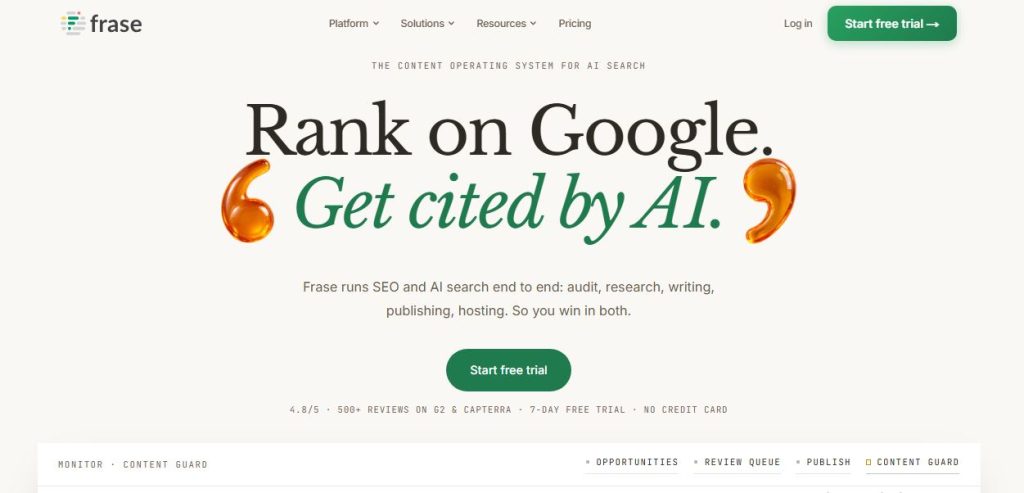
Frase is an AI content platform built around SEO and GEO, which means optimizing for Google and for the AI engines that cite sources. It treats content as a loop: capture what your audience asks, research and draft, publish, track how pages perform in Google and AI search, and fix the ones that slip.
For the full picture, read our Frase review and the Frase pricing breakdown.
Frase Key Features
These are the eight features that define Frase today:
- SEO research that ends in a brief: Frase studies the pages ranking for your keyword and turns their topics, questions and headings into a brief, with topic clusters to plan related content.
- AI agent with brand voice: It drafts in your brand voice, writes natively in more than 70 languages, and can publish on its own for the content types you choose.
- Live SEO and GEO scoring: The editor scores your draft for Google and for AI search as you write, with suggestions you choose to apply.
- AI Visibility tracking: Frase monitors where AI engines cite your brand, starting with ChatGPT and Google AI and adding Perplexity, Claude and Gemini on higher plans.
- Site audits: It crawls your site and scores each page for SEO, GEO and AI readiness, ranked by impact.
- Content Guard: It watches published pages for ranking or traffic decay, drafts a fix, and republishes only after you approve.
- Frase Answers: A free widget answers visitors from your own content and records the questions they ask, so you know what to write next.
- Publishing and integrations: Frase publishes to WordPress, Webflow, Sanity and Wix, or hosts content on FraseCMS, and offers an MCP server and CLI for use inside other AI tools.
Frase Starting Price
Frase starts at $49 per month on monthly billing, or $39 per month billed yearly, for the Starter plan with 10 articles. Professional is $129 ($103 yearly) and Scale is $299 ($239 yearly). A 7-day free trial needs no credit card.
What Is Content Harmony?
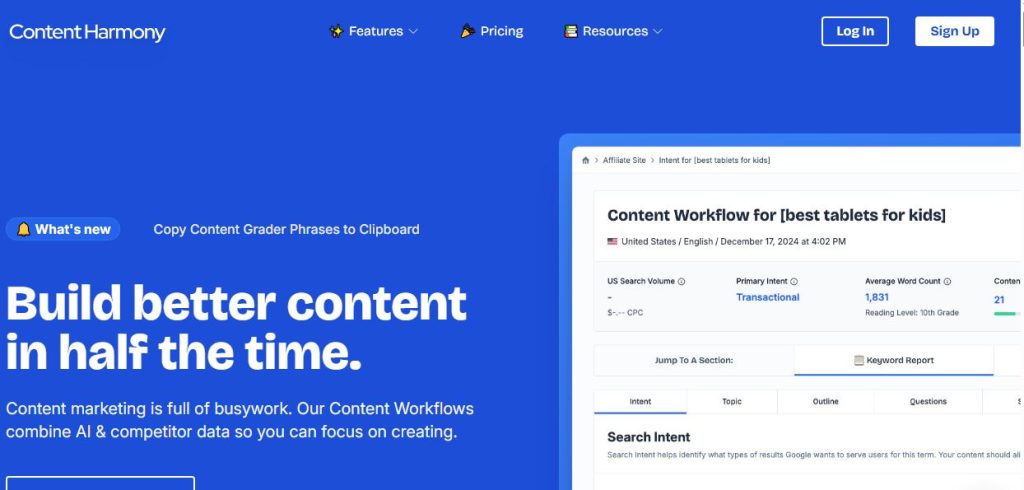
Content Harmony is a content briefing and optimization platform. You can start with a keyword report, which can group thousands of keyword ideas into topical clusters. From there it builds a detailed content brief for each topic, and later grades the finished draft against its topic model. Reviewers describe it as a mature, brief-led workspace, and it is popular with agencies and in-house teams that hand briefs to freelance writers.
Content Harmony Key Features
These are the eight features that define Content Harmony today:
- Keyword reports: Generates keyword ideas and groups them into topical clusters, so you can spot missing topics.
- Search intent classification: Labels keywords by intent, and shows Google AI Overviews in the Search Intent tab of keyword reports so you can see when an AI snapshot pushes organic results down.
- Detailed content briefs: Built from SERP analysis, with outlines, target keywords and competitor insights.
- Customizable brief formats: Briefs can be tailored to a team’s template and workflow.
- Shareable briefs: Give clients, freelancers and editors the right access without extra seats.
- Content Grader: Grades drafts and existing content against an AI-driven topic model.
- Readability scoring: Adds a readability check alongside topic coverage.
- Unlimited users and projects: Paid Standard plans include unlimited users, unlimited projects and rollover credits.
Content Harmony Starting Price
Content Harmony uses a credit-based model. Each content workflow, meaning a keyword report plus a brief plus a grader run, costs one credit. Recent checks of its site show plans from $50 per month for 5 workflows, across six monthly plans: Standard 5 at $50, Standard 12 at $99, Standard 25 at $199, Standard 50 at $299, Standard 100 at $599 and Standard 150 at $799. Enterprise plans start from $1,000 per month. There is no free plan, but a paid trial gives you your first 10 credits for $10, with full platform access, no automatic billing and no time limit. Some older directories show a $99 per user price and brief-based tiers, which appear to be out of date.
How Frase and Content Harmony Compare
This table sets the two tools side by side. Content Harmony details come from third-party reviews, so confirm current features on its site.
| Feature | Frase | Content Harmony |
|---|---|---|
| Keyword and SERP research | Yes | Yes, through keyword reports |
| Topic clustering | Topic clusters | Clusters keyword ideas into topics |
| Content briefs | Detailed briefs with topic clusters | Core strength, customizable and shareable |
| Live optimization score | SEO and GEO score as you write | Content Grader run on a draft |
| Readability scoring | Not a headline feature | Yes |
| Scoring for AI search | Yes | Entity-based topic model, no GEO score |
| AI writing | AI agent with brand voice, 70+ languages | No built-in article writer |
| AI citation tracking | Every plan | No brand tracking; shows AI Overviews in keyword reports |
| Site-wide audit | Yes, with cannibalization detection | Grades existing pages individually |
| Ranking decay monitoring and fixes | Content Guard | Not listed |
| Visitor question capture | Frase Answers | Not listed |
| Publishing to a CMS | WordPress, Webflow, Sanity, Wix, FraseCMS | Shareable briefs and exports |
| Users | 1, 3 or 5 seats by plan | Unlimited on paid plans |
Research
Frase begins from a keyword. It studies what already ranks, pulls out the topics, questions and headings competitors cover, and offers topic clusters to plan related content. Frase Answers adds questions from your own visitors.
Content Harmony begins with a keyword report. It generates keyword ideas, groups them into topical clusters, and classifies search intent, which helps you see which topics your content is missing.
The workflow difference: Both help you decide what to cover. Content Harmony puts more weight on keyword grouping and intent upfront. Frase puts more weight on what ranking pages include and on questions from your own audience.
Content Briefs
This is where the two are closest, and Content Harmony is at its best.
Content Harmony’s briefs are its signature output. They are detailed, customizable and easy to share, which is why teams use them to hand work to freelancers and clients.
Frase also turns research into a brief, with topic clusters, and can hand that brief straight to its AI agent.
The workflow difference: If your writers work from briefs and nothing else, either tool delivers. Content Harmony’s briefs are built for a human handoff. Frase’s can flow directly into a draft.
Content Optimization
Content Harmony’s Content Grader scores a draft, or an existing page, against its AI-driven topic model, and adds readability scoring. Reviewers note that it is a grading step after writing, whereas some competitors score live as you type.
Frase scores as you write, covering both SEO and GEO, meaning optimization for AI search as well as Google. Suggestions are optional, and nothing changes without your approval.
The workflow difference: Content Harmony checks the draft when it is done. Frase guides you while you write, and also considers AI search.
AI Writing
Frase’s agent drafts in your brand voice, can write natively in more than 70 languages, and can publish on its own for chosen content types once you trust it.
Content Harmony does not have a built-in article writer. It focuses on research, planning and grading, and is designed to guide human writers, or separate AI tools, through structured briefs rather than writing the text itself.
The workflow difference: If you want the tool to produce first drafts, Frase does more. If your writers draft by hand from briefs, Content Harmony’s approach suits that.
AI Visibility
Frase includes AI Visibility on every plan. Starter tracks ChatGPT and Google AI, Professional adds Perplexity plus AI crawler monitoring, and Scale adds Claude and Gemini. It also scores content for GEO as you write.
Content Harmony does not have an AI visibility index or a brand-tracking tool that measures how often your brand is mentioned across AI engines. It supports AI visibility in two smaller ways: it shows Google AI Overviews in the Search Intent tab of its keyword reports, and its Content Grader uses an AI-driven, entity-based topic model that supports comprehensive coverage.
The workflow difference: If you report on whether AI tools cite your brand, this is the clearest gap between the two.
Content Audits and Monitoring
Content Harmony can grade existing content against its topic model, so you can score pages you already have. It is a page-by-page check rather than a monitoring system.
Frase crawls your site and scores each page for SEO, GEO and AI readiness, ranked by impact. Content Guard then watches published pages for ranking or traffic decay, drafts a revision, and republishes only after you approve.
The workflow difference: Content Harmony tells you how well a page covers its topic. Frase also tells you when a page starts to slip and prepares the fix.
Publishing
Frase publishes to WordPress, Webflow, Sanity and Wix in a click, or hosts content on FraseCMS. It also offers an MCP server, CLI and API.
Content Harmony is built around handing briefs to writers, with shareable formats and exports. It is not a publishing tool.
The workflow difference: Frase carries content through to your CMS. Content Harmony stops at the brief and the grade.
Pricing Comparison
The two tools charge in different ways, so compare what each plan measures as well as its price.
| Frase | Content Harmony | |
|---|---|---|
| Entry plan | Starter, $49 monthly ($39 yearly) | Standard 5, $50 monthly for 5 workflows |
| Higher plans | Professional $129 ($103 yearly), Scale $299 ($239 yearly) | Standard 12 $99, 25 $199, 50 $299, 100 $599, 150 $799 |
| Top plan | Enterprise, custom | Enterprise, from $1,000 monthly |
| Free option | 7-day trial, no credit card | No free plan; $10 paid trial for your first 10 credits |
| Users | 1, 3 or 5 seats by plan | Unlimited on paid plans |
Here is what the plans measure:
| Frase Starter | Frase Professional | Frase Scale | Content Harmony entry | Content Harmony Standard 150 | |
|---|---|---|---|---|---|
| Main unit | 10 articles | 40 articles | 100 articles | 5 workflows | 150 workflows |
| Monthly price | $49 | $129 | $299 | $50 | $799 |
| Users | 1 | 3 | 5 | Unlimited | Unlimited |
A few points stand out. A Content Harmony workflow covers a keyword report, a brief and a grading run, while a Frase article covers research, drafting and scoring, so the units are not the same. Even so, the per-unit prices differ a lot: about $10 per workflow at Content Harmony’s entry level, roughly $6 at 50 to 100 workflows and about $5.30 at 150, against about $4.90 per Frase article on Starter, $3.23 on Professional and $2.99 on Scale. Those are our own calculations from monthly prices.
Content Harmony’s unlimited users is the offsetting advantage. For a team with many writers and editors, paying for seats on other tools can add up, while Content Harmony charges by workflow credit. Frase’s plans include 1, 3 or 5 seats. For more on Frase’s plans, see our Frase pricing guide.
Ease of Use and Onboarding
Frase is self-serve. You can start the 7-day trial without a credit card, connect your site and Google Search Console, run an audit, and begin a brief within a session. The platform has several areas to learn, so expect a short learning curve.
Content Harmony has a narrower job, and reviewers generally find it easy to use. In a G2 comparison, reviewers rated it easier to use and set up than MarketMuse. It has no free plan, but a $10 paid trial gives you your first 10 credits with full platform access, no automatic billing and no time limit. It offers training for teams.
Rule of thumb: A narrower tool is quicker to learn. A broader tool saves more steps once you know it.
Integrations and Ecosystem
Frase connects to Google Search Console and Google Analytics, publishes to WordPress, Webflow, Sanity and Wix or hosts on FraseCMS, and offers an MCP server, CLI and API for use inside other AI tools.
Content Harmony focuses on sharing and exporting briefs. Its strength is that anyone, including clients and freelancers, can open a brief without needing an account seat. We did not find a detailed integration list, so check which exports and connections your plan includes.
The difference: Frase is built to plug into a publishing workflow. Content Harmony is built to pass briefs between people.
Language Support
Frase writes natively in more than 70 languages, which matters for multilingual sites and non-English markets.
Content Harmony did not publish a clear list of supported languages in the material we reviewed. If you work outside English, confirm support with Content Harmony before you commit.
The difference: If you publish in several languages, Frase has the clearer story.
Workflow: Brief Factory vs Full Loop
The clearest way to see the difference is to follow one article through each tool.
With Frase:
- Pick a keyword, or take a question captured by Frase Answers.
- Frase studies the top-ranking pages and builds a brief.
- The agent drafts in your brand voice.
- You edit with the live SEO and GEO score.
- You publish to your CMS.
- Frase tracks rankings and AI citations, and Content Guard drafts a fix if the page slips.
With Content Harmony:
- Run a keyword report and group the keywords into topics.
- Generate a detailed brief for the chosen topic.
- Share the brief with a writer or client.
- The writer drafts outside the tool.
- Run the Content Grader on the draft and send feedback.
- Publish through your own process.
Notice where each workflow puts the effort. Content Harmony sharpens the handoff between strategist and writer. Frase tries to cover the whole path. Teams that coordinate many writers often like Content Harmony’s briefs. Solo creators and small teams that want fewer tools often prefer Frase.
Explore Frase’s current features and free trial →
Frase Strengths
- Research, briefs, drafting, scoring, publishing and monitoring in one platform
- AI Visibility and GEO scoring included from the entry plan
- Live scoring while you write
- Content Guard drafts fixes for decaying pages
- Writes natively in 70+ languages
- Lower cost per unit of output
- 7-day trial with no credit card
Content Harmony Strengths
- Detailed, customizable briefs that are easy to share
- Unlimited users and projects on paid plans
- Keyword reports with clustering and intent classification
- A Content Grader with readability scoring
- Rollover credits and team training
- Reviewers find it easy to set up and use
Alternatives to Frase and Content Harmony
If neither tool fits, two other options cover what these two do not. For a wider list, see our guide to Frase alternatives and the best AI SEO tools.
KoalaWriter: The Cheap Alternative
If price is the main obstacle, KoalaWriter is the budget route. Plans start at $25 per month for 45,000 words, against $49 for Frase Starter and $50 for Content Harmony on monthly billing, and every new account gets 5,000 free words with no credit card. It turns a keyword into a full article using live search data, applies SEO optimization automatically, and offers a bulk mode.
The trade-offs are real. Koala is centered on producing articles, so it lacks Content Harmony’s brief sharing, and in the material we reviewed we did not find an AI citation tracker like Frase’s. It suits affiliate and niche site owners who want drafts at volume on a small budget. See our Frase vs KoalaWriter comparison.
Jasper: Best for Marketing Workflows
If your work goes beyond SEO articles, Jasper is the stronger fit. It is built for marketing teams that need on-brand content across blogs, ads, email and social, with Brand Voices, Knowledge assets, Audiences and marketing agents. Pro costs $59 per seat per month on yearly billing, or $69 monthly, and Business is custom.
The trade-off is that Jasper is not centered on SERP research or ranking. Reviewers report that its deeper SEO scoring relies on a Surfer SEO integration. It suits teams where brand consistency across channels matters more than search depth. See our Frase vs Jasper comparison.
Try Jasper’s 7-day free trial →
Which Tool Fits Different Use Cases?
- A solo blogger or affiliate marketer: Frase. Drafting, publishing and monitoring are included, and a brief-sharing workflow is more than a one-person operation needs.
- An agency or team briefing many freelancers: Content Harmony, for shareable briefs and unlimited users.
- A strategist who hands off briefs and reviews drafts: Content Harmony.
- A team that reports on AI citations: Frase, since Content Harmony has no AI visibility index.
- A publisher writing in multiple languages: Frase.
- A blog with a large library of aging posts: Frase, for Content Guard.
- A budget-conscious publisher who mainly needs drafts: KoalaWriter.
- A marketing team producing more than SEO articles: Jasper.
For head-to-head comparisons with other tools, see Frase vs Surfer SEO, Frase vs Clearscope, Frase vs Scalenut and Frase vs MarketMuse.
FAQ
Is Frase better than Content Harmony?
Neither is better for everyone. Content Harmony is a focused brief-and-grade tool that suits teams coordinating writers. Frase covers more of the workflow, including drafting, AI visibility, publishing and monitoring. Choose by workflow.
Which is cheaper, Frase or Content Harmony?
The entry prices are close, at $49 for Frase and $50 for Content Harmony on monthly billing, but Frase gives you 10 articles against 5 workflows. Content Harmony’s unlimited users can lower costs for large teams.
Does Content Harmony have a free plan or trial?
There is no free plan, but a paid trial gives you your first 10 credits for $10, with full platform access, no automatic billing and no time limit. Frase offers a 7-day trial with no credit card.
Does Content Harmony track AI visibility?
It does not have an AI visibility index or brand-tracking tool, though it shows Google AI Overviews in its keyword reports. Frase includes AI Visibility on every plan.
Can Content Harmony write articles?
No. It does not have a built-in article writer and focuses on research, briefs and grading. Frase’s agent drafts full articles in your brand voice.
Does Frase have content briefs like Content Harmony?
Yes. Frase turns its SERP research into a brief with topics, questions and headings, and can hand it to its AI agent for drafting.
Can I use Frase and Content Harmony together?
You can, with Content Harmony for briefs and Frase for drafting and monitoring, but they overlap, so most people choose one.
What is a good Content Harmony alternative?
Frase is a good option if you want briefs, drafting, AI visibility and monitoring together. KoalaWriter is a cheaper option for drafts, and Jasper suits marketing workflows.
Conclusion
Frase and Content Harmony both turn search data into a plan for better content, but they put the effort in different places. Content Harmony excels at the handoff: detailed, shareable briefs for teams that coordinate writers, with unlimited users. Frase aims to cover the whole path, from research through publishing and monitoring, with AI visibility tracking included.
If you manage a stable of freelancers, Content Harmony is worth a look. If you want to research, write, publish and watch your content in one place, start with Frase’s free trial and test it on a real article.
Related reading: Frase review | Frase pricing | Frase vs Surfer SEO | Frase vs Clearscope | Frase vs Scalenut | Frase vs MarketMuse | Frase vs KoalaWriter | Frase vs Jasper | Frase alternatives | Best AI SEO tools