
Comparing between KWFinder and Semrush comes down to one question: do you need a focused keyword research tool or a full SEO suite? KWFinder (part of Mangools) is the simpler, more affordable way to find keywords you can actually rank for. Semrush is the stronger all-in-one platform for competitor research, technical audits, backlink analysis and AI search tracking.
In this KWFinder vs Semrush comparison, I break down 2026 pricing, keyword research, competitor analysis, rank tracking, site audits and ease of use. Then I match each tool to the type of site and budget it suits best, so you can pick the one that earns its monthly fee.
KWFinder vs Semrush: The Short Answer
- Choose KWFinder if you are a blogger, affiliate marketer, freelancer or small business owner who mainly needs keyword research, SERP analysis and simple rank tracking.
- Choose Semrush if you run an agency, manage several websites, or need site audits, deep competitor data and AI visibility reporting.
- Use both if your budget allows and you want KWFinder’s easy-to-read keyword difficulty scores alongside Semrush’s wider data.
What’s New in 2026
Four developments matter most for anyone comparing Mangools vs Semrush this year.
Semrush now belongs to Adobe. Adobe completed its acquisition on April 28, 2026, and Semrush now describes itself as a brand visibility platform rather than only an SEO tool. Expect a stronger focus on enterprise marketing teams and AI search.
Semrush Pro costs $139.95 per month. Guru is $249.95 and Business is $499.95, with discounts on annual billing.
AI search visibility is now a feature category. Semrush One plans bundle classic SEO with tracking across AI platforms such as ChatGPT, Perplexity and Google’s AI Overviews, and Mangools has begun adding lighter AI search tracking of its own.
Mangools plans start at $30.50 per month. Basic, Premium and Agency cost $30.50, $40.50 and $70.50 monthly, or $18.85, $26.35 and $48.85 per month when billed annually. Every paid plan includes all five tools plus API and MCP access, and there is a permanent free plan.
Keyword Research Tool or Full SEO Suite?
Most Semrush vs KWFinder comparisons stack features side by side and crown a winner. The problem is that feature counts hide what really matters: how much of the tool you will use every week.
Think about your last month of SEO work. If most of it was entering seed keywords, checking keyword difficulty and choosing article topics, you were using a keyword research tool, and a full suite means paying for site audits, PPC data and social tools you rarely open. If you were auditing sites, studying competitor backlinks and reporting to clients, a keyword tool alone would have slowed you down.
KWFinder vs Semrush at a Glance
| KWFinder (Mangools) | Semrush | |
|---|---|---|
| Best for | Bloggers, affiliates, small businesses | Agencies, advanced marketers, larger teams |
| Starting price | $30.50/month ($18.85 billed annually) | $139.95/month ($117.33 billed annually) |
| Strength | Simple, reliable keyword difficulty | Breadth: keywords, audits, backlinks, ads, content, AI visibility |
| Learning curve | Low | Moderate to steep |
| Free option | Permanent free plan and 10-day free trial | Free trial on paid plans |
What Is KWFinder?
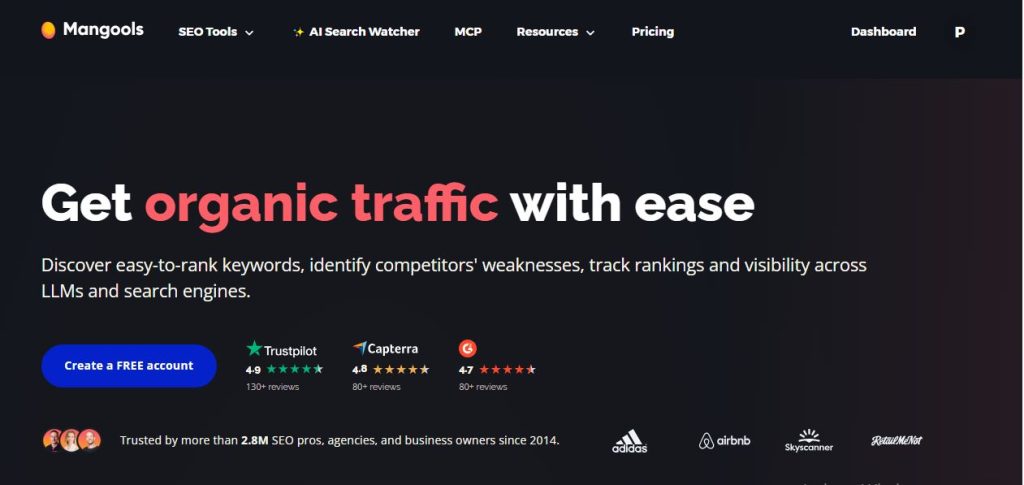
KWFinder is the keyword research tool from Mangools, a Slovakia-based SEO software company. It was built to answer one question quickly: which keywords can my site realistically rank for? Instead of surrounding you with dozens of metrics, it gives you search volume, a colour-coded keyword difficulty score from 0 to 100 and a clean SERP overview, so you can judge a keyword in seconds.
The tool is best known for surfacing long-tail, lower-competition keywords, which is where newer and smaller sites usually have the best chance to rank. You can target keywords by country, language and location, see a 12-month search volume trend to spot seasonal topics, and browse suggestions made up of related terms, autocomplete ideas and question-style searches.
What Comes With a Mangools Subscription
A Mangools plan bundles KWFinder with four companion tools:
- KWFinder: keyword research with difficulty scores, suggestions and search volume trends.
- SERPChecker: analysis of the live search results for any keyword, with authority and link metrics for each ranking page.
- SERPWatcher: rank tracking with a single Performance Index, charts and alerts.
- LinkMiner: a backlink checker for any URL, with Citation Flow, Trust Flow and Link Strength metrics.
- SiteProfiler: a quick overview of any domain’s authority, backlinks and traffic.
Together they cover the core loop of a small site: find a keyword, check the competition, publish, then track results.
Who KWFinder Is For
KWFinder suits bloggers, affiliate marketers, freelancers and small businesses that mainly need dependable keyword research at a fair price. The learning curve is gentle, and Mangools offers a permanent free plan and a 10-day free trial, which makes it a low-risk first SEO tool. It is not a full SEO platform, so it leaves out features such as a site audit and large-scale competitor and backlink research. That is the trade-off for its simplicity.
What Is Semrush?
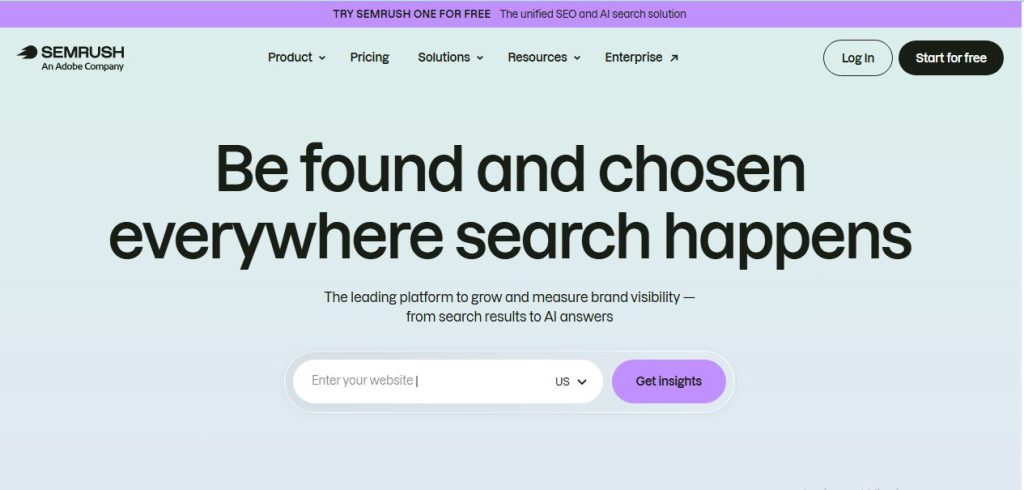
Semrush is an all-in-one online marketing platform founded in 2008 and now part of Adobe, following the acquisition completed on April 28, 2026. It started as an SEO and competitor research tool and has grown into a broad suite covering SEO, content marketing, advertising, social media and, more recently, AI search visibility.
What defines Semrush is breadth and data scale. It markets a keyword database of more than 25 billion keywords and a backlink index of more than 43 trillion links, and it organises its tools into toolkits that share data, so you can move from keyword research to competitor analysis to technical fixes without switching platforms.
Key Semrush Tools
- Keyword Magic Tool: keyword research with search intent labels, advanced filters, SERP feature data and Keyword Difficulty (KD%), plus Personal Keyword Difficulty for your own site.
- Domain Overview and Organic Research: snapshots of any site’s traffic and top keywords, with trends over time.
- Backlink Analytics and Backlink Audit: link data, toxic link detection and link-building tools.
- Site Audit: a crawler that checks more than 140 technical SEO issues and tracks a site health score.
- Position Tracking: rank tracking by location and device, with competitor comparisons and SERP feature tracking.
- Content tools: topic research, content briefs and an SEO writing assistant, available on higher plans.
- Advertising Research and Traffic Analytics: insight into competitors’ paid keywords, ads and estimated traffic sources.
- AI visibility tools: Semrush One plans add tracking of how your brand appears in AI answers.
Who Semrush Is For
Semrush is aimed at agencies, in-house marketing teams, advanced SEOs and businesses that want SEO, content and competitor data in one login. The range of features means a steeper learning curve and a higher price than a focused keyword tool, but users who will use audits, competitor research and reporting regularly tend to get the most value from it.
KWFinder vs Semrush Pricing
Pricing is where these two tools differ most. Here is what each costs at list price.
KWFinder / Mangools pricing. Every paid plan includes all five Mangools tools (KWFinder, SERPChecker, SERPWatcher, LinkMiner and SiteProfiler) plus API and MCP access, and there is a permanent free plan plus a 10-day free trial. The differences between plans are daily usage limits, rank-update frequency and team seats.
- Basic: $30.50/month, or $18.85/month billed annually. Up to 100 keyword and SERP requests per day, 200 tracked keywords, no extra seats
- Premium: $40.50/month, or $26.35/month billed annually. Up to 500 requests per day, 700 tracked keywords, 3 extra seats
- Agency: $70.50/month, or $48.85/month billed annually. Up to 1,200 requests per day, 1,500 tracked keywords, daily rank updates, 5 extra seats
Mangools has also run Black Friday discounts on annual plans in past years, and that sale window is only a few weeks away.
Semrush pricing. The classic SEO Toolkit has three tiers.
- Pro: $139.95/month, or about $117.33/month billed annually
- Guru: $249.95/month, or about $208.33/month billed annually
- Business: $499.95/month, or about $416.66/month billed annually
Two details catch buyers out. First, content marketing tools and historical data are reserved for Guru and above, so the real jump for many users is from $139.95 to $249.95. Second, extra users cost more on every plan, so a small team’s bill grows quickly.
The takeaway on cost: over a year, the cheapest Semrush plan costs roughly six times the cheapest Mangools plan on annual billing. That gap only makes sense if you will use what the extra money buys.
Keyword Research: KWFinder vs Semrush
Keyword research is where most people make their decision, so it deserves the closest look.
KWFinder keeps the process simple. Enter a seed keyword and you get search volume, a keyword difficulty score from 0 to 100, a SERP overview showing who ranks and how strong those pages are, plus related, autocomplete and question keywords. Its biggest strength is that the difficulty score is easy to trust when you are hunting for low-competition, long-tail keywords, which is exactly what new and small sites need.
Semrush goes much wider with its Keyword Magic Tool. You get search intent labels (informational, commercial, transactional and navigational), advanced filters, SERP feature data, and a Keyword Gap tool that shows which terms your competitors rank for and you do not. Semrush markets a database of more than 25 billion keywords, far larger than what Mangools offers, which matters most in niche or non-English markets.
Verdict: KWFinder wins on speed and clarity for finding rankable keywords. Semrush wins on depth, intent data and competitor gaps. If you are choosing keywords for a new blog or affiliate site, KWFinder usually gets you to a decision faster.
How KWFinder and Semrush Calculate Keyword Difficulty
Both tools score difficulty from 0 to 100, but the number does not mean the same thing in each. Understanding the difference helps you avoid picking keywords that look easy and turn out to be anything but.
KWFinder’s score blends link metrics with domain-level and page-level authority from the pages that currently rank. The result is a broad read on how strong the competition is. Its green-to-red colour coding makes the score quick to scan, which is a big help when you are sorting hundreds of keyword ideas.
Semrush’s KD% leans harder on links. The median number of referring domains pointing to the ranking pages carries the most weight (roughly 41%), followed by the Authority Score of the ranking domains (roughly 17%), and the formula is adjusted for each country’s regional database. Semrush also offers Personal Keyword Difficulty (PKD%), which compares a keyword against your own site’s authority so the score reflects your realistic odds, not a generic average.
Which one should you trust? Neither is wrong, because they answer different questions. KWFinder tells you quickly whether a keyword is in your league. Semrush tells you how much link authority you would need and, with PKD, whether your site can get there. Semrush itself suggests that new or low-authority sites start with keywords scoring under about 30.
Whichever tool you use, stick to one scale across your research so you learn what easy means in your niche. And treat difficulty as a first filter, not a final answer: open the search results and check whether the top pages are strong, or just thin posts, forums and outdated articles you can beat.
Beyond Keyword Research: Where Semrush Pulls Ahead
Keyword research is where KWFinder is strongest, but ranking a page takes more than choosing the right keyword. Here is how the two platforms compare across the rest of an SEO workflow, starting with what each one actually gives you.
What the Mangools Suite Covers
KWFinder does not work alone. Every Mangools plan bundles four companion tools:
- SERPChecker analyses the live search results for any keyword, showing who ranks and how strong those pages are.
- SERPWatcher tracks your rankings over time with a single Performance Index.
- LinkMiner shows the backlinks of any page, including new and lost links, with Citation Flow, Trust Flow and Link Strength metrics.
- SiteProfiler gives a quick snapshot of any domain’s key metrics.
Together they cover the core loop for a small site: find a keyword, check the competition, publish, then track results. What they do not include is a site crawler, advertising data or deep traffic estimates.
What Semrush Adds
Semrush organises its tools into toolkits inside one platform, which is where the extra cost goes.
Competitor and domain research. Domain Overview gives a snapshot of any site’s organic traffic and top keywords. Organic Research shows which keywords a competitor ranks for and how that has changed over time, Traffic Analytics estimates audience size and traffic sources, and Advertising Research reveals the paid keywords and ad copy rivals are using. Keyword Gap and Backlink Gap then show exactly what competitors have that you do not.
Backlink analysis and link building. Backlink Analytics runs on an index Semrush says holds more than 43 trillion links. Backlink Audit flags toxic links, and the Link Building Tool helps you find prospects and manage outreach. LinkMiner is fine for quick checks, but it is not built for this kind of depth.
Technical SEO. Site Audit crawls your website and checks for more than 140 technical issues, from crawlability problems, duplicate content and broken links to missing meta tags, page speed and Core Web Vitals. Problems are grouped by severity with fix recommendations, and a site health score lets you watch progress over time. KWFinder has nothing comparable, so you would need a separate crawler or Google Search Console for technical checks.
Rank tracking. SERPWatcher is simple and readable, but it tracks 200 to 1,500 keywords depending on your plan and updates weekly on Basic and Premium (daily on Agency). Semrush’s Position Tracking goes further with location and device tracking, competitor comparisons, visibility metrics, SERP feature tracking and cannibalization reports, which matters for local or highly competitive niches.
Content tools. Semrush’s content toolkit adds topic research, content briefs and an SEO writing assistant, though these sit on Guru and above. With Mangools, the keyword and SERP analysis is yours to turn into an outline, so many users pair it with a separate content optimization tool.
Reporting and integrations. Semrush offers fuller client reporting and connects with Google Search Console and Google Analytics. Mangools keeps things lighter, which suits solo users and small teams but can feel limited for agencies.
A Typical Workflow in Each Tool
The clearest difference shows up when you plan a single article.
With KWFinder and Mangools, the process is short and linear:
- Enter a seed keyword in KWFinder and filter for low-difficulty, long-tail ideas.
- Open SERPChecker to see how strong the top results really are.
- Write and publish your article.
- Add the keyword to SERPWatcher and check progress.
With Semrush, each step connects to the next:
- Use the Keyword Magic Tool to find keywords and check their search intent.
- Run Keyword Gap against a competitor to spot topics you are missing.
- Build a content brief and write with the SEO writing assistant.
- Run Site Audit to confirm the page has no technical problems.
- Track the result in Position Tracking next to your competitors.
The first workflow is faster and cheaper. The second is deeper and better suited to teams who need to prove results to clients or stakeholders.
KWFinder vs Semrush: Feature-by-Feature Verdict
- Keyword research for beginners: KWFinder
- Keyword depth and search intent data: Semrush
- Competitor analysis: Semrush
- Backlink analysis: Semrush
- Site audits: Semrush (KWFinder has none)
- Rank tracking: KWFinder for simplicity, Semrush for depth
- Ease of use: KWFinder
- Price and value for small sites: KWFinder
- AI search visibility: Semrush
The pattern is consistent: KWFinder wins wherever simplicity and cost matter most, and Semrush wins wherever depth and breadth matter most.
AI Search Visibility: The New Battleground
More people now get answers from AI assistants and AI Overviews, so marketers increasingly want to know whether their brand is mentioned or cited there. This is the biggest shift in the SEO tool market right now.
Semrush has leaned hard into it. Its Semrush One plans, priced well above the classic toolkit, combine traditional SEO with AI visibility tracking across several AI platforms. Mangools has started adding AI search tracking too, though at a lighter level.
My advice: do not pay for a higher plan just for AI tracking unless clients or stakeholders are asking for it. The fundamentals still drive most results: finding the right keywords, publishing genuinely helpful content and earning links. AI tracking tools are young and changing fast.
KWFinder vs Semrush: Which Tool Should You Choose?
You run a blog or affiliate site on your own. KWFinder is the better value. You get keyword research, SERP checks and rank tracking for a fraction of the cost, and the clean interface makes it a great SEO tool for beginners.
You own a small business and handle your own SEO. Start with KWFinder. If you later need technical audits and competitor tracking, upgrade to Semrush Pro or Guru.
You are a freelancer with a few clients. It depends on your reporting needs. If clients expect audits and detailed reports, Semrush justifies its price. If you mostly deliver content strategy and keyword plans, Mangools Premium or Agency can cover most of the workflow.
You work at an agency or in-house at a larger company. Semrush, usually Guru or Business, is the practical choice because of its data depth, team features and reporting.
You are switching from another tool. Both are easy to start with, but check usage limits first. Mangools limits daily lookups on lower plans, and Semrush limits projects and tracked keywords on Pro.
Can You Use Mangools and Semrush Together?
Yes, and many SEOs do. A common setup is KWFinder for day-to-day keyword research and topic selection, and Semrush for periodic site audits and competitor deep dives. If budget is tight, run a Semrush trial for a one-off audit, fix the issues it finds, and keep Mangools as your everyday keyword research tool.
KWFinder vs Semrush: Pros and Cons
KWFinder pros: simple interface, trustworthy keyword difficulty, low price, five tools in one subscription, plus a permanent free plan and 10-day free trial.
KWFinder cons: smaller database, no site audit, lighter backlink and competitor data, daily usage limits and weekly rank updates on lower plans.
Semrush pros: huge data, a full SEO and marketing toolkit, strong competitor and backlink analysis, site audits and growing AI visibility features.
Semrush cons: high price, a big jump between Pro and Guru, extra cost per user, and a learning curve for beginners.
Semrush and KWFinder Alternatives
If neither tool fits, consider SE Ranking for a middle ground between price and features, Ubersuggest as a low-cost entry-level option, or Frase if content optimization is your priority. For more options, see my guide to the best Ahrefs alternatives, and my comparisons of Ahrefs vs KWFinder and Mangools vs SE Ranking.
Final Verdict on KWFinder vs Semrush
Choose KWFinder if you want the simplest, most affordable way to find keywords you can really rank for. It is the smarter pick for bloggers, affiliate marketers and small businesses.
Choose Semrush if SEO is a core part of your business and you will use its audits, competitor research, backlink tools and AI visibility features often enough to justify the cost.
Still unsure? Start with KWFinder’s free plan or 10-day trial, see whether you hit its limits, and upgrade only when your work demands it.
Get the KWFinder 10-day free trial | Try Semrush
FAQs About KWFinder vs Semrush
Is KWFinder better than Semrush? For simple keyword research and low-competition topics, many users prefer KWFinder because it is easier to use and far cheaper. For all-round SEO work such as audits, backlinks and competitor analysis, Semrush is better.
Which is better for beginners, KWFinder or Semrush? KWFinder. Its clean interface and clear keyword difficulty score make it easier to learn, and the free plan lets you start without paying.
Is Semrush worth the price in 2026? It is worth it if you will use more than keyword research, especially site audits, competitor tools and reporting. For bloggers who only need keywords, it is usually overkill.
How much does KWFinder cost? KWFinder is sold as part of Mangools. Plans start at $30.50 per month, or $18.85 per month on annual billing, and every paid plan includes all five Mangools tools plus API and MCP access.
How much does Semrush cost? The SEO Toolkit starts at $139.95 per month for Pro, $249.95 for Guru and $499.95 for Business, with discounts for annual billing.
Does KWFinder have a free plan or trial? Yes. Mangools has a permanent free plan with limited usage and a 10-day free trial, so you can test KWFinder before paying.
Does Semrush have a free trial? Yes, Semrush offers a free trial on its paid plans.
Who owns Semrush now? Adobe completed its acquisition of Semrush in April 2026.
Can KWFinder replace Semrush? Only for keyword research and basic tracking. It has no site audit and much lighter backlink and competitor tools.