
Affiliate marketing is one of the most beginner-friendly ways to earn money online. You recommend products or services you trust, and you earn a commission when someone buys through your unique link. No inventory, no product creation, no customer support.
I’ve worked in digital marketing for over four years, and I wrote this affiliate marketing guide for people starting from zero. If you’re searching for affiliate marketing for beginners, you’ll find everything here in one place: how it works, how much you can realistically earn, how to start step by step, how to get traffic in the age of AI search, and the mistakes that quietly kill most new affiliate sites.
In this guide:
- What is affiliate marketing?
- How much can you earn?
- Pros and cons
- How to start, step by step
- Content that earns commissions
- How to get traffic (including AI search)
- Tools you need
- Tracking and optimizing
- Legal basics and disclosure
- Common beginner mistakes
- How to scale
- Other ways to monetize
- A real-world example
- FAQs
- Your 30-day action plan
What Is Affiliate Marketing?
Affiliate marketing is a performance-based marketing model. A business (the merchant) pays you (the affiliate) a commission when you send a customer or lead their way through your unique affiliate link. You only get paid when the desired action happens, which is why it’s called performance-based.
Commissions usually come as a percentage of the sale or a fixed amount per sale or lead. Some programs also pay recurring commissions, which means you earn every month for as long as the customer keeps paying. Software and SaaS tools often work this way. For example, GetResponse has offered affiliates a 33% recurring commission for as long as the customer stays subscribed (check the current terms before you promote it).
How affiliate marketing works in 3 steps
- You join an affiliate program and get a unique tracking link.
- You share that link through your blog, YouTube channel, email list, social media or paid ads.
- Someone clicks and buys, and you earn a commission.
The key players
- Merchants (advertisers): the businesses that create the product and pay commissions.
- Affiliates (publishers): you. You promote the offer to your audience.
- Consumers: the people who buy through your link.
- Affiliate networks: platforms that connect merchants and affiliates, handle tracking and pay out commissions. Some merchants run their own program without a network.
Types of commissions
- One-time commissions: you’re paid once per sale. Common with physical products and courses.
- Recurring commissions: you’re paid every billing cycle. Common with software subscriptions.
- Pay per lead: you’re paid when someone signs up for a free trial or submits a form.
- High-ticket commissions: a larger payout on expensive products or services, so you need fewer sales.
Quick summary: you pick a niche, join programs, build a platform, create helpful content, get traffic, and earn commissions. The rest of this guide shows you how.
How Much Can You Earn With Affiliate Marketing?
There’s no fixed answer, and be careful with anyone who promises one. Your income depends on your niche, your traffic, how well your content matches buyer intent, and the commission structure of the programs you promote.
These are rough stages that affiliates commonly talk about. They’re categories, not guarantees:
- Beginner: $0 to $1,000 per month
- Intermediate: $1,000 to $10,000 per month
- Advanced: $10,000 to $100,000 per month
- Super affiliate: over $100,000 per month
Most beginners spend their first months earning nothing while they build content and traffic. If you’re starting a blog, plan for several months of consistent publishing before you see meaningful results. The affiliates who reach the higher stages usually don’t rely on one channel. They combine content, email, video and sometimes paid traffic.
Want to run the numbers for your own goals? Try the free Affiliate Commission Calculator to see how many sales you need to hit a monthly target.
Is Affiliate Marketing Worth It? Pros and Cons
The benefits
- Low startup costs. You don’t create a product, hold stock or handle shipping.
- Flexibility. You can work from anywhere, and it works as a side hustle.
- Scalability. Once a piece of content ranks or an email sequence works, it can keep earning.
- Freedom of choice. You decide which products to promote and which platform to use.
- Performance-based income. Your earnings reflect the results you create.
- No overhead. You don’t need a team or an office to start.
The downsides (the part most guides skip)
- It takes time. Traffic and trust don’t appear overnight.
- You don’t control the program. Merchants can cut commissions, change terms or close their program.
- You depend on traffic sources. Google changes, algorithm updates and platform rules can all hit your income.
- Competition is real, especially in popular niches.
- Passive income isn’t instant or fully passive. Content needs updating, and links need checking.
If you’re comfortable with a slow start and consistent work, affiliate marketing can be a strong business model. If you want quick money, it’s probably not the right fit.
How to Start Affiliate Marketing for Beginners (Step by Step)
Step 1: Choose a niche
A niche is a specific topic or market you focus on. A clear niche helps you attract a focused audience and makes your recommendations more believable.
When choosing, check three things:
- Interest: can you write or talk about it for months without burning out?
- Demand: are people searching for it? Check with tools like Google Trends, Semrush or KWFinder.
- Profit potential: are there affiliate programs with decent commissions, ideally recurring ones?
Common niche areas include:
- Business and money: digital marketing, personal finance, freelancing, investing, making money online.
- Technology: software, AI tools, hosting, gadgets.
- Health and fitness: nutrition, workout gear, supplements, wellness.
- Personal development: productivity, mindset, time management.
- Lifestyle: travel, pets, home and garden, photography.
- Relationships and family: parenting, dating, homeschooling.
Tip: don’t pick a niche only because it pays well. Pick one where you can build real experience and trust. A narrow topic (for example, “AI tools for freelance writers”) is easier to rank for than a huge one (“technology”).
Need help with a site name? Try the Domain Name Generator at Namecheap.
Example of Popular Niches
Health and Fitness
- Weight loss
- Food & Nutrition
- Workout gear
- Building muscles
- Supplements
- Pregnancy
- Addiction & Recovery
Business and Money
- Personal Finance
- Digital Marketing
- Real Estate
- Business Coaching
- Local Business
- Cryptocurrency
- Investing
- Freelancing
- Make money online
Relationships
- Marriage Counseling
- Divorce Recovery
- Dating
- Parenting
- Baby care & Products
- Life Coaching
- Sex & Intimacy
- How To get your ex back
- How To spruce your love life
- Homeschooling
- Workplace & Networking
Technology
- Gadgets
- Software
- Artificial Intelligence (AI)
- Hosting services
- Smartphones
- Gaming & Consoles
- Smartwatches
- Smart TV & Speakers
Personal Development
- Meditation
- Self Help
- Productivity
- Law of Attraction
- Time Management
- Spirituality
- Peak Performance
Lifestyle
- Backyard Living
- Traveling
- Pet care
- Photography
- Gardening
- Fashion & Beauty
- Video Production & Editing
- Music production
- Survival
Step 2: Find affiliate programs
Once you have a niche, look for programs that fit it. Evaluate each one using these questions:
- Relevance: does it genuinely help your audience?
- Commission rate and type: is it one-time or recurring, and what does it pay?
- Cookie duration: how long after a click will you still get credit for a sale?
- Product quality and reputation: only promote what you’d be comfortable recommending to a friend.
- Program terms: check what’s allowed, especially around paid ads and bidding on brand names.
Where to find programs
- Direct programs: many software companies run their own affiliate programs. Search “[product name] affiliate program.”
- Affiliate networks: popular options include Awin, CJ, Impact, PartnerStack, ClickBank and Amazon Associates. PartnerStack is strong for software, ClickBank leans toward digital products, and Amazon Associates covers a huge range of physical products but usually pays lower rates.
One important update: ShareASale no longer exists as a standalone network. Awin closed it in October 2025 and moved its merchants and publishers onto the Awin platform, so if you want that merchant base, join Awin.
For a deeper breakdown, read my guide to the best affiliate marketing networks for beginners.
Note: To find other affiliate programs use Google. Search using relevant keywords in your niche. For example, if you’re in the Fitness niche search for “Fitness affiliate programs” or “Weight Loss affiliate programs”
Step 3: Choose your platform
You need a place to publish content and share your links. You don’t have to be everywhere. Pick one main platform and add others later.
A blog or website
This is my favorite starting point because you own it and it can bring in search traffic over time. You write helpful articles around what buyers search for (such as “best email marketing software”) and recommend relevant products with affiliate links. To get started, you can register a domain and hosting in one place with Bluehost. I walk through the full process in my guide on how to build an affiliate marketing website.
YouTube
If you prefer creating video content over text content then YouTube is the right platform for you. Great for reviews, comparisons, tutorials and walkthroughs. You show the product working, give your honest opinion and put your affiliate link in the description with a clear call to action. YouTube is also one of the sources that appears often in Google results and AI answers, which makes it a strong long-term channel.
An Email list
Email lets you reach people directly instead of depending on an algorithm. You offer a lead magnet (a checklist, template, mini-guide or short course) in exchange for an email address, then send useful emails with occasional recommendations. Beginner-friendly tools include Systeme.io, GetResponse and ConvertKit.
Social Media
Short-form video, LinkedIn, X, Instagram, Pinterest, Reddit and Quora can all send traffic. Choose one or two platforms where your audience actually spends time. In communities like Reddit and Quora, focus on genuinely helping people first and follow each community’s rules on links.
Step 4: Set up the basics
Before you publish your first affiliate post, make sure you have:
- A clear affiliate disclosure (more on that below).
- About, Contact and Privacy Policy pages, which help people trust your site.
- A way to track links (covered later in this guide).
- A simple content plan, such as 10 to 30 keyword-based articles you’ll write first.
Create Content That Earns Commissions
Content is what turns visitors into buyers. The goal isn’t to publish a lot. It’s to publish helpful content that matches what people are trying to decide.
Content types that work for affiliates
- Product reviews: an honest, detailed look at one product, with pros, cons, pricing and who it’s for.
- Comparison posts: “X vs Y” articles that help readers choose between two options.
- Listicles (“best of” posts): roundups such as “best landing page builders,” which target people ready to buy.
- Alternatives posts: a list of alternatives to a well-known product.
- Tutorials and how-tos: show readers how to get a result, with the product as part of the solution.
- Case studies: document what you did and what happened, with real numbers.
- Resource pages: a page listing the tools you personally use and recommend.
- Product mentions: natural recommendations inside a related article.
- Banners: image links, which tend to work better as a supporting element than a main strategy.
What good affiliate content looks like in 2027
Search engines and AI systems are getting better at spotting thin, copied or purely promotional pages. Content that stands out usually has:
- First-hand experience. Show that you used the product, with your own screenshots, results and honest observations.
- A clear point of view. Say who a product is for and who should skip it.
- Transparent comparisons. Explain how you evaluate products. This is why I publish a ranking methodology on Tajedo.
- Accurate, current information. Pricing, features and programs change, so update your posts regularly.
- Direct answers. Put a short, clear answer near the top of each section, then expand on it.
AI tools can help with research, outlines and editing. But publishing generic AI-written pages with no real experience behind them is a fast way to create content that never ranks or earns trust.
Make your headlines stronger with the free Headline Analyzer.
How to Get Traffic to Your Affiliate Content
Content without visitors earns nothing. You can use free traffic, paid traffic, or both.
Search engine optimization (SEO)
SEO is the process of helping your pages show up in search results. For affiliate sites, it’s often the most valuable long-term traffic source because people searching for “best” and “vs” terms are close to buying.
The basics:
- Keyword research: find the phrases your audience searches, and check search volume and keyword difficulty. For a new site, start with lower-competition, long-tail phrases. The Long Tail Keyword Generator can help you get ideas.
- Search intent: match the format Google already rewards. If the top results are comparisons, write a comparison.
- On-page SEO: use your target keyword naturally in the title, headings, intro and URL.
- Internal links: link related posts together so readers and search engines can navigate your site.
- Backlinks: earn links from other relevant sites through useful content and outreach.
- Regular updates: refresh older posts so they stay accurate.
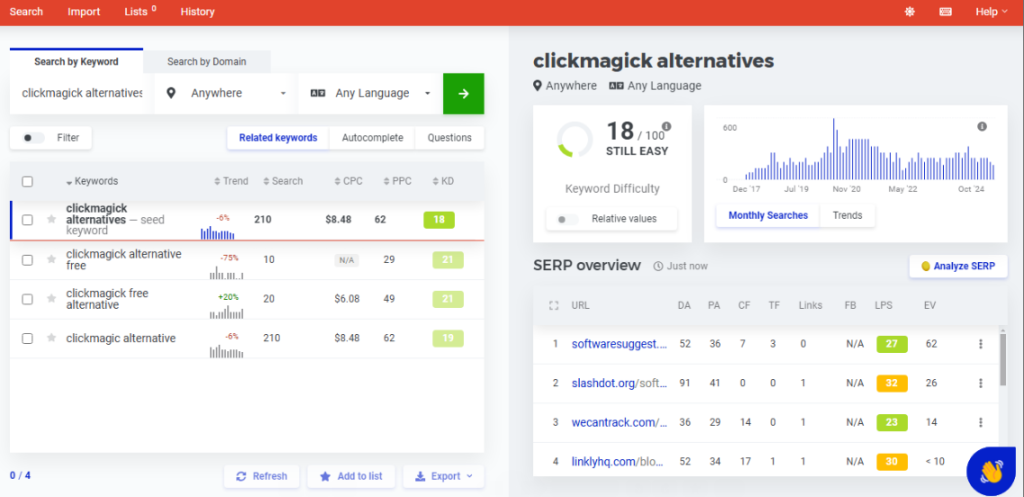
Keyword research tools: KWFinder is great for finding low-competition keywords. RankIQ helps with content outlines and optimization. Frase helps research and optimize content, and Semrush is a powerful all-in-one option. Google Keyword Planner is a free starting point.
Now using a keyword research tool like Kwfinder. I will enter a keyword phrase in the keyword tool to find low competition keywords with a high search volume. Since I am conducting keyword research for a new website, I will target keywords with a Keyword difficult (KD) of <20 and Search volume of >200
AI search: what has changed
Search is changing. Google and other platforms now show AI-generated answers for many queries, and that affects how much traffic websites receive. A Pew Research Center study of US adult browsing data found that users clicked a traditional search result in 8% of visits when an AI summary appeared, compared with 15% when it didn’t. Clicks on the links inside the AI summary itself were rare, at about 1% of visits.
What that means for you:
- Don’t rely on one traffic source. Combine search with email, video and community traffic.
- Target buyer-intent searches. “Best,” “vs,” “alternatives,” “review” and “pricing” queries are harder for a quick summary to fully satisfy.
- Write to be quoted. Clear definitions, direct answers and well-structured sections make it easier for AI tools to understand and cite your content.
- Show real experience. Original tests, screenshots and honest opinions are the hardest thing for generic content to copy.
- Build your own audience. An email list is yours, no matter how search results change.
It’s a reminder that even the biggest affiliate publishers feel these shifts. In its latest earnings report, NerdWallet cited continued headwinds in organic search traffic for its credit card and small-business product lines.
Email Marketing
Email is one of the best ways to turn one-time visitors into repeat readers. Offer a useful lead magnet, send helpful content on a consistent schedule, and mention relevant affiliate products when they genuinely fit. Learning basic copywriting will make a big difference here, because clear, honest writing builds trust and conversions.
Social Media and Video
Short-form video and social posts can give new sites early traffic while SEO builds. Repurpose each article into a short video, a post or a thread, and always link back to your main content or email list.
Paid Traffic Strategies
Paid traffic (for later)
Paid traffic means you pay for visitors through Google Ads, Meta (Facebook and Instagram) ads or ad networks. It can scale results fast, but it can also lose money fast. Before you spend anything:
- Read the affiliate program’s terms. Many programs restrict bidding on their brand name or require approval for paid campaigns.
- Start with a small budget and track every click.
- Make sure the commission is high enough to leave a profit after ad costs.
I recommend most beginners start with free traffic and move to paid once they have something proven to scale.
Essential Tools for Affiliate Marketing
You don’t need many tools to start, but a few make the work easier. Here are the main categories (see my full list of the best affiliate marketing tools for more).
- Hosting and domain: Bluehost for getting a WordPress site online.
- SEO and keyword research: KWFinder, RankIQ, Frase and Semrush.
- Email marketing: Systeme.io for a beginner-friendly all-in-one option, and GetResponse for automation and segmentation.
- Link tracking: ClickMagick to see which links, pages and campaigns actually produce sales.
- Link management in WordPress: plugins such as ThirstyAffiliates or Pretty Links to cloak and organize affiliate links.
- Content and design: Canva for graphics, Grammarly for editing, and an AI assistant for brainstorming and outlines.
- Analytics: Google Analytics to understand traffic and behavior.
- Campaign links: the free UTM Link Builder to tag links so you know which channel sent each click.
If you later run your own affiliate program for a product you sell, take a look at the best affiliate management software.
Track and Optimize Your Results
If you’re not tracking, you’re guessing. Keep an eye on:
- Clicks on each affiliate link
- Conversions and commissions per product
- Conversion rate (conversions divided by clicks)
- Top pages and top traffic sources
- Earnings per click (EPC), which shows how valuable your traffic is
Use this data to double down on what works. If a page gets lots of clicks but few sales, review the offer, the placement of the link, or whether the product matches what the reader wants. If a program converts well, create more content around it.
Tag your links with UTM parameters so you know whether a sale came from your blog, your email list or a YouTube description, and use a tracker like ClickMagick when you need deeper campaign data.
Legal Basics and Affiliate Disclosure
In the US, the Federal Trade Commission (FTC) requires you to disclose when you earn money from a recommendation. The FTC’s Endorsement Guides were revised in June 2023, and they define a “clear and conspicuous” disclosure as one that is difficult to miss and easily understandable by ordinary consumers.
In practice:
- Disclose near the affiliate links, not only in a footer or on a separate page.
- Use plain language, for example: “This post contains affiliate links. If you buy through them, I may earn a commission at no extra cost to you.”
- Disclose on every platform. On YouTube, say it in the video and place it in the description. In emails and social posts, put it where people will see it before they click.
- Keep a full disclosure page on your site and link to it.
- Follow each program’s rules. Networks and merchants often have their own disclosure and advertising requirements.
Rules differ by country, so check the requirements where you and your audience are based. This is general information, not legal advice. You can create a ready-to-use statement with the free Affiliate Disclosure Generator.
Common Affiliate Marketing Mistakes to Avoid
1. Choosing a niche that’s too broad or too crowded. You’ll struggle to stand out. Narrow your focus and define a clear angle.
2. Promoting only the highest-paying products. If the product doesn’t fit your audience, a big commission won’t save you. Balance payout with relevance.
3. Not tracking your links. Without data, you won’t know what’s working. Track clicks and conversions from day one.
4. Promoting products you haven’t researched or tested. It damages trust fast. Recommend products you’ve used or properly researched, and be honest about the downsides.
5. Being inconsistent. Publishing in bursts and disappearing for weeks slows growth. Build a realistic content schedule and stick to it.
6. Skipping disclosure. It’s a legal risk and a trust problem. Disclose clearly, every time.
7. Depending on one traffic source. If all your visitors come from one place, one update can wipe out your income. Add email and at least one more channel.
8. Never updating old content. Outdated pricing and features hurt both rankings and trust. Review your top posts regularly.
9. Publishing generic, low-effort content. Copied or mass-produced pages rarely rank anymore. Add your own experience, screenshots and opinions.
10. Expecting fast results. Most affiliate businesses take months to gain traction. Plan for the long game.
How to Scale Your Affiliate Marketing Business
Once you have steady traffic and your first consistent commissions, you can grow in several ways:
- Expand into related topics. A site about email marketing tools can branch into landing pages, funnels or course platforms, for example.
- Build and segment your email list. Group subscribers by interest so each email recommendation is more relevant.
- Promote recurring and high-ticket programs. Fewer sales can produce bigger or repeating income. Software with recurring commissions, such as ClickMagick, KWFinder and Frase, is a good example. Always check the current program terms.
- Update and improve your best pages. Often the quickest win is making your top-performing posts better.
- Add video and other channels. Repurpose your best content for YouTube and short-form platforms.
- Outsource and automate. Hire writers, editors or designers for repetitive work, and use automation tools to save time.
Other Ways to Monetize Your Website
Affiliate commissions don’t have to be your only income stream. Other options include:
- Display ads
- Sponsored posts
- Your own digital products (ebooks, templates, courses)
- Paid memberships or premium content
- Coaching and consulting
- Lead generation for other companies
- Paid webinars
A common path is to start with affiliate income, build an audience, and then create a product of your own. Your own product gives you more control than relying only on other companies’ programs.
A Real-World Example: NerdWallet
NerdWallet is one of the best-known examples of a content-led affiliate-style business in personal finance. The company reported $836.6 million in revenue for 2025, up from $687.6 million in 2024, according to its SEC-reported results. Much of that revenue comes from partners that pay when readers choose financial products through the site.
What you can learn from it:
- Pick a niche with strong buyer intent. People researching credit cards, loans and insurance are close to making a decision.
- Be useful before you sell. NerdWallet built its audience with comparisons and guides.
- Diversify. NerdWallet’s own report noted that some product lines declined because of organic search headwinds, while other areas grew. Relying on a single source of traffic or a single product category is risky at any size.
You’re not NerdWallet, and you don’t need to be. But the same principles apply at any scale: serve a clear audience, earn trust, and don’t put all your traffic in one place.
Frequently Asked Questions
What is affiliate marketing in simple terms?
It’s a way to earn commissions by recommending other companies’ products. You share a special link, and if someone buys through it, you get paid a share of the sale.
How do beginners start affiliate marketing?
Choose a niche, join one or two affiliate programs, set up a platform (a blog, YouTube channel or email list), publish helpful content, and share your links with a clear disclosure. Then work on getting traffic consistently.
Is affiliate marketing free to start?
You can start with very little. Some platforms, like social media and YouTube, are free. If you build a website, expect to pay for a domain and hosting, and you may later pay for tools like keyword research or email software.
How much money can you make with affiliate marketing?
It varies widely. Many beginners earn little or nothing at first, while experienced affiliates with strong traffic and good offers can earn significant monthly income. Results depend on your niche, traffic, content quality and the programs you promote.
How long does it take to make money with affiliate marketing?
There’s no set timeline, but many people need several months of consistent work before seeing their first meaningful commissions, especially when relying on search traffic.
Do I need a website for affiliate marketing?
No, but a website gives you the most control and long-term potential. You can also start with YouTube, social media or an email list, and some programs have rules about where you can promote.
Is affiliate marketing legit?
Yes. It’s an established business model used by major brands. Like any business, there are scams and bad programs, so research each program, avoid anything that promises guaranteed income, and read the terms before you join.
Do I have to disclose affiliate links?
Yes, in the US and many other countries. Place a clear disclosure near your links, and follow the rules of each affiliate program and platform you use.
Conclusion: Your 30-Day Action Plan
Affiliate marketing rewards patience, consistency and honesty. Start small, focus on helping your audience, and improve as you go.
Here’s a simple 30-day plan to get moving:
- Week 1: Choose your niche. Pick one platform. Sign up for 2 to 3 affiliate programs. Set up your disclosure and basic pages.
- Week 2: Do keyword research and build a list of 20 to 30 article topics. Outline your first three posts.
- Week 3: Publish your first three posts (start with a review, a comparison and a “best” list). Add your affiliate links and disclosure.
- Week 4: Set up link tracking and an email lead magnet. Share your content on one social or community channel. Review what you learned and plan the next month.
Keep going, keep tracking, and keep improving. For the next steps, read my guides on building an affiliate marketing website, the best affiliate marketing tools and the best affiliate networks for beginners.
Disclosure: this post contains affiliate links. If you buy through them, I may earn a commission at no extra cost to you.