
Ranktracker vs Mangools comes down to where each tool starts. Ranktracker is a rank tracker that grew into a full SEO suite, with daily tracking, keyword research, backlink tools and a site audit built around it. Mangools is a keyword research tool that grew into a suite, with KWFinder at its core and four companion tools around it. Both are affordable, and both can handle the basics of SEO, but they feel very different to use.
In this Ranktracker vs Mangools comparison, I look at 2026 pricing, rank tracking, keyword research, SERP analysis, backlinks, site audits, ease of use and team features. Then I match each tool to the type of site and budget it suits, so you can choose the one that fits how you work.
Ranktracker vs Mangools: The Short Answer
- Ranktracker fits site owners, freelancers and small agencies who want daily rank tracking, local tracking, a built-in site audit and unlimited projects and users in one platform.
- Mangools fits bloggers, affiliate marketers and small teams whose main job is keyword research, with simple rank tracking alongside it and a clean, easy-to-learn interface.
- Some SEOs use both, with Mangools for keyword discovery and Ranktracker for daily tracking and audits.
What Is Ranktracker?
Ranktracker is an all-in-one SEO platform built around one core job: tracking where your pages rank in search results. It started from rank tracking and expanded into the surrounding tools most site owners need, which is why it appeals to people who want one login for monitoring and basic research.
The platform includes:
- Rank Tracker: daily keyword position tracking with competitor comparisons.
- Keyword Finder: keyword research with search volume and difficulty data.
- SERP Checker: a look at the top results for any keyword and what makes them rank.
- Backlink Checker and Backlink Monitor: link data for any site, plus monitoring for new and lost links.
- Web Audit: a crawler that checks your site for technical SEO issues.
- Local tracking: rank tracking for Google Maps and Google Business Profile listings.
- Extras: an SEO checklist, an AI article writer and reporting tools.
Ranktracker’s plans are Launch, Growth, Scale and Authority, and they scale mainly by tracked keywords and refresh frequency. Every plan includes unlimited projects and unlimited users, which is unusual at this price level and makes it popular with freelancers managing several sites and with small teams. It also offers a free trial, so you can test it before paying.
What Is Mangools?
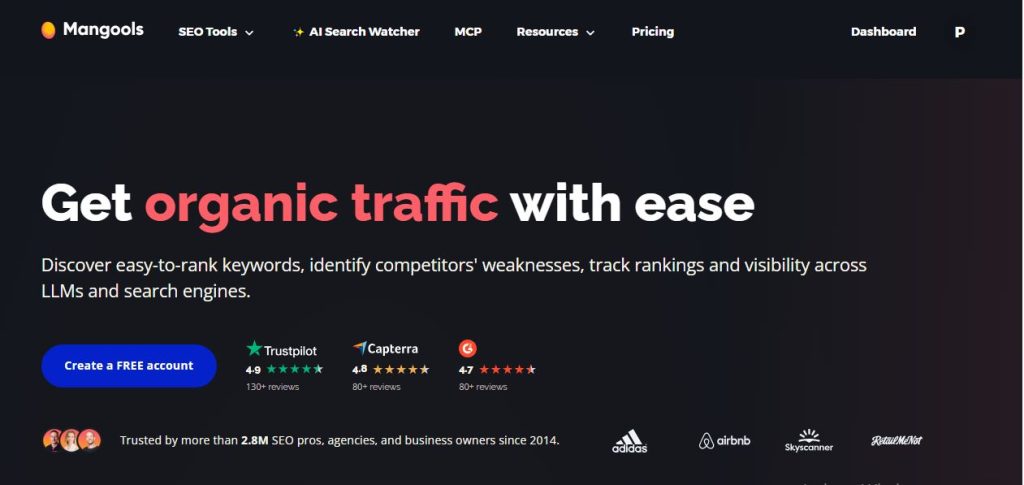
Mangools is a beginner-friendly SEO toolkit built around one promise: help you find keywords you can actually rank for, fast. Its flagship tool, KWFinder, turns any seed keyword into a clear picture of search volume, trends and a colour-coded difficulty score, so you can spot winnable topics in seconds instead of digging through spreadsheets. And instead of paying for five separate tools, a single Mangools subscription puts everything in one login.
- KWFinder: keyword research with suggestions, search volume trends and difficulty scores.
- SERPChecker: analysis of the live search results for any keyword.
- SERPWatcher: rank tracking with a Performance Index, charts and alerts.
- LinkMiner: a backlink checker with Citation Flow, Trust Flow and Link Strength metrics.
- SiteProfiler: a quick overview of any domain’s authority, backlinks and traffic.
Mangools has three paid plans, Basic, Premium and Agency, and every plan includes all five tools plus API and MCP access. There is also a permanent free plan and a 10-day free trial. The interface is known for being clean and beginner friendly, which is a big part of its appeal for bloggers and small businesses.
Get the Mangools 10-day free trial
Ranktracker vs Mangools at a Glance
| Ranktracker | Mangools | |
|---|---|---|
| Built around | Rank tracking | Keyword research |
| Starting price | $31/month billed annually ($39 monthly) | $18.85/month billed annually ($30.50 monthly) |
| Rank updates | Daily | Weekly on Basic and Premium, daily on Agency |
| Site audit | Yes (Web Audit) | No |
| Local tracking | Google Maps and Business Profile tracking | Location-based keyword research and tracking |
| Users and projects | Unlimited on every plan | Extra seats on Premium and Agency |
| Free option | Free trial | Permanent free plan and 10-day free trial |
Ranktracker vs Mangools Pricing
Both tools are priced for individuals and small teams, but they structure their plans differently, so it helps to look at what you actually get.
Ranktracker Pricing and Free Trial
Ranktracker has four plans, all with unlimited projects and unlimited users.
- Launch: $31/month billed annually, or $39/month billed monthly. Built for beginners and single sites, with 500 daily top-100 keyword tracks and basic reporting.
- Growth: $71/month billed annually, or $89/month billed monthly. For growing businesses that need deeper SEO tracking.
- Scale: $119/month billed annually, or $149/month billed monthly. For larger workloads and more frequent data refreshes.
- Authority: $239/month billed annually, or $299/month billed monthly. For agencies and large-scale needs.
Ranktracker also offers a free trial, so you can try the tools before you commit.
Mangools Pricing and Free Plan
Mangools has three paid plans, and every plan includes all five tools.
- Basic: $30.50/month, or $18.85/month billed annually. Up to 100 keyword and SERP requests per day, 200 tracked keywords, no extra seats.
- Premium: $40.50/month, or $26.35/month billed annually. Up to 500 requests per day, 700 tracked keywords, 3 extra seats.
- Agency: $70.50/month, or $48.85/month billed annually. Up to 1,200 requests per day, 1,500 tracked keywords, daily rank updates, 5 extra seats.
Mangools also has a permanent free plan and a 10-day free trial.
Cost Per Tracked Keyword
Because rank tracking is the core overlap between these tools, price per tracked keyword is a useful way to compare them. Using each plan’s monthly price and tracked keyword allowance:
- Ranktracker Launch: about 8 cents per keyword on monthly billing (about 6 cents annually), with daily updates.
- Mangools Basic: about 15 cents per keyword on monthly billing (about 9 cents annually), with weekly updates.
- Mangools Premium: about 6 cents per keyword on monthly billing (about 4 cents annually), with weekly updates.
- Mangools Agency: about 5 cents per keyword on monthly billing (about 3 cents annually), with daily updates.
The pattern is worth noticing. At the entry level, Ranktracker gives you more daily-tracked keywords for the money. Higher up, Mangools becomes very competitive on cost per keyword, but you need the Agency plan to get daily updates. If fresh daily data matters most, compare Ranktracker’s plans against Mangools Agency. If weekly updates are fine, Mangools Premium is hard to beat on price.
Rank Tracking: Ranktracker vs SERPWatcher
Rank tracking is the biggest point of difference between these two tools, so it deserves the closest look.
Ranktracker is built around tracking. Every plan refreshes rankings daily, tracks your keywords against competitors, supports multiple search engines and languages, and includes Google Maps and Google Business Profile tracking for local businesses. Reporting is a core part of the product, which suits freelancers and agencies sending updates to clients.
SERPWatcher, the rank tracker in Mangools, takes a simpler approach. It rolls your performance into a single Performance Index, shows interactive charts of your rankings over time and sends email alerts when positions change. It tracks 200, 700 or 1,500 keywords depending on your plan, and updates weekly on Basic and Premium and daily on Agency.
How they compare: if you want daily data from the entry plan, local tracking and detailed reporting, Ranktracker is built for that job. If weekly checks are enough and you value a clean, easy-to-read dashboard, SERPWatcher does the job well and costs less at the entry level.
Keyword Research: Ranktracker Keyword Finder vs KWFinder
Keyword research is where Mangools has its roots, so it is no surprise that KWFinder is the more specialised tool here.
KWFinder gives you keyword suggestions made up of related terms, autocomplete ideas and questions, a 12-month search volume trend, a colour-coded keyword difficulty score from 0 to 100, and a SERP overview for each keyword. Its plans allow 100, 500 or 1,200 keyword research requests per day, and keyword suggestions are capped at 200 per request on Basic and unlimited on Premium and Agency. It is particularly good for finding long-tail, low-competition keywords quickly.
Ranktracker’s Keyword Finder covers the essentials: you enter a topic and location, and it returns keyword ideas with search volume and difficulty data. It works well when you want keyword research and rank tracking in the same dashboard, though it is built to support the tracker rather than to be a deep research tool in its own right.
How they compare: KWFinder is the stronger choice if keyword research is your main task, since it is the product the whole Mangools suite is built on. Ranktracker’s Keyword Finder is more than adequate for finding ideas to track and for everyday research on a small site.
For deeper keyword tool comparisons, see my posts on KWFinder vs Semrush and Ahrefs vs KWFinder.
SERP Checker: Ranktracker vs Mangools SERPChecker
Both platforms let you look at the live search results for a keyword and judge how tough the competition is.
Mangools SERPChecker shows the top results with authority and link metrics for each page, so you can quickly see whether the first page is dominated by strong domains or weak ones. Mangools limits SERP analysis to 100, 500 or 1,200 requests per day depending on your plan.
Ranktracker’s SERP Checker gives you a look at the top results for a keyword and the factors behind those rankings, which helps when you are deciding whether a keyword is worth targeting.
In practice, both do the job. SERPChecker is a little more polished and is a natural step after KWFinder, while Ranktracker’s SERP Checker fits neatly into its tracking workflow.
Backlink Checker: Ranktracker vs LinkMiner
Neither of these is a full link research platform, so it helps to set expectations: both are checking and monitoring tools, not replacements for the big enterprise suites.
Ranktracker includes a Backlink Checker and a Backlink Monitor, so you can look at the links pointing to any site and keep an eye on new and lost links over time. The monitoring feature is useful if you build links and want to know when one disappears.
Mangools LinkMiner shows backlinks for any URL with Citation Flow, Trust Flow and Link Strength metrics, and lets you filter by link type. Backlink allowances are measured in rows per month: 100K on Basic, 500K on Premium and 1.2M on Agency.
If you want ongoing link monitoring in the same tool as your rank tracking, Ranktracker has the edge. If you mainly check backlinks occasionally while researching competitors, LinkMiner is enough.
Site Audit: Does Ranktracker or Mangools Have One?
Ranktracker does. Its Web Audit tool crawls your site and flags technical SEO issues, which is a real advantage for site owners who want to catch problems like broken links, missing tags and crawl errors without paying for a separate tool.
Mangools does not. It has SiteProfiler, which gives a snapshot of a domain’s authority, backlinks and traffic, but it is not a crawler. If you use Mangools and need technical checks, you can pair it with a free option such as Google Search Console or another crawler.
This is one of the clearest feature gaps between the two platforms, and it is often the deciding factor for site owners who want everything in one place.
Extra Features and Tools
Ranktracker adds an SEO checklist to guide on-page optimization, an AI article writer and reporting tools, which round it out as an all-in-one workspace.
Mangools includes SiteProfiler for quick domain research and gives every paid plan API and MCP access, which is useful for users who want to connect their SEO data to other tools and workflows.
Ease of Use and Learning Curve
Both tools are aimed at people who do not want a steep learning curve, and reviewers frequently describe both as easy to set up.
Mangools is especially known for its clean, uncluttered dashboard and colour-coded difficulty scores, so beginners can find useful keywords within minutes of signing up. Ranktracker is also considered straightforward, and because it bundles tracking, research and audits into one dashboard, it can feel like a single workspace rather than a set of separate tools.
If you are completely new to SEO, either is a reasonable starting point. Mangools may feel slightly more guided for keyword research, while Ranktracker may feel more natural if tracking and auditing are your main tasks.
Reports, Teams and Agency Use
Team features are an area where the pricing structures matter.
Ranktracker includes unlimited users and unlimited projects on every plan, which makes it easy to add team members or clients without paying extra. That is a real advantage for freelancers managing multiple sites and for small agencies.
Mangools has no extra seats on Basic, 3 on Premium and 5 on Agency, which suits solo users and small teams but can feel limiting if you want to give many people access. Mangools also offers an API and MCP access on all paid plans.
For client reporting, Ranktracker’s reporting tools are a core part of the platform. Mangools offers simpler reporting centred on SERPWatcher’s performance charts.
Ranktracker vs Mangools: Pros and Cons
Ranktracker pros: daily rank tracking, unlimited projects and users on every plan, a built-in site audit, Google Maps and Business Profile tracking, backlink monitoring and a free trial.
Ranktracker cons: keyword research is lighter than KWFinder, and the entry plan costs more than Mangools Basic.
Mangools pros: best-in-class keyword research simplicity, colour-coded difficulty, a permanent free plan and 10-day free trial, five tools in one subscription, a lower entry price and very competitive cost per keyword on Premium.
Mangools cons: no site audit, weekly rank updates on Basic and Premium, limited extra seats and daily usage limits on lower plans.
Get the Mangools 10-day free trial
Which Tool Should You Choose?
Bloggers and Affiliate Marketers
If your main job is finding keywords and planning content, Mangools is usually the better fit because KWFinder makes it quick to find low-competition topics. Add Ranktracker later if you want daily tracking and audits.
Local Businesses and Local SEO
Ranktracker is the stronger option here, since it includes Google Maps and Google Business Profile tracking along with daily updates and a site audit.
Freelancers and Small Agencies
Ranktracker’s unlimited projects and users make it easy to manage multiple clients, and its reporting tools help with updates. Mangools Agency is a solid alternative if keyword research is a big part of your service.
Beginners Learning SEO
Both are beginner friendly. Choose Mangools if you want to start with keyword research and learn the basics in a simple interface, or Ranktracker if you want tracking and audits from day one.
Users on a Tight Budget
Mangools has the lower entry price and a permanent free plan, which makes it the easier way to start for free. Ranktracker’s entry plan costs more but includes daily tracking and unlimited users.
Can You Use Ranktracker and Mangools Together?
Yes, and the pairing works well. Use Mangools for keyword discovery and SERP analysis, then track the keywords you target in Ranktracker for daily updates and audits. This only makes sense if both tools are within budget, so start with one and add the other only when you hit its limits.
Ranktracker and Mangools Alternatives
If neither fits, other budget-friendly options include SE Ranking, Ubersuggest and Semrush for a bigger suite. For more options, see my guides to Mangools alternatives and the best Ahrefs alternatives.
Final Verdict: Ranktracker or Mangools?
The right choice depends on the work you do most. If you track rankings daily, run local campaigns or want a built-in site audit with unlimited users, Ranktracker is built for that. If you spend most of your time finding keywords and planning content, Mangools is built for that, with simple tracking alongside it. Plenty of SEOs use both.
Not sure yet? Start with Mangools’ free plan or 10-day trial, see how far it takes you, and add Ranktracker when your projects call for daily tracking and audits.
Get the Mangools 10-day free trial | Visit Ranktracker
Frequently Asked Questions
Is Ranktracker or Mangools better?
Neither is better for everyone. Ranktracker suits users who want daily rank tracking, local tracking and a site audit with unlimited users. Mangools suits users who prioritise keyword research and a simple interface.
Is Ranktracker cheaper than Mangools?
No, at the entry level Mangools is cheaper. Mangools Basic costs $30.50 per month ($18.85 billed annually), while Ranktracker Launch costs $39 per month ($31 billed annually). Ranktracker gives you daily updates and more tracked keywords on its entry plan, so the cost per keyword is lower there.
Does Ranktracker have a free trial?
Yes, Ranktracker offers a free trial so you can test the platform before paying.
Does Mangools have a free plan?
Yes. Mangools has a permanent free plan with limited usage and a 10-day free trial.
Which is better for rank tracking, Ranktracker or Mangools?
Ranktracker is built around rank tracking, with daily updates on every plan and Google Maps tracking. Mangools’ SERPWatcher is simpler and updates weekly on Basic and Premium, and daily on Agency.
Which is better for keyword research?
Mangools, through KWFinder, is the more specialised keyword research tool. Ranktracker’s Keyword Finder is good for everyday research alongside tracking.
Does Mangools have a site audit?
No. Mangools has no site audit tool. Ranktracker includes a Web Audit.
Can Ranktracker replace Mangools?
For rank tracking, audits and basic keyword research, many users find Ranktracker enough. If you rely on KWFinder’s keyword research depth, you may prefer to keep Mangools.
Is Ranktracker good for local SEO?
Yes. It includes Google Maps and Google Business Profile tracking, which makes it a strong option for local businesses.
Which tool is better for beginners?
Both are beginner friendly. Mangools is slightly more guided for keyword research, and Ranktracker is straightforward for tracking and audits.