

Affiliate recruitment management is the strategic, end-to-end process of identifying, evaluating, onboarding, and activating partners to promote a company’s products or services.
It’s a continuous cycle focused on building a high-quality, engaged, and productive base of affiliates that aligns with the brand’s goals and drives sustainable revenue.
Affiliate marketing isn’t just a tactic; it’s a multi-billion-dollar industry that, when managed correctly, can become one of your most powerful and scalable revenue channels. But here’s the catch: a successful affiliate program doesn’t magically build itself.
The difference between a stagnant, low-performing program and a thriving, revenue-generating engine lies in strategic affiliate recruitment management.
Many businesses make the mistake of thinking recruitment is simply about getting as many affiliate sign-ups as possible. They cast a wide, indiscriminate net and hope for the best.
This approach often leads to a bloated roster of inactive partners, brand safety risks, and wasted resources.
True affiliate recruitment management is a holistic discipline. It’s about meticulously defining who you want to partner with, knowing where to find them, creating a compelling reason for them to join, vetting them for quality and fit, and setting them up for success from day one.
It’s about building relationships, not just processing applications.
This comprehensive guide walks you through every stage of the affiliate recruitment management lifecycle, transforming your approach from a simple numbers game into a strategic growth lever.
Looking for an Affiliate Management Solution?
A successful affiliate program needs more than great partners. You need the right system to manage those relationships, track performance, handle commissions, and understand which affiliates are driving results.
If you’re ready to move beyond spreadsheets and manual affiliate management, Trackdesk can help you build, manage, and scale your affiliate program from one platform.
Part 1: Laying the Groundwork Before You Recruit a Single Partner
Before you send your first outreach email, you need to build a solid foundation.
Skipping this preparatory phase is like building a house on sand. Without a clear strategy, even a large number of affiliate applications may not translate into meaningful revenue.
Define Your Ideal Affiliate Profile (IAP)
One of the most important steps is to stop thinking about “affiliates” as a single group and start defining your Ideal Affiliate Profile (IAP).
Your IAP is a detailed description of the type of partner who is most likely to succeed with your brand.
Without a clear IAP, your recruitment efforts can become unfocused and inefficient.
To build your IAP, consider the following factors:
Content and Promotional Method
How does the potential affiliate reach their audience?
They might be:
- Bloggers and content creators
- YouTubers
- Social media influencers
- Coupon and deal sites
- Loyalty and cashback platforms
- PPC/media buyers
- Email list owners
- Review websites
- Industry publications
You may want a mixture of promotional methods, but you should know which types of partners are most valuable to your business.
For example, a high-end SaaS product will likely prioritize B2B bloggers, software reviewers, and industry thought leaders over coupon websites.
Niche and Vertical Alignment
How closely does the affiliate’s content relate to your product?
A fitness apparel brand should prioritize fitness influencers, trainers, athletes, and fitness bloggers rather than partnering with creators whose audiences have little connection to fitness.
The closer the niche alignment, the more authentic the promotion is likely to feel—and the greater the potential for conversions.
Audience Demographics
Who is the affiliate talking to?
Look at factors such as:
- Age
- Location
- Interests
- Income level
- Professional background
- Purchasing behavior
Ideally, the affiliate’s audience should overlap significantly with your target customer.
A creator can have a large audience but still be a poor affiliate partner if most of that audience has little interest in your product.
Brand and Value Alignment
Brand safety is another important consideration.
Ask yourself:
- Does the affiliate’s website look professional?
- Is their content original and well-researched?
- Do they communicate ethically?
- Does their tone align with your brand?
- Do they interact with their audience professionally?
A partnership is also an endorsement. You should therefore be comfortable having the affiliate publicly associated with your brand.
Performance Metrics
Don’t focus exclusively on vanity metrics such as follower counts.
Look at:
- Engagement rates
- Comments
- Shares
- Likes
- Website traffic
- Search visibility
- Audience quality
- Conversion potential
Tools such as Similarweb can provide additional insight into website traffic.
A micro-influencer with 10,000 highly engaged followers can sometimes be more valuable than a celebrity with one million passive followers.
Craft an Irresistible Affiliate Program Offer
Top affiliates are selective. They receive partnership offers from numerous companies, so your affiliate program needs to give them a compelling reason to choose you.
Your affiliate offer should clearly answer one question:
What’s in it for the affiliate?
Competitive Commission Structure
Commission is usually one of the first things potential affiliates evaluate.
Common structures include:
Percentage of Sale
This is one of the most common affiliate commission models.
The appropriate rate depends heavily on your industry, product type, margins, and customer acquisition economics.
Physical products with lower margins may offer relatively modest commissions, while digital products and SaaS businesses can often afford higher rates.
Tiered Commissions
Tiered commissions reward affiliates for generating more sales.
For example:
- 10% commission for 1–10 sales per month
- 15% commission for 11–25 sales
- 20% commission for 26+ sales
This structure gives affiliates an incentive to increase their performance.
Recurring Commissions
Recurring commissions can be especially attractive for subscription-based businesses such as SaaS platforms, membership sites, and subscription services.
For example, a company could offer affiliates 20% of subscription revenue for a defined period or for the lifetime of the customer, depending on the economics of the program.
Recurring commissions can make an affiliate program significantly more attractive because affiliates can build ongoing revenue from customers they refer.
Generous Cookie Duration
Cookie duration, also known as the referral window, determines how long an affiliate can receive credit after someone clicks their affiliate link.
A short seven-day cookie may be less attractive for products with longer buying cycles.
Depending on your business model, a 30-, 60-, or 90-day cookie can make your offer more competitive.
High-Quality Creatives and Promotional Tools
Don’t make affiliates do all the promotional work themselves.
Provide a useful library of marketing assets, including:
- Professionally designed banners
- Text links
- Email swipe copy
- Product images
- Brand logos
- Social media graphics
- Product comparison information
- Product feeds for e-commerce affiliates
The easier you make promotion, the easier it is for affiliates to start generating traffic.
Reliable Payouts and Clear Terms
Be transparent about:
- Payment schedules
- Minimum payout thresholds
- Payment methods
- Commission rules
- Refund and chargeback policies
- Attribution rules
- Promotional restrictions
For example, if you pay commissions on a Net 30 basis, explain exactly what that means.
Consistency matters. Affiliates want to know that they will be paid accurately and on time.
Dedicated Affiliate Manager
A dedicated affiliate manager can be a major competitive advantage.
Giving affiliates access to a real person they can contact for questions, campaign ideas, product information, or troubleshooting demonstrates that you view them as partners rather than simply traffic sources.
Part 2: The Hunt—Strategic Affiliate Recruitment Channels
Once your foundation is ready, it’s time to find your ideal affiliates.
A multi-channel approach is usually the most effective because it combines broad discovery with precision targeting.
Tapping Into Affiliate Networks
Affiliate networks such as ShareASale, CJ Affiliate, Rakuten Advertising, and Impact connect merchants with publishers and affiliates.
For B2B and SaaS companies, platforms such as PartnerStack can also be valuable recruitment channels.
Advantages of Affiliate Networks
Access: You can reach a large pool of affiliates who are actively searching for programs to promote.
Infrastructure: Many networks provide tracking, reporting, payment processing, and other program-management infrastructure.
Discovery: Network tools can help merchants find affiliates based on categories, keywords, performance metrics, and other criteria.
Disadvantages of Affiliate Networks
Costs: Networks can charge setup fees, recurring fees, transaction fees, or other costs in addition to affiliate commissions.
Competition: Your program appears alongside thousands of other merchants, including competitors.
Less Direct Relationships: Depending on the platform and workflow, the network can sometimes create additional distance between the merchant and affiliate.
How to Succeed on Affiliate Networks
Don’t simply list your affiliate program and wait for applications.
Use the network’s recruitment tools to actively search for relevant publishers.
For example, you can identify affiliates promoting competing products and send them personalized invitations explaining why your program may be worth considering.
The Direct Outreach Approach
Direct outreach allows you to hand-pick potential partners who closely match your Ideal Affiliate Profile.
It requires more work, but it can produce highly relevant and valuable relationships.
Step 1: Prospecting
Use Targeted Google Searches
Instead of searching for broad terms, use specific long-tail searches.
For example, a running shoe company could search for:
- “best running shoes for flat feet review”
- “Saucony vs Brooks comparison”
- “best running shoes for beginners”
- “best shoes for marathon training”
Websites ranking for these types of searches may already have an audience interested in products within your category.
Explore Social Media
Search relevant keywords and hashtags on platforms such as:
- YouTube
- TikTok
- X
Look for creators producing:
- Product reviews
- Tutorials
- Comparisons
- Product demonstrations
- “Best of” lists
- Educational content
Analyze Competitor Backlinks
Competitor backlink analysis can be a powerful recruitment strategy.
SEO platforms such as Ahrefs, Mangools and Semrush can help you identify websites linking to competing products.
Look for pages containing terms such as:
- Review
- Affiliate
- Best
- Comparison
- Discount
- Alternatives
- Deals
These websites may already be comfortable promoting products through affiliate partnerships, making them potential prospects for your own program.
Step 2: Craft the Perfect Outreach Email
Generic, copy-and-paste outreach emails are easy to ignore.
The goal is to demonstrate that you’ve actually researched the person you’re contacting.
Personalize the Opening
Reference a specific article, video, or piece of content.
For example:
Hi Sarah, I just finished reading your detailed review of the new GoPro, and your breakdown of the image stabilization was fantastic.
This immediately feels more personal than a generic introduction.
Quickly Introduce Yourself and Your Value Proposition
Get to the point.
Explain:
- Who you are
- Which company you represent
- What your product does
- Why you believe it fits their audience
State the Key Terms
Highlight the strongest parts of your affiliate offer.
For example:
We offer a competitive 15% commission, a 60-day cookie window, and dedicated support for all our partners.
Make It Frictionless
Give the prospect a clear next step.
Include a direct link to your affiliate program application or registration page.
Have a Follow-Up Plan
People are busy, and your first email may simply get missed.
A polite follow-up five to seven days later can give your outreach another opportunity to get a response.
Inbound Recruitment: Let Affiliates Find You
Not every affiliate needs to be recruited through direct outreach.
You should also make it easy for potential partners to discover your program organically.
Create a Dedicated Affiliate Page
Create a prominent Affiliates, Partners, or Referral Program page on your website.
A link to the page can be placed in your website footer so that potential partners can easily find it.
Optimize Your Affiliate Page
Your affiliate page should essentially function as a sales page for your affiliate program.
Include:
- A compelling headline
- A clear explanation of your company
- An explanation of your product
- Commission information
- Cookie duration
- EPC or other relevant performance information
- Affiliate benefits
- Testimonials from successful affiliates
- Program FAQs
- Promotional resources
- A prominent application CTA
The easier it is to understand the opportunity, the more likely qualified prospects are to apply.
Leverage Your Existing Ecosystem
Some of your best future affiliates may already be connected to your business.
Your Customers
Happy customers can become highly authentic advocates.
Promote your affiliate program through:
- Customer email campaigns
- Product dashboards
- Account portals
- Customer communities
- Post-purchase communications
Customers already understand your product, which can make their recommendations particularly credible.
Your Social Media Followers
Your existing followers are another potential source of affiliates.
People who regularly engage with your content are already familiar with your brand and may be interested in monetizing their audience by promoting your products.
👉 Related Post: How to Recruit Affiliates: 9 Proven Steps
Part 3: From Applicant to Asset—Vetting and Onboarding
Recruitment doesn’t end when someone submits an application.
In fact, vetting and onboarding are two of the most important stages of affiliate recruitment management.
These processes help separate professional affiliate programs from programs that simply accumulate large numbers of inactive or low-quality partners.
The Vetting Process: Your Program’s Bouncer
Avoid automatically approving every affiliate application.
An open-door approach can expose your program to:
- Fraud
- Low-quality traffic
- Brand safety problems
- Policy violations
- Misleading promotions
- Unethical promotional practices
Every application should be reviewed against a consistent set of criteria.
What Your Affiliate Application Should Ask
Consider requesting:
- Website URLs
- Social media profile URLs
- A description of their promotional methods
- Estimated monthly website traffic
- Audience size
- Primary audience demographics
- Experience with affiliate marketing
- Examples of previous promotional campaigns
Asking about promotional methods is particularly important because some methods may violate your program terms.
For example, you may prohibit affiliates from bidding on your brand name through paid search.
Manual Review Checklist
Content Quality and Professionalism
Look at the affiliate’s website or content channels.
Is the content:
- Original?
- Well-written?
- Useful?
- Professionally presented?
- Easy to navigate?
A website filled with thin or poorly written content may not be a good fit for your program.
Brand and Niche Fit
Evaluate whether the affiliate’s content, audience, and tone align with your brand.
A high-traffic website isn’t necessarily a good partner if its audience or values conflict with your business.
Audience Engagement
Don’t rely solely on follower counts.
Look for genuine interaction such as:
- Comments
- Shares
- Discussions
- Replies
- Video engagement
- Community activity
An account with a huge following but almost no genuine engagement may indicate an inflated or low-quality audience.
Traffic Source Check
Look for warning signs such as:
- Excessive advertising
- Scraped content
- Thin content
- Suspicious domains
- Poor-quality traffic sources
- Misleading promotional practices
Compliance Check
Check whether the affiliate provides appropriate disclosures and basic website policies.
For example, an affiliate website should generally have an affiliate disclosure when required by applicable laws and platform rules.
For US-facing programs, businesses should pay particular attention to relevant Federal Trade Commission guidance.
The Onboarding Experience: Setting Affiliates Up for Success
The first 30 days of an affiliate partnership are extremely important.
A strong onboarding process can turn an approved affiliate into an active partner instead of someone who signs up and disappears.
Make the Welcome Email Count
Don’t send a generic “You’re approved” message.
Your welcome email should include:
- A warm welcome
- Their affiliate tracking link
- A link to the affiliate dashboard
- A link to your getting-started guide
- Promotional resources
- Important program terms
- Contact information for their affiliate manager
The goal is to eliminate uncertainty and give the affiliate everything they need to take their first action.
Create a Rich Affiliate Resource Center
Your affiliate dashboard or resource center should serve as a central hub for your partners.
Include:
- Affiliate links
- Banners
- Text links
- Email templates
- Product information
- Content guidelines
- Keyword suggestions
- Promotional calendars
- Program terms
- Product launch information
- Upcoming promotions
- Best practices
The easier it is for affiliates to find what they need, the faster they can begin promoting.
Make the First Personal Touchpoint
A personal email from the affiliate manager during the first week can make a significant difference.
For example:
Hi James, welcome aboard! I’m your dedicated affiliate manager. I’ve taken a look at your blog and have a few ideas for how our product could fit into your existing content. Let me know if you’d be open to a quick 15-minute chat next week to brainstorm.
This type of proactive support shows the affiliate that you’re invested in their success.
Part 4: Activation and the Continuous Recruitment Cycle
Recruitment doesn’t end with approval.
The final step is activation—getting a new affiliate to generate their first click, conversion, and sale.
From Approved to Activated
An approved affiliate who generates zero traffic provides little value to the program.
That’s why you need a strategy for identifying and activating inactive partners.
Monitor the Zero-Click Report
Most affiliate platforms allow you to identify partners who have been approved for a certain period but have not generated any clicks.
For example, you could create a report showing affiliates who:
- Were approved more than 30 days ago
- Have generated zero clicks
- Have generated clicks but no conversions
These affiliates become your activation targets.
Launch an Activation Campaign
Offer a First-Sale Bonus
A first-sale incentive can encourage new affiliates to take action.
For example, you could offer a $25 bonus to affiliates who generate their first qualifying sale within their first 30 days.
Make sure any bonus structure is clearly explained in your program terms.
Provide Product Samples
For content creators and review affiliates, giving them access to the product can make promotion much easier.
A creator who has personally used a product may be able to produce more useful and authentic content than someone relying solely on product descriptions.
A product sample should therefore be viewed as a potential marketing investment rather than simply a giveaway.
Offer Personalized Strategy Sessions
Don’t wait for inactive affiliates to ask for help.
Offer to help them identify:
- Content opportunities
- Keywords
- Promotional angles
- Relevant products
- Campaign ideas
- Conversion opportunities
This demonstrates that your affiliate program is focused on partnership rather than simply recruiting more affiliates.
Closing the Loop: How Management Informs Recruitment
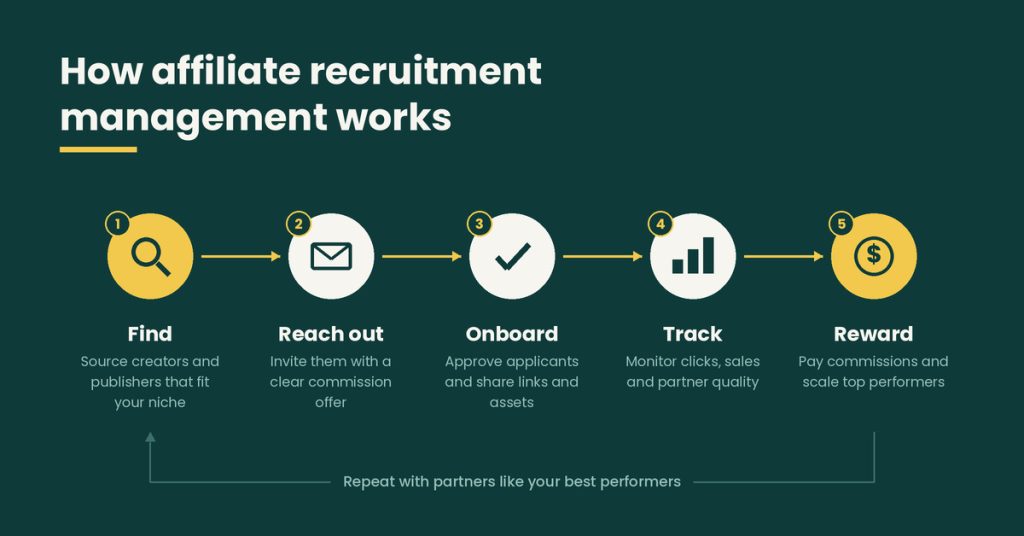
Affiliate recruitment isn’t a linear process.
It is a continuous cycle in which the information you gather from managing existing affiliates improves your future recruitment strategy.
Analyze Your Top Performers
Identify your top-performing affiliates and look for common characteristics.
For example:
- Do they primarily use SEO?
- Are they YouTube creators?
- Do they publish product comparisons?
- Do they have highly engaged email lists?
- Are they targeting a particular audience?
- Do they focus on tutorials or reviews?
These insights can help you refine your Ideal Affiliate Profile.
Instead of guessing what a successful affiliate looks like, you can build your recruitment strategy around actual performance data.
Then go out and find more partners who resemble your top performers.
Ask Your Best Affiliates for Referrals
Your strongest affiliates may already know other high-quality creators, marketers, publishers, and influencers.
Don’t be afraid to ask for referrals.
For example:
You’ve been such a fantastic partner for us. We’re looking to expand with more partners like you. Do you know anyone in your network who might be a good fit?
A referral from an existing high-performing affiliate can be a powerful recruitment channel because it combines trust with relevance.
Conclusion: Build Partnerships, Not Just Lists
Effective affiliate recruitment management is a sophisticated, ongoing strategy.
It requires planning, personalization, diligence, and a commitment to building genuine, mutually beneficial relationships.
The goal isn’t simply to accumulate as many affiliate applications as possible.
Instead, focus on building a repeatable system for:
- Defining your Ideal Affiliate Profile
- Creating a compelling affiliate program
- Finding qualified prospects
- Recruiting through multiple channels
- Vetting applicants carefully
- Onboarding new partners effectively
- Activating inactive affiliates
- Analyzing your top performers
- Refining your recruitment strategy
- Building long-term affiliate relationships
By moving away from a quantity-over-quality mindset and embracing this continuous cycle, you can build a more productive and scalable affiliate program.
The result is more than a list of affiliates.
It’s a community of trusted brand advocates who can consistently promote your products, generate qualified customers, and contribute to sustainable business growth.
Ready to Simplify Affiliate Recruitment and Management?
Finding great affiliates is only the beginning. Once you start recruiting partners, you also need the right system to track referrals, manage commissions, monitor affiliate performance, and keep your partners organized.
Trackdesk gives businesses an affiliate management platform designed to make it easier to run and scale an affiliate program without relying on spreadsheets or complicated manual processes.
If you’re serious about building a productive affiliate program, try Trackdesk and see how it can simplify your affiliate management workflow.