
If you’re stuck on the Voluum vs BeMob decision, you’re choosing your source of truth. Your tracker shows which offers to scale. It shows which placements to cut. A wrong pick costs ad spend. The wrong plan costs margin.
Both trackers are well known in performance marketing. But they serve different buyers. Voluum is a premium cloud tracker. It offers deep automation and long data retention. BeMob is lean and affordable. It has a permanent free plan. Some marketers search BeMob vs Voluum instead. The comparison is the same.
This guide compares features, pricing, and fit. By the end, you’ll know which affiliate tracking software suits your volume and team.
Voluum vs BeMob at a Glance
| Feature | Voluum | BeMob |
|---|---|---|
| Best for | Scaling media buyers, agencies, high-volume teams | Beginners, solo affiliates, budget-conscious buyers |
| Free plan | No permanent free plan | Yes, 100,000 events/month |
| Entry paid price | $149/mo ($119/mo billed annually) | $49/mo |
| Top listed plan | Enterprise: $1,999/mo ($1,599/mo annual), 60M events | Enterprise: $499/mo, 30M events |
| Data retention | 6 to 24 months depending on plan | 1 to 6 months depending on plan |
| Automation | Automizer, auto-rules, Traffic Distribution AI (plan dependent) | Rules and optimization tools |
| Anti-fraud | Anti-Fraud Kit included on Profit plan | Basic bot filtering features |
| Team features | Multi-user seats and read-only client workspaces on Agency plan | Varies by plan |
| Cost efficiency at volume | Higher | Considerably lower |
Quick verdict: Choose BeMob for a free or low-cost ad tracker. It suits small to mid-sized campaigns. Choose Voluum for long data retention, advanced automation, and agency features. Your margins must absorb the higher cost.
What Is Voluum?
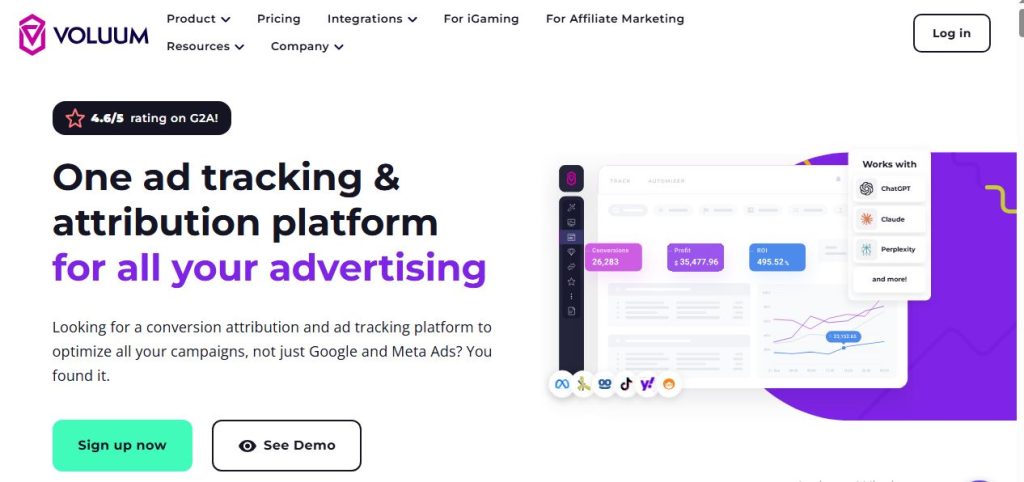
Voluum is a cloud-based tracking platform for performance marketers. It is a premium tool. Its plans scale from individual to business tiers. Retention and features grow with each tier.
Who Voluum Is Built For
Voluum targets serious media buyers, agencies, and high-volume teams. These users run many traffic sources. They manage client accounts. They need long history. They want automation that works for them.
Core Strengths
- Long data retention: 6 months on Profit, up to 24 months on Enterprise. This helps with seasonal and year-over-year analysis.
- Automation: the Automizer on entry plans. Auto-rules and Traffic Distribution AI on Scale.
- Anti-Fraud Kit: included from the Profit plan.
- Agency tools: multi-user seats and read-only client workspaces on higher tiers.
Pros and Cons
Pros: deep retention, built-in anti-fraud, automation, agency-ready workspaces, and enterprise API access with dedicated support.
Cons: no permanent free plan, a high entry price, and big jumps between tiers.
What Is BeMob?
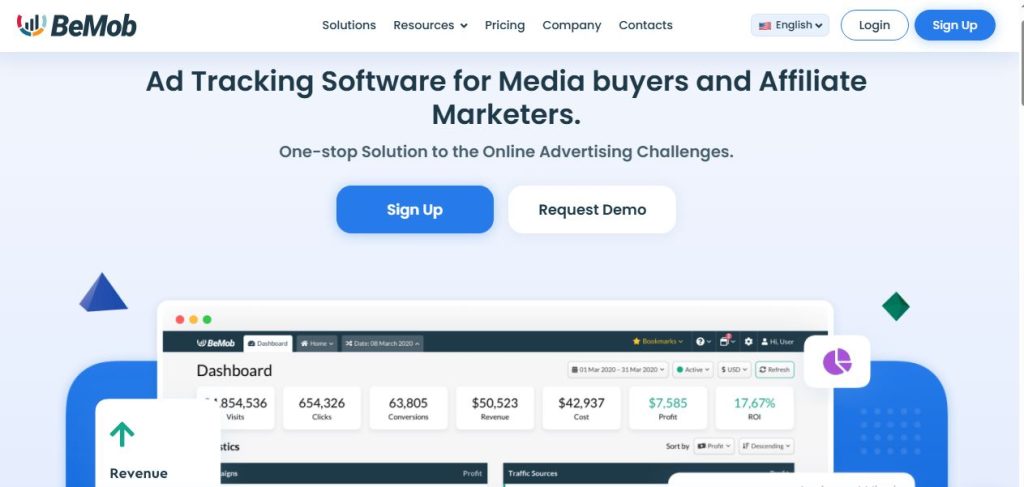
BeMob is an ad tracker known for fair pricing and a permanent free plan. It covers the core needs of CPA tracking software. That means campaign setup, offers, landers, traffic sources, postback conversion tracking, and reporting.
Who BeMob Is Built For
BeMob suits beginners, solo affiliates, and small teams. They want reliable tracking without a heavy bill. It is also a common first tracker. Many buyers use it while they validate their first profitable campaigns.
Core Strengths
- Free forever plan: 100,000 events per month at $0.
- Low-cost scaling: paid plans start at $49 per month for 1 million events.
- High volume per dollar: 10 million events for $249. 30 million for $499.
- Simple setup: a lighter learning curve than enterprise-grade trackers.
Pros and Cons
Pros: a real free tier, low pricing at every level, falling overage rates, and a gentle learning curve.
Cons: shorter data retention (1 to 6 months). No overage on the free plan, so you must upgrade at the limit. Fewer enterprise extras than Voluum.
Voluum vs BeMob: Feature-by-Feature Comparison
Tracking Accuracy and Methods
Both tools track clicks and conversions with tracking links and postback URL (server-to-server, or S2S) setups. This is the standard for affiliate networks. Accuracy depends more on setup than on the brand. A correct postback matters. So does clean click ID passing. Test every campaign with a manual conversion before you spend real money.
Reporting and Analytics
Retention is where the tools differ most. Voluum stores 6 to 24 months of data, depending on plan. That lets you compare performance across seasons. BeMob stores 1 month on Free and Professional. It stores 3 months on Business and 6 on Enterprise. Want to compare this Black Friday to last year’s? You will need to export your data regularly.
Campaign Automation and Optimization
Voluum leans harder into automation. The Profit plan includes the Automizer for up to $1,000 per month of integrated ad spend. Scale adds 20 auto-rules and Traffic Distribution AI. These help shift traffic toward better landers and offers. Start-up plans raise integrated ad spend to $15,000. BeMob offers rules and optimization tools. They suit buyers who prefer manual control. Automation depth is more limited at similar price points.
Anti-Fraud and Bot Filtering
Voluum includes its Anti-Fraud Kit from the Profit plan. Cleaner data means better decisions. This matters most on push, pop, and native traffic. Bot activity is common there. BeMob offers basic traffic filtering. If fraud filtering is central to your workflow, check BeMob’s current feature list. You may also want a dedicated traffic quality tool.
Custom Tracking Domains and Speed
Custom tracking domains improve deliverability. They also avoid blocks on shared domains. Voluum Profit includes 3 custom domains plus 1 dedicated domain. Scale includes 5 plus 1 dedicated. Start-up includes 9 custom domains. BeMob’s domain limits vary by plan. Redirect speed matters too. Slow redirects lose clicks before the page loads. Test latency from your main traffic geos.
Traffic Source and Network Integrations
Both trackers support common traffic sources. These include social, native, push, pop, and search. Voluum also offers Conversion API-style integrations and integrated ad spend. Before you commit, confirm that your traffic sources and affiliate networks are supported. Look for templates or documented setups.
User Interface and Learning Curve
BeMob’s interface is simpler. First campaigns launch faster. Voluum is more powerful but more complex. Expect a longer onboarding if you are new to trackers. For beginners, that learning curve is a real cost.
Customer Support
Voluum lists dedicated support at the Enterprise tier. BeMob’s support options depend on plan. Check each vendor’s current support channels. Read recent user feedback before you decide.
Voluum vs BeMob Pricing Compared
The biggest difference is cost. BeMob is cheaper at every volume. It is also the only one of the two with a permanent free tier.
Pricing reflects current plans as of October 2026.
Voluum Pricing Plans
| Plan | Monthly | Billed annually | Events/month | Data retention | Highlights |
|---|---|---|---|---|---|
| Profit | $149 | $119/mo | 1M | 6 months | 3 custom domains + 1 dedicated, Anti-Fraud Kit, Automizer (up to $1,000/mo integrated ad spend), overage $0.06 per 1,000 events |
| Scale | $349 | $299/mo | 5M | 12 months | 5 custom domains + 1 dedicated, 20 auto-rules, Traffic Distribution AI |
| Start-up | $599 | $539/mo | 10M | 12 months | Cookieless tracking features, 9 custom domains, integrated ad spend up to $15,000 |
| Agency | $999 | $799/mo | 25M | 18 months | Multi-user seats, read-only client workspaces |
| Enterprise | $1,999 | $1,599/mo | 60M | 24 months | Expanded API access, dedicated support |
Ready to try Voluum? See Voluum plans and get started
BeMob Pricing Plans and the Free Ad Tracker Option
| Plan | Monthly | Events/month | Data retention | Overage |
|---|---|---|---|---|
| Free | $0 | 100,000 | 1 month | None allowed; upgrade at the limit |
| Professional | $49 | 1M | 1 month | $0.05 per 1,000 events |
| Business | $249 | 10M | 3 months | $0.025 per 1,000 events |
| Enterprise | $499 | 30M | 6 months | $0.02 per 1,000 events |
Want to start free? Create your BeMob account
Cost at Different Scales
Here is what each tracker costs at common monthly volumes. The table uses monthly (non-annual) rates. It shows the cheapest plan, or plan plus overage.
| Monthly events | Voluum (monthly / annual billing) | BeMob | Difference (monthly billing) |
|---|---|---|---|
| 100K | $149 / $119 (Profit) | $0 (Free) | BeMob saves $149 |
| 1M | $149 / $119 (Profit) | $49 (Professional) | BeMob saves $100 |
| 5M | $349 / $299 (Scale) | $249 (Business) | BeMob saves $100 |
| 10M | $599 / $539 (Start-up) | $249 (Business) | BeMob saves $350 |
| 25M | $999 / $799 (Agency) | $499 (Enterprise) | BeMob saves $500 |
| 60M | $1,999 / $1,599 (Enterprise) | about $1,099 (Enterprise plus 30M overage at $0.02 per 1,000) | BeMob saves about $900 |
At 5M events, BeMob Professional plus 4M events of overage costs $49 plus $200, or $249. That matches the Business plan price. So Business is the better choice at that volume.
Hidden Costs to Consider
- Overage fees: Voluum Profit charges $0.06 per 1,000 events over the limit. BeMob’s rates fall as you move up. They run from $0.05 to $0.02 per 1,000 events.
- Retention versus price: BeMob costs less but stores data for less time. If you need 12 months or more, Voluum is your option.
- Plan jumps: Voluum’s jump from Scale to Start-up is $250 per month. Plan for volume spikes. Don’t rely on overage.
- Feature gating: several Voluum automation and domain features depend on plan level. Confirm which plan includes what you need.
- Annual billing: Voluum’s annual rates cut $30 to $400 per month, depending on plan. You commit for the year.
Pricing takeaway: If cost per event is your priority, BeMob wins at every volume. If you want long retention, automation, and agency tools, Voluum’s premium pays for those extras.
Voluum vs BeMob for Different Types of Users
Best for Beginners and Solo Affiliates
BeMob. The free plan lets you learn tracking at no cost. The $49 Professional plan scales to 1 million events. That is a third of Voluum’s entry price.
Best for Media Buyers Scaling Campaigns
It depends on how you optimize. Want automation and 12+ months of data? Voluum Scale fits. It includes Traffic Distribution AI and 20 auto-rules. Prefer manual control and low cost? BeMob Business gives you 10M events for $249.
Best for Agencies and Teams
Voluum. The Agency plan adds multi-user seats and read-only client workspaces. It also offers 18 months of retention. These suit client reporting. BeMob may still save you money. Check that its current plans include the team features you need.
Best for Large-Volume Advertisers
Voluum for features. BeMob for cost. Voluum Enterprise adds expanded API access, 24-month retention, and dedicated support. BeMob Enterprise gives you 30M events for $499. Retention is 6 months. That is hard to beat on price.
Voluum vs BeMob: Pros and Cons Summary
| Voluum | BeMob | |
|---|---|---|
| Pros | Long data retention (up to 24 months); Anti-Fraud Kit included; Automizer, auto-rules, Traffic Distribution AI; multi-user and client workspaces; dedicated support at Enterprise | Permanent free plan; lowest cost at every volume; lower overage rates at higher tiers; simpler interface for beginners |
| Cons | No free plan; high entry price; large jumps between tiers; more complex to learn | Shorter data retention (1 to 6 months); no overage on the free plan; fewer advanced automation and agency features at similar tiers |
In any Voluum review or BeMob review, weigh these points against your workflow. Don’t judge by feature lists alone.
Voluum and BeMob Alternatives Worth Considering
If neither tracker fits, consider these options:
- RedTrack: a cloud tracker for performance marketers. It focuses on integrations and reporting depth. A popular Voluum alternative for teams comparing premium trackers.
- Binom: a self-hosted tracker. Experienced buyers choose it for control over infrastructure and cost.
- Keitaro: another self-hosted option. It is widely used for flexible traffic distribution and customization.
- ClickFlare: a cloud tracker for affiliates who want a modern interface and competitive pricing. A frequent BeMob alternative.
Self-hosted trackers can cut per-event costs further. But you handle server setup, maintenance, and uptime. Weigh that effort against the savings. Confirm current pricing and features on each vendor’s site.
How to Choose Between Voluum and BeMob
Decision Checklist
- Monthly event volume: under 1M favors BeMob on price. At 10M+, the gap widens.
- Budget: can you absorb $119 to $149 per month before your first profitable campaign?
- Data history: do you need more than 6 months of reports?
- Team size: do you need seats and client workspaces?
- Automation: do you want the tracker to optimize for you, or do you prefer manual control?
- Fraud exposure: do you buy push, pop, or native traffic, where bots are common?
Choose Voluum If…
- You need 12 to 24 months of data retention.
- You want built-in automation, like the Automizer, auto-rules, and Traffic Distribution AI.
- You run an agency and need multi-user seats and client workspaces.
- Anti-fraud tooling matters from day one.
- Campaign profits can justify the higher monthly cost.
Sound like you? Try Voluum here
Choose BeMob If…
- You are starting out and want a free ad tracker.
- Your volume runs from 100K to 30M events, and cost matters.
- You optimize manually and don’t need long retention.
- You want a simple interface and a fast first setup.
Sound like you? Start with BeMob here
Final Verdict: Voluum or BeMob?
There is no universal winner in the Voluum vs BeMob debate. But the split is clear. BeMob wins on value. It is free to start. It is cheaper at every volume we compared. It is simple enough to launch a first campaign fast. Voluum wins on depth. You get longer data retention, built-in automation, anti-fraud tooling, and agency-ready features. The price is much higher.
Are you a beginner, or running lean? Start with BeMob. Upgrade when a real need appears. Are you an agency or a high-volume buyer? Voluum’s premium is easier to justify.
Ready to decide? Test your setup on BeMob’s free plan. Or start a Voluum plan if its features match your workflow.
Voluum vs BeMob FAQs
Is BeMob better than Voluum?
Not universally. BeMob wins on budget and simplicity. It has a free plan and lower pricing at every volume. Voluum is stronger on data retention, automation, and agency features. The better tracker depends on your volume, team, and workflow.
Is BeMob really free?
Yes. BeMob has a permanent free plan. You get 100,000 events per month and 1 month of data retention. Overage isn’t allowed. At the limit, you must upgrade to the $49 Professional plan.
Which tracker has better fraud protection?
Voluum. Its Anti-Fraud Kit comes with the Profit plan. It is the stronger documented option. If bot traffic worries you, compare each vendor’s current filtering features first.
Can I switch from Voluum to BeMob without losing data?
Not automatically. Historical data stays in the original tracker. Export your reports before you cancel. Then rebuild campaigns, offers, and postbacks in the new tracker. Test them before you send live traffic.
Do Voluum and BeMob work with Facebook and TikTok?
Both work with major social and native traffic sources. Check each vendor’s integration docs for your platform. Also check any server-side conversion tracking you need.
Which affiliate tracking software is best for beginners?
BeMob is usually the better start. It has a free plan, lower pricing, and a simpler interface. Move to Voluum later if you need advanced automation, longer retention, or team features.
How accurate is Voluum compared to BeMob?
Both are reliable when set up correctly. Accuracy depends on your postback setup, click ID passing, and testing. For the best answer, run a split test. Compare reported clicks and conversions against your network’s numbers.